25 July, 2026 | 4:49 AM


Pranahita canals set for revamp
16-03-2026 12:00:00 AM
metro india news I hyderabad
The Telangana government is reigniting focus on the long-pending Pranahita project, a flagship irrigation initiative aimed at harnessing waters from the Pranahita River—a major tributary of the Godavari—to provide abundant irrigation to the water-scarce northern regions of the state.
Once considered one of the most ambitious water projects in Telangana, the scheme, which had stalled due to political shifts and design changes, is now being revived with a revamped, cost-effective approach under the current Congress-led administration.
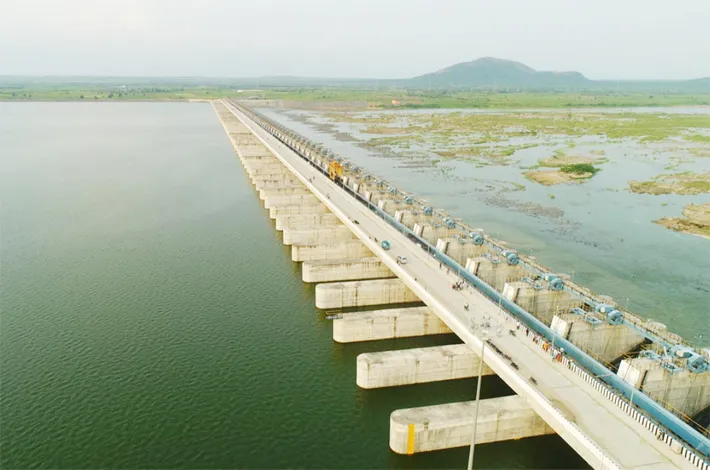
According to official sources in Hyderabad on March 15, the government is accelerating efforts to transport Pranahita River waters from Tummidihatti (also spelled Thummidihatti or Tummudihatti) to the Sundilla barrage, a key component of the existing Kaleshwaram Lift Irrigation Project. The alignment survey for this link has been completed, and a preliminary report has been submitted to the government.
Last November, the state invited tenders worth Rs. 11.88 crore for preparing a comprehensive Detailed Project Report (DPR). The contract was awarded to Aarvee Consultancy, which recently delivered the alignment report.
With government approval, the firm will now conduct in-depth studies on geography, hydrology, flood estimates, and other technical aspects to finalize the full DPR. The project draws on existing infrastructure from its original phase.
Initiated in 2008 by the then-Congress government in undivided Andhra Pradesh, the Pranahita project involved excavating canals at an estimated cost of around Rs. 10,000 crore. Approximately 76.5 km of canals were dug from Tummidihatti toward Yellampalli, but work halted midway due to political changes and redesigns. The subsequent BRS regime prioritized the Kaleshwaram lift scheme, effectively sidelining Pranahita.
Now, the current government plans to leverage those pre-existing 76.5 km of canals while introducing a fresh alignment to reach the Sundilla barrage.
A major innovation in the revived plan is shifting from energy-intensive lifting to a gravity-based system. The earlier design included a lift mechanism at Mylaram to pump water uphill, which incurred high construction and operational costs, including substantial electricity consumption.
The new proposal eliminates the lift entirely, relying on the natural slope (gravity flow) to transport water. This includes constructing a 19.3 km tunnel from Mylaram to Mittapalli, followed by 13.8 km of new canal to connect to Sundilla, creating a total water conveyance route of about 109.7 km. Officials highlight that this approach will significantly reduce power usage, lower maintenance expenses, shorten the overall canal length by 6-7 km, cut construction costs, and speed up implementation.
A critical element remains the barrage at Tummidihatti. Inter-state coordination with Maharashtra is essential, as the barrage site lies near the border, with potential submergence impacts on both states. <
Past proposals envisioned a 152-meter height, but Maharashtra objected, citing excessive flooding in its territory. An agreement in 2016 capped the full reservoir level (FRL) at 148 meters with limited storage (around 1.85 TMC).
The current Telangana government is exploring a compromise height of 149-150 meters to balance needs while minimizing submersion. The DPR will target storing and diverting approximately 80 TMC of water to Sundilla barrage via a roughly 6.5 km concrete structure and embankment. Discussions with Maharashtra will resume once the DPR is ready, followed by Central Water Commission approvals. Upon completion, the project promises transformative benefits for northern Telangana. By channeling Pranahita waters to Sundilla, it will enhance irrigation in Godavari basin areas, boost cultivable land, and meet drinking water demands. Districts such as Adilabad (now including Kumaram Bheem Asifabad), Mancherial, Nirmal, and Karimnagar stand to gain significantly, with water availability improving for agriculture in drought-prone uplands.
Farmers, who saw hopes dashed when the original project stalled, are renewing optimism with this revival. The integrated system could distribute the 80 TMC storage through canals, increasing irrigation potential and supporting regional economic growth. Analysts view this as a step toward more efficient water management in Telangana.
By integrating with existing Kaleshwaram infrastructure—using Sundilla to lift water further to projects like Sripada Yellampalli—the plan optimizes resources, reduces environmental strain, and avoids past pitfalls like high energy dependency. If the DPR proceeds smoothly and inter-state issues are resolved, the project could mark a new era of sustainable irrigation, fulfilling long-standing aspirations for equitable water distribution in the state.