25 July, 2026 | 3:58 AM


Five States, One Big National Political Test
16-03-2026 12:00:00 AM
Anita Saluja
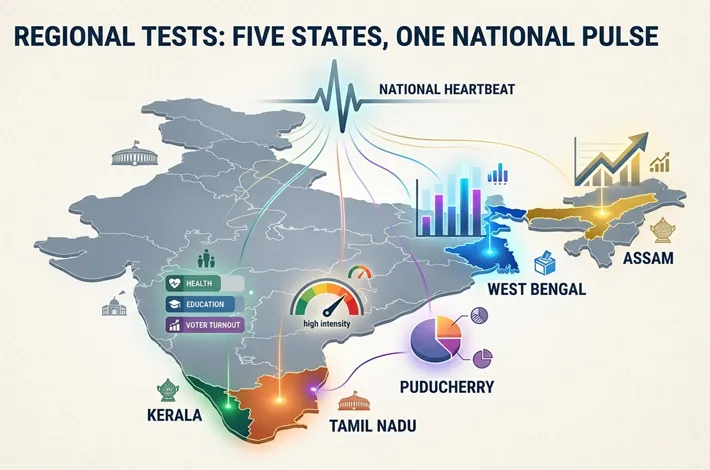
With the Election Commission of India announcing the schedule for the upcoming Assembly elections in West Bengal, Assam, Kerala, Tamil Nadu and Puducherry, the stage is set for a crucial political battle. The contest is not merely for power in these States but also a high-stakes fight for national political supremacy between Prime Minister Narendra Modi and Leader of Opposition Rahul Gandhi.
These elections are equally critical for powerful regional leaders such as Mamata Banerjee in West Bengal, M. K. Stalin in Tamil Nadu and Edappadi K. Palaniswami of the All India Anna Dravida Munnetra Kazhagam. For the Communist Party of India (Marxist)-led Left, the battle is existential as it has already lost its long-standing stronghold in West Bengal and now faces pressure in Kerala.
Prime Minister Modi enters this electoral cycle with momentum. Despite a setback in the 2024 Indian general election, where the Bharatiya Janata Party fell short of the halfway mark of 272 seats, the party retained power at the Centre with the support of allies in the National Democratic Alliance. Subsequently, the BJP has performed strongly in several State elections, reinforcing Modi’s political dominance.
However, sustaining this dominance requires a strong performance in the current round of Assembly polls. A poor showing could embolden the opposition and weaken the perception of BJP’s electoral invincibility.
For Rahul Gandhi and the Indian National Congress, the stakes are even higher. In the 2024 parliamentary election, the Congress improved its tally to nearly 100 seats, marking a modest revival after years of decline. Yet the party has struggled to translate this momentum into victories in State Assembly elections.
Rahul Gandhi is now attempting to seize the political initiative from the BJP. His strategy centres on regaining power in Assam and Kerala, where the Congress has been out of office for nearly a decade. At the same time, if the Dravida Munnetra Kazhagam retains power in Tamil Nadu as part of the INDIA bloc, it would strengthen Rahul Gandhi’s claim to leadership of the opposition alliance ahead of the 2029 general election.
Recognising the importance of these States, the Congress leadership has taken direct control of the campaigns. Rahul Gandhi is expected to campaign extensively in Kerala, while Priyanka Gandhi Vadra has been appointed chairperson of the party’s screening committee in Assam.
For the BJP, prospects appear mixed. The party is unlikely to make major gains in Kerala or Tamil Nadu. In Puducherry, the government led by Chief Minister N. Rangaswamy of the All India N.R. Congress is aligned with the NDA, but whether it can retain power remains uncertain.
Tamil Nadu presents a particularly complex contest. The BJP has revived its alliance with the AIADMK, but the absence of a charismatic leader like J. Jayalalithaa continues to haunt the party. Whether the AIADMK-BJP alliance can defeat the ruling DMK remains a major question.
The BJP is also attempting to forge ties with actor-turned-politician Vijay and his party Tamilaga Vettri Kazhagam, reportedly even offering the possibility of a Deputy Chief Minister’s post in a potential coalition government.
Kerala, traditionally dominated by the Congress-led United Democratic Front and the Left-led Left Democratic Front, has witnessed small but significant gains by the BJP. The party recently ended four decades of Left control to win the municipal corporation in Thiruvananthapuram. It also secured its first parliamentary victory in the State when actor-politician Suresh Gopi won the Thrissur Lok Sabha seat in 2024.
In preparation for the 2026 Kerala Assembly election, Modi inducted Suresh Gopi and George Kurien as Ministers of State in the Union government. Nevertheless, the BJP still has a long way to go before it can emerge as a serious contender for power in the State.
Assam is the one State where the BJP appears confident of victory. Under Chief Minister Himanta Biswa Sarma, the party has consolidated its political base. Sarma has adopted a strong Hindutva-oriented political strategy, often targeting illegal immigration and raising concerns about demographic changes.
Controversies have erupted over Sarma’s remarks referring to Muslims as “Miya voters” and over the Special Intensive Revision of the voter list, which critics say disproportionately affects Muslim voters. Sarma has repeatedly claimed that millions of illegal immigrants must be identified and removed, a stance he believes will consolidate Hindu support for the BJP.
Another major battleground is West Bengal, where the BJP continues its efforts to defeat Chief Minister Mamata Banerjee and her All India Trinamool Congress. In the 2021 Assembly election, the BJP emerged as the principal opposition with 77 seats in the 294-member Assembly.
While the party hopes to increase its vote share further, defeating Mamata Banerjee remains a formidable challenge. The outcome may hinge on campaign strategies, voter turnout and the intensity of political polarisation. The famous slogan “khela hobe” — signalling a fierce political fight — may once again define the electoral narrative in the State.
The Union government has also announced infrastructure projects for West Bengal, including a dedicated freight corridor connecting Dankuni to Surat and a proposed high-speed rail corridor between Varanasi and Siliguri. Whether these announcements influence voters remains uncertain.
For Rahul Gandhi, success in these elections is vital to break the Congress party’s prolonged struggle in Assembly polls. If the party continues to lose, its claim to lead the INDIA bloc in the 2029 general election could weaken.
The Congress also faces structural challenges. In Tamil Nadu it remains a junior partner in the DMK-led alliance with little prospect of leading the government. In West Bengal, Mamata Banerjee has shown little interest in aligning with the Congress. Meanwhile, cooperation with the Left is difficult because the two parties compete directly in Kerala.
Given these constraints, the Congress is focusing heavily on Kerala and Assam as the key battlegrounds for revival.
In Kerala, the party leadership recently resolved internal tensions involving Shashi Tharoor after a meeting with Congress President Mallikarjun Kharge and Rahul Gandhi. The reconciliation was seen as an attempt to present a united front ahead of the election.
The Congress organisation in Kerala is now being overseen by senior leader K. C. Venugopal. Recent successes in a by-election in Nilambur and local body polls have boosted the party’s morale.
In Assam, the Congress has appointed Gaurav Gogoi, son of former Chief Minister Tarun Gogoi, as the president of the State unit. If the party manages to win the election, Gogoi is widely seen as a potential chief ministerial candidate.
The decision to appoint Priyanka Gandhi as chairperson of the candidate screening committee is also strategic. It is intended to counter Himanta Biswa Sarma, who once belonged to the Congress and is believed to have deep insight into the party’s internal functioning.
However, the role carries risks. Candidate selection is often blamed when parties lose elections, and Priyanka Gandhi may face criticism if the Congress fails to perform well in Assam.
At present, political observers see the BJP holding an edge in Assam, the Congress having a favourable position in Kerala, Mamata Banerjee remaining strong in West Bengal, and the DMK-Congress alliance maintaining the advantage in Tamil Nadu.
Ultimately, the results will depend on campaign dynamics, leadership strategies and the intensity of political polarisation. These elections will test whether the BJP’s Hindutva-driven politics continues to deliver electoral dividends and whether the Congress can re-establish itself as the principal national challenger to the BJP.
For Prime Minister Modi, the challenge is to convert this round of Assembly elections into a step toward a “Congress-mukt” or even “INDIA bloc-mukt” political landscape by defeating the DMK in Tamil Nadu, the Trinamool Congress in West Bengal and the Left in Kerala. For Rahul Gandhi, the battle is about proving that the Congress still has the capacity to lead the opposition and mount a credible national challenge in the years ahead.
(Writer is Delhi-based senior journalist, political commentator and analyst. Views are personal)