3 July, 2026 | 9:07 AM


Oil price shock to strain India’s fiscal position: S&P
17-04-2026 12:00:00 AM
Growth Slowdown | BBB rating seen stable; credit losses of Indian banks may rise
Informist New Delhi
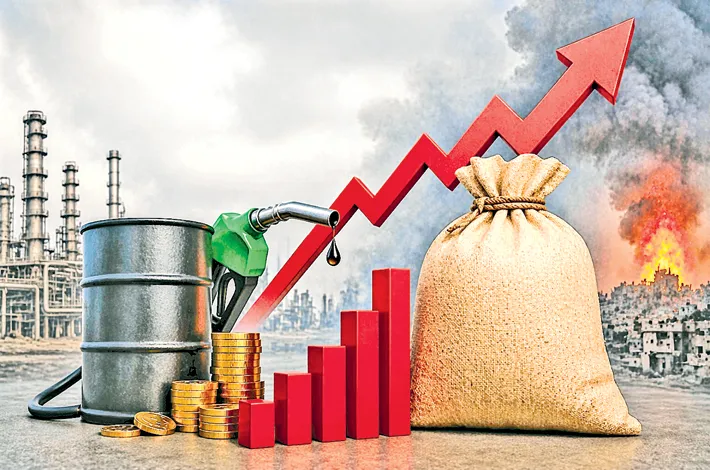
India will see additional fiscal stress in 2026-27 owing to energy supply constraints and the price shock caused by the war in West Asia, S&P Global Ratings said on Thursday. However, it does not expect the added fiscal strains to affect its credit rating of BBB on India.
High energy prices will translate to a wider current account deficit, increased consumer prices, and higher costs for producers in India, analysts at the rating agency said in a webinar. Supply disruptions could cause a material weakening in credit quality, though the impact of higher energy prices alone is more manageable, they added.
The government's expenses could increase significantly this financial year, posing challenges in meeting the budget's fiscal deficit target of 4.3% of GDP for the financial year 2026-27. This will mainly be due to the ballooning of fertiliser subsidies in the wake of the current geopolitical situation. While the fiscal deficit target for the financial year was set at 4.3% of GDP in the Union Budget, the deficit is now pegged at 4.5% of GDP based on the downward revision in India's nominal GDP as per the new series. Even if the government misses the fiscal deficit target this year, fiscal consolidation efforts will remain strong in the long term, S&P said.
India's current account deficit may widen in the financial year 2026-27, but a robust external position can absorb its impact. The rating agency expects the rupee to fall to ₹97 a dollar if crude oil prices average $130 per barrel. Since the war in West Asia began on Feb 28, Brent crude oil prices have risen to as high as $119 per barrel. In a severe shock, the currency could reach the ₹104 mark against a dollar, said Vishrut Rana, Asia-Pacific senior economist at S&P, based on calculations for a scenario where crude oil prices jump to $200 per barrel.
As per the base case, Brent crude oil prices are likely to average $85 per barrel in 2026-27, $70 per barrel in 2027-28, and $65 per barrel in 2028-29. In this scenario, S&P has projected India's GDP growth to rise 7.1% in 2026-27, 7.2% in 2027-28, and 7.0% in 2028-29. If oil prices average $130 per barrel, growth will be 6.3% in 2026-27. It has also projected growth at 6.6% in 2027-28 if oil prices average $100 per barrel.
Once the higher energy price shock sets in, the impact will be seen at the consumer level. In the base case, S&P has forecast India's CPI inflation to average 4.3% in 2026-27, 4.5% in 2027-28, and 4.3% in 2028-29. CPI inflation averaged 2.1% in 2025-26. In the oil price shock scenario, inflation is expected to jump to 5.6% in 2026-27 before moderating to 5.4% in 2027-28 and 4.5% in 2028-29.