29 November, 2026 | 12:02 AM


Modi, Shah, Gyanesh meet their Waterloo: Rahul
29-11-2026 12:00:00 AM
- Democracy Being Killed
- Appeals to Jagan, Chandrababu reconsider their decision
- Gen Z is fearless
- Those supporting the Bill are cowards
metro india news I
Leader of Opposition in the Lok Sabha Rahul Gandhi on Saturday sharply criticised the Centre’s proposed Delimitation Bill during a special press conference at Indira Bhawan, the AICC headquarters, alleging that the plan to expand the Lower House from 543 to around 850 seats is a calculated political manoeuvre by the BJP to redraw India’s electoral map in its favour.
Addressing the media interaction that concluded in the evening, Gandhi described the proposal as an “escape route” after what he called the exposure of large-scale electoral manipulation. He said the ruling party, having been “trapped” on the issue of vote theft, was now seeking a fresh mechanism to retain power. “We have trapped Modi, Shah and Gyanesh. They know it, we know it,” he stated, referring to Prime Minister Narendra Modi, Home Minister Amit Shah and Chief Election Commissioner Gyanesh Kumar. He added that the Congress possessed significant information on the CEC and would release it soon.
Rahul Gandhi repeatedly highlighted the number 850, urging young voters, particularly Gen Z, to remember it as a symbol of the “murder of Indian democracy.” He argued that the expansion would hand Modi, Shah and Kumar a “blank canvas” or “blank cheque” to redesign constituency boundaries at will. Drawing parallels with recent exercises in Assam and Jammu and Kashmir, he claimed that a larger House would enable extensive restructuring that weakens the representation of communities opposed to the BJP and allows the targeting of specific opposition leaders.
He dismissed the government’s stated rationale of implementing women’s reservation. The Women’s Reservation Bill has already been passed by Parliament and can be operationalised immediately within the existing 543 seats, including a sub-quota for OBCs, Gandhi said. “So the question is, why 850?” he asked. Linking the move to earlier allegations, he noted that the Election Commission itself had indicated that about 140 million people who voted in 2024 were ineligible, rendering those polls illegal in his view. He also referenced voter deletions in Bihar, alleged irregularities in West Bengal, Karnataka and other states as part of a pattern the opposition had documented.
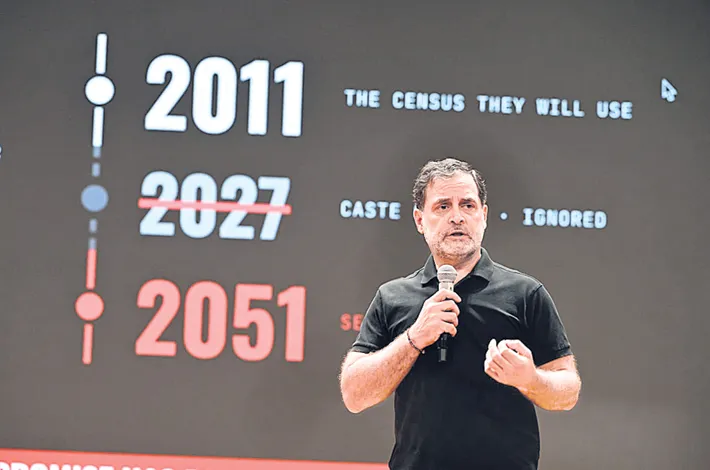
On the proposed Delimitation Commission, Gandhi alleged that the Election Commission has been “captured” and that the new body would similarly fall under BJP control. According to him, it would include Gyanesh Kumar, a former Supreme Court judge selected by the government, and a third member chosen by Kumar himself, with its decisions shielded from court challenge. He demanded the use of the latest census data rather than the 2011 figures, incorporation of caste census findings, and a truly bipartisan commission to protect the rights of SCs, STs, OBCs and minorities.
Rahul Gandhi maintained that the core issue is not merely the freezing of state-wise seat shares until 2051 or the increase in numbers, but the power it confers to reshape Indian democracy itself. He said Congress and the broader opposition would fight the legislation “tooth and nail.” The press conference came hours after floor leaders of the INDIA bloc met at Congress president Mallikarjun Kharge’s residence to coordinate strategy ahead of the special parliamentary session beginning Monday, when the government is expected to introduce the Constitution (132nd Amendment) Bill and related legislation.
In the interaction, Gandhi framed the debate as a defence of democratic institutions against what he portrayed as an attempt to institutionalise electoral advantage before votes are even cast. He reiterated polling data claimed by the Congress showing that 80 per cent of Indians and nearly all of Gen Z believe elections are being stolen by the trio of Modi, Shah and Kumar. The Leader of Opposition positioned the opposition’s resistance as essential to preventing a permanent tilt in the political landscape through boundary changes.
The special media interaction, streamed live on party platforms, focused almost exclusively on delimitation and related electoral concerns. Gandhi used visual aids and repeated key phrases to underscore his central message that expanding the Lok Sabha to 850 seats is less about representation or women’s empowerment and more about creating room for partisan redesign of constituencies. He linked the proposal to previous opposition campaigns on “vote chori,” arguing that public awareness of alleged irregularities has forced the government into this new approach.
As Parliament prepares for the special sitting, the opposition has outlined demands including retention of the current Lok Sabha strength, implementation of women’s reservation within existing seats, and safeguards for state-wise proportions. Gandhi’s remarks set a confrontational tone for the coming session, casting the Bill as a fundamental threat to fair electoral competition rather than a technical or progressive reform. The Congress leader concluded by appealing directly to younger citizens to recognise the long-term implications of the proposed changes for the country’s democratic future.