21 September, 2026 | 1:11 AM


Ministers propose, Babus’ dispose
01-08-2026 12:00:00 AM
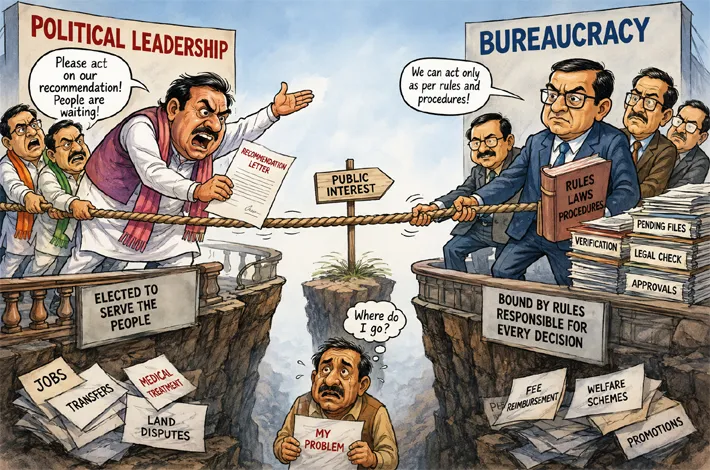
Ministers, bureaucrats at odds over recommendation letters
metro india news I hyderabad
A widening gap between Telangana's political leadership and the bureaucracy has reportedly emerged as a key concern within the government, with several ministers expressing dissatisfaction over the manner in which their recommendation and endorsement letters are being handled by senior IAS officers, district collectors and heads of departments.
Government sources indicate that many ministers believe their representations on public issues are not receiving the attention they deserve, while officials maintain that every decision must strictly adhere to rules and legal provisions. The issue has triggered a debate within administrative circles over striking the right balance between political accountability and bureaucratic independence.
Every day, hundreds of people approach ministers seeking assistance with a wide range of issues, including employment, transfers, promotions, medical treatment, admissions to educational institutions, fee reimbursements, land disputes, welfare schemes and local development works. Ministers, acting on these requests, issue endorsement letters to the concerned departments with the expectation that genuine grievances will be examined and resolved.
However, government sources say several ministers have complained that many of these recommendations are either treated as routine correspondence or receive no response at all from officials.
Sources further indicate that in several instances, district collectors, principal secretaries and heads of departments have reportedly informed ministers that requests cannot be processed if they are not in accordance with existing rules, while in other cases there has been no official response. As a result, citizens and party workers who approach ministers for help often return with complaints that even ministerial recommendation letters are not being acted upon. Ministers are said to believe this is affecting their political credibility and weakening public confidence in elected representatives.
Government circles describe the issue as more than a disagreement between individual ministers and officers. They view it as a systemic challenge involving two different responsibilities within governance. While ministers, as elected representatives, are expected to respond to public demands and resolve grievances, civil servants are constitutionally required to take decisions based on laws, rules and administrative procedures. Administrative experts believe that unless there is effective coordination between the political executive and the bureaucracy, such differences are likely to persist.
Officials, on the other hand, are reportedly exercising greater caution than ever before while processing files. In recent years, investigations by the ACB, CBI, vigilance authorities and courts into administrative decisions have increased significantly. In several cases, officers have continued to face inquiries even after retirement. Against this backdrop, many IAS officers are said to be carefully examining every file and avoiding decisions based solely on ministerial recommendations, fearing possible legal consequences in the future. According to official sources, this explains why requests are being processed only after ensuring complete compliance with applicable rules.
Ministers, however, are understood to hold a different view. Sources say they argue that recommendation letters are not issued indiscriminately and are provided only after examining whether applicants have genuine and deserving cases. They believe that if even such recommendations are ignored without proper consideration, it creates dissatisfaction among the public and damages the government's image. There are also reports that some ministers have directly conveyed their displeasure to district collectors over the issue.
According to government sources, the matter was also reportedly discussed during a recent Cabinet meeting, where concerns were raised over the lack of response to recommendations made by public representatives. Some ministers are said to have emphasised the need for stronger coordination with officials so that the dignity of elected representatives is maintained, particularly at the district level, while ensuring that administrative procedures are not compromised.
Political observers believe the issue could have wider implications for governance. If the perception grows that recommendations made by ruling party ministers and MLAs carry little value, public dissatisfaction may increase and confidence in the government's functioning could be affected. At the same time, officials argue that bypassing established rules could expose them to allegations of corruption, irregularities and legal action in the future.
Against this backdrop, discussions are reportedly underway within government circles on the possibility of issuing clearer guidelines on how recommendation letters from public representatives should be handled by the administration. Analysts believe that only a well-defined coordination mechanism—one that respects both legal procedures and the role of elected representatives—can help bridge the growing gap between the political leadership and the bureaucracy while ensuring effective governance.