20 November, 2026 | 2:19 AM


Last hour voting data missing
20-11-2026 12:00:00 AM
ECI DATA GAPS IN SHINDE’S SEAT RAISE ALARM
metro india news I mumbai
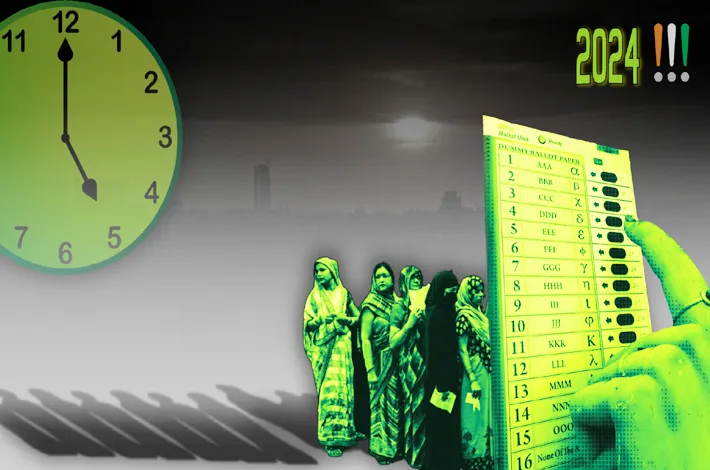
An investigative report by The Reporters’ Collective has flagged significant gaps in the Election Commission of India’s (ECI) internal records for the 2024 elections, revealing that data on votes cast after 5 pm is missing in 200 constituencies across Maharashtra, Haryana, and Jammu & Kashmir. The findings, detailed in the second part of the outlet’s Election Audit series by journalists Sumedha Mittal and Venkatesh Nayak, have sparked renewed debate over transparency in the electoral process, particularly around the final hour of polling when scrutiny is often thinner.
The report draws on returning officers’ reports and other internal ECI documents covering 467 Assembly and 63 Lok Sabha constituencies—over 4,200 physical pages that are not routinely made public. According to the investigation, ECI rules require polling officials to record both the number of voters entering booths and the votes polled on EVMs every two hours until the close of polling, typically at 6 pm. Yet in 200 seats, the after-5 pm figures are simply absent.
Maharashtra accounts for the bulk of these gaps: 132 constituencies (114 Assembly and 18 Lok Sabha). Jammu & Kashmir has 45 such seats, while Haryana accounts for the rest. In the 174 Maharashtra Assembly seats where post-5 pm data was recorded, about 50.87 lakh votes were cast after 5 pm—noticeably lower than the statewide evening surge of roughly 76 lakh votes initially highlighted by officials after the November 2024 Assembly polls.
One constituency highlighted in the report and widely circulated on social media is Kopri-Pachpakhadi in Thane, the home seat of Maharashtra Chief Minister Eknath Shinde. Official records show 1,13,328 votes polled by 5 pm. The final tally exceeded 2 lakh (approximately 2.03 lakh), implying more than 89,000 votes were cast in the last hour and beyond across 366 polling booths. Shinde, contesting on the Shiv Sena (Shinde faction) ticket, defeated Shiv Sena (UBT) candidate Kedar Dighe by a margin of about 1.20 lakh votes (1,59,060 to 38,343).
The Reporters’ Collective calculated the implied pace: roughly four votes per booth every minute, or one voter every 15 seconds. Completing the full process—entering the booth, showing the voter slip, signing the register, receiving indelible ink, and pressing the EVM button—in that timeframe, continuously for an hour at every booth, strains practical feasibility, the report notes. The after-5 pm record for this seat is missing, consistent with the pattern in the other 199 constituencies.
Experts cited in coverage of the report have long noted that the final hour of polling, especially after dark, can be more vulnerable because many party agents leave and oversight decreases. The absence of mandatory two-hourly data leaves the ECI without a clear internal audit trail for what occurred in these seats between 5 pm and the formal close of polls (and any voters still in queue).
When the journalists approached the ECI with detailed questions, the Commission treated the inquiry as a “complaint” and asked them to submit the Commission’s own data back to it, according to the report.
State chief electoral officers have previously responded to related queries by pointing to final Form 17C accounts and index cards as the statutory records, distinguishing them from the administrative summaries in returning officers’ reports.
The original findings were amplified on X by independent journalist handle @TheRebel_IN, whose post detailing the Kopri-Pachpakhadi numbers and the broader data gaps garnered thousands of likes and shares within hours of publication. The accompanying video from The Reporters’ Collective walks through the documents and calculations.
Eknath Shinde’s decisive win in his stronghold was not in dispute on counting day in November 2024, and no formal challenge to the result on these specific grounds has been reported. However, the systematic absence of last-hour data across hundreds of seats has prompted calls for greater transparency and stricter adherence to recording protocols.
Opposition voices and civil society groups have long raised concerns about evening turnout spikes; this investigation provides internal documentation that, its authors argue, should have triggered closer scrutiny at ECI headquarters. The ECI has not issued a detailed public rebuttal specifically addressing the missing after-5 pm entries in the 200 constituencies as of this writing. Democracy depends on verifiable records. Where those records stop at 5 pm, questions about the final hour inevitably arise—and remain unanswered until fuller disclosure or independent verification is provided.