20 November, 2026 | 2:19 AM


Jawaharnagar Dump Turns into Toxic Lake
20-11-2026 12:00:00 AM
metro india news I hyderabad
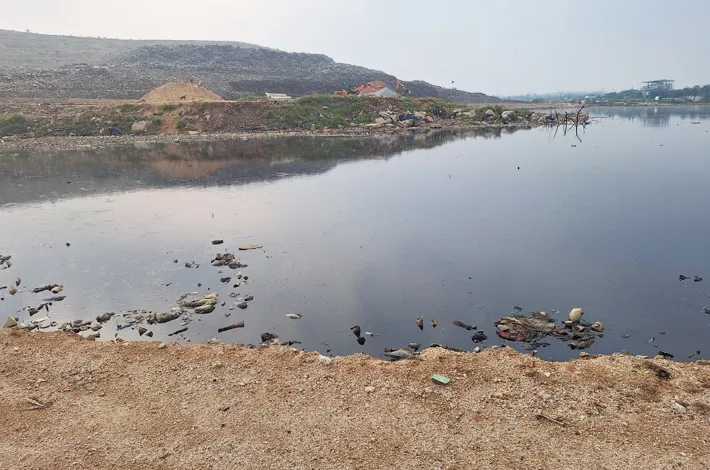
What looks like a sprawling lake on the edge of the Jawaharnagar dumping yard is actually a vast pool of leachate — the foul-smelling liquid that seeps out of rotting garbage. As it expands, authorities allegedly release the overflow into streams and ponds, contaminating farmland, groundwater and surface water across dozens of villages.
Hyderabad generates an estimated 10,000 tonnes of solid waste daily from areas within the Outer Ring Road (ORR). All of it is transported to the Jawaharnagar dumping yard, where massive heaps of garbage release leachate that collects in a depression, forming an artificial lake. Locals say several lakh litres accumulate every day.
A 2,000-kilolitre-per-day treatment plant at the site is grossly inadequate, residents and activists allege. They claim it rarely operates at full capacity. When the lake fills up, Ramky, the agency handling municipal solid waste, releases the excess downhill through a sluice. The toxic liquid then seeps into the soil and flows into streams, tanks and wells.
Located on elevated ground with granite underneath, the dumping yard allows leachate to travel both over the surface and underground. Within a 1.5-km radius, the Dammaiguda tank has turned black, with fish and other aquatic life disappearing. Farmers report that crops irrigated with contaminated water become unsafe for consumption.
Groundwater in surrounding villages reportedly contains excessive total dissolved solids, chlorides, hardness and nitrates, besides heavy metals such as lead, arsenic, mercury and chromium. Residents complain of skin diseases, allergies, stomach ailments, asthma and respiratory problems. Longer-term exposure is also blamed for kidney and liver damage, neurological disorders and cancers.
Konne Venu, co-convenor of the committee, claimed pollution had spread across a 30-km radius, affecting nearly 40 lakh people in 40 villages and colonies. Nearly 50 tanks have reportedly received leachate, he said, accusing authorities of neglect.
Activists blame Ramky, the Greater Hyderabad Municipal Corporation, the Malkajgiri and Cyberabad municipal corporations, the State government and the Pollution Control Board for failing to address the crisis.
They say soil fertility has declined due to high salinity and abnormal pH levels, while several water bodies have lost aquatic life.
Residents are demanding relocation of the dumping yard, adequate leachate treatment facilities and decentralised waste processing. Until effective measures are taken, they warn, contamination will continue threatening the health and livelihoods of lakhs of people.
Borewells and open wells in nearby colonies yield black water. Bathing causes skin diseases. Cancer cases are rising and families refuse marriage proposals.
Alluri Savitri,
Jawaharnagar Dumping Yard Closure Struggle Committee