13 September, 2026 | 12:08 AM


Intellectual Labor Commoditized !
13-09-2026 12:00:00 AM
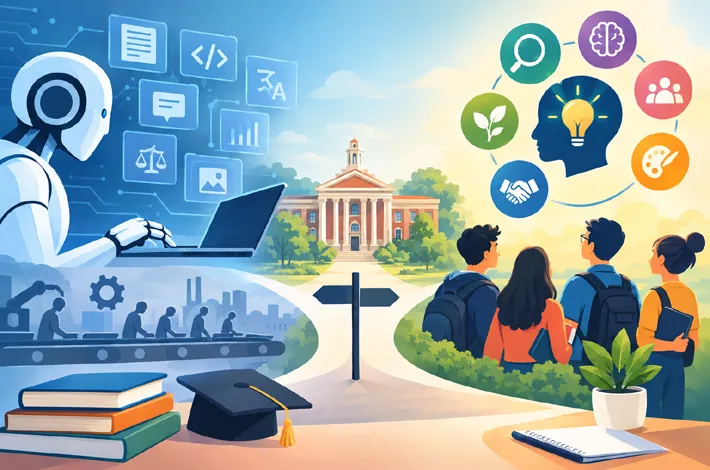
Prof at IISc warns raising existential questions for universities
Personalized AI tutors can adapt to individual learning paces and styles in ways that a single classroom instructor cannot. Teachers may increasingly become supervisors and mentors of AI-driven systems rather than primary deliverers of conten
-Dr. Prathosh AP AI scientist and assistant professor, IISc, Bengaluru
metro india news I hyderabad
In a candid discussion that has resonated widely among tech professionals and educators, Dr. Prathosh A P, an AI scientist and assistant professor at the Indian Institute of Science (IISc) Bengaluru, delivered a stark assessment of artificial intelligence’s impact on knowledge work. Speaking to students and in related conversations, he argued that rapid advances in AI are commoditizing intellectual labour in much the same way the Industrial Revolution diminished the economic value of physical strength.
The comments, shared in a video that has circulated on social media, pose an unsettling question for higher education: if companies stop recruiting on campus within the next five to ten years—even from India’s premier institutions—what becomes the purpose of a university education? Dr. Prathosh drew a historical parallel.
Before mechanization, muscular power held high economic value. Machines rendered that form of labour far less scarce and valuable, shifting power toward those who owned and directed the new tools. Over the subsequent centuries, societies built economies around knowledge and information asymmetry. Intelligence, coding skill, analytical ability, writing, design, and specialized expertise became the scarce resources that commanded high wages and prestige.
Large language models and related AI systems, he said, are now eroding that scarcity. These systems can perform many forms of intellectual work faster, cheaper, and at greater scale than most humans. The implications are already visible. Software engineering, content creation, translation, routine legal analysis, basic data reporting, and aspects of teaching and design face significant disruption.
AI does not merely assist; in many domains it matches or exceeds average human output while operating continuously without fatigue or salary demands. As a result, the premium once attached to possessing and applying knowledge is declining. What was once a durable career foundation risks becoming a commoditized input, much like physical labour after the factory system took hold. This shift forces a re-examination of universities. For decades, especially in India, elite institutions such as the IITs and IISc have functioned in part as talent pipelines.
Campus placements offered a clear return on the intense investment of time, money, and effort required to gain admission and complete rigorous programs. Students and families often viewed degrees primarily through the lens of employment outcomes at major technology firms and consulting companies. Dr. Prathosh asked what happens when that pipeline weakens or breaks. If leading employers can obtain capable output from AI systems or smaller teams augmented by them, the traditional justification for large-scale campus hiring diminishes.
Universities may need to redefine their role beyond credentialing for knowledge-based jobs. He pointed to broader changes already underway in education. Personalized AI tutors can adapt to individual learning paces and styles in ways that a single classroom instructor cannot. Teachers may increasingly become supervisors and mentors of AI-driven systems rather than primary deliverers of content. The one-size-fits-all model of lectures and standardized curricula faces pressure.
At the same time, deeper questions of purpose arise. If knowledge transmission and skill training for employment become less central, universities might emphasize curiosity, original problem formulation, ethical reasoning, interdisciplinary synthesis, and the uniquely human capacities that remain difficult for current AI to replicate. Dr. Prathosh did not paint a purely dystopian picture. He expressed measured optimism rooted in human adaptability. Survival and progress, he noted, have historically favored those who adjust to new conditions rather than those who cling to previous advantages. Humans possess distinctive strengths: the ability to think about the distant future, a powerful survival instinct, and the capacity to set goals and navigate uncertainty in ways machines do not yet fully share.
A new economic and social order is likely to emerge, one that may place greater value on directing AI systems, identifying meaningful problems, exercising judgment, and fostering human relationships and creativity that resist full automation. His practical advice centered on resilience rather than resistance. Individuals should avoid building careers around any single tool or narrow technical skill, as tools evolve rapidly. Instead, cultivate the ability to identify real problems, frame questions that matter, and use AI as an amplifier of human insight rather than a substitute for thinking. Continuous learning, intellectual curiosity, and adaptability become more important than mastery of any particular programming language or domain knowledge that AI can absorb and reproduce.
The conversation arrives at a moment when AI capabilities are advancing swiftly, compute power is concentrated among a few large players, and training costs for frontier models remain high. Policymakers, educators, and industry leaders face the challenge of managing the transition. Concentration of power in a handful of technology companies, questions of accountability when AI systems err, and the need for new social and economic models all require attention.
For students currently navigating competitive admissions and placements, the message is sobering yet clarifying: the value of education may increasingly lie less in the knowledge transferred and more in the habits of mind developed—the capacity to ask better questions, adapt, and contribute in domains where human judgment and purpose still hold decisive importance. Dr. Prathosh’s remarks underscore a broader reckoning. The commoditization of intellectual labour does not eliminate the need for universities or human contribution. It demands that both evolve.
Institutions that once prepared graduates primarily for knowledge-work employment may need to prepare them for a world in which such work is abundant and cheap, and in which the scarce resources are vision, ethics, original inquiry, and the ability to thrive alongside powerful machines. The next five to ten years will test how successfully academia, industry, and society respond to that challenge.