24 September, 2026 | 12:55 AM


From money orders to UPI
24-09-2026 12:00:00 AM
There was a time when sending Rs 100 to a family member in another town required patience. The sender had to visit a bank, fill out forms, stand in a queue and pay a fee for a demand draft. Then came another trip to the post office, more paperwork, another queue and another fee before the money finally reached its destination. The process could take half a day.
Today, the same Rs 100 can reach another bank account within seconds. Scan a QR code, enter the amount, authenticate the payment—and it’s done. India’s payment revolution is not just about replacing paper with technology. It has also changed what people expect. Waiting, once accepted as part of making a payment, is now increasingly hard to tolerate.
India Post introduced money orders in 1879–80, enabling people to send money across distances without travelling. The Post Office Savings Bank, launched in 1882, expanded the postal network’s financial role. Over time, money orders gave way to cheques, demand drafts, electronic transfers, ATMs, internet banking and mobile banking, gradually reducing the effort involved in moving money.
The smartphone transformed this further. UPI, launched in 2016 with 21 banks, enabled instant account-to-account transfers across participating banks through a common digital platform. By 2026, UPI had become part of everyday commerce, processing 24.51 billion transactions worth Rs 29.82 lakh crore in August alone.
The QR code counter
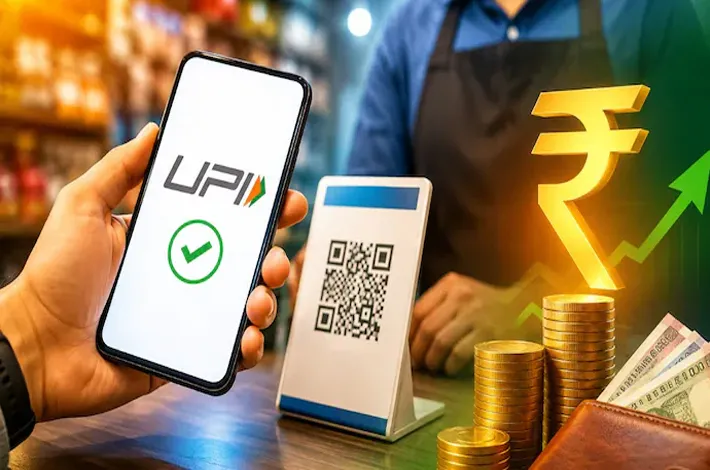
The QR code has become India’s new payment counter. Neighbourhood shops, roadside vendors, restaurants, taxi drivers and small service providers can accept digital payments without card terminals, while customers can pay without cash.
Behind this simplicity is an extensive network of banks, payment apps, authentication systems, cybersecurity and settlement infrastructure.
Digital payments also reduce the need to print, transport, count and store cash, lowering risks of loss and theft.
For migrant workers sending money home, parents transferring funds to children, or small traders accepting payments, distance has become far less significant.
The cost behind convenience
UPI may feel free to consumers, but instant payments carry costs. From October 15, 2026, a 0.4% Merchant Discount Rate (MDR) will apply to specified person-to-merchant UPI payments above Rs 2,000, capped at Rs 300 for transactions of Rs 75,000 and above. Person-to-person transfers and merchant payments up to Rs 2,000 will remain free. Small merchants receiving up to Rs 1 lakh monthly through UPI QR payments will also remain under the zero-MDR framework. The government expects about 96% of person-to-merchant transactions to remain unaffected.
Specified payments in railways, telecom, insurance, fuel and agricultural inputs will attract a flat Rs 5 MDR, while certain capital-market transactions will face 0.02%, capped at Rs 300. UPI has transformed everyday finance by making speed, convenience and access central to how India pays.
Kailas Nagesh