24 September, 2026 | 1:09 AM


Opposition Demands Gyanesh Visarjan!
24-09-2026 12:00:00 AM
Internal Rift in Election Commission sparks opposition outcry over voter list revisions
metro india news I hyderabad : In sudden development that may cause tectonic shift in the whole election process in the country, a detailed investigation by a leading news daily has exposed significant internal disagreements within the Election Commission of India (ECI) over the Special Intensive Revision (SIR) of electoral rolls, a process that has removed more than 13 crore names from draft voter lists across 30 states and Union Territories.
The report, based on months of examination of internal records and communications, reveals that Election Commissioners Sukhbir Singh Sandhu and Vivek Joshi formally objected on record at least 14 times over 10 months to decisions and orders they say were issued without their knowledge. These objections covered core aspects of the Commission’s work, including new voter registration, deletions and restorations, control over electoral roll data, and specific actions in states like West Bengal and Goa.
The ECI functions as a three-member body under Article 324 of the Constitution, with the Chief Election Commissioner and two Election Commissioners holding equal rank. Decisions are to be taken unanimously where possible, or by majority. According to the investigation, the two Commissioners allege they were kept in the dark for extended periods on key processes related to the nationwide SIR, which began in Bihar in mid-2025 and expanded thereafter. The full Commission reportedly did not meet for months between May and August. In one instance, they wrote separately to Cabinet Secretary T.V. Somanathan about a work allocation order that altered oversight of IT files, describing it as a clear violation, before jointly striking it down. Specific concerns highlighted include changes to Form 6, the application for new voters.
In July, a new question was added asking whether the applicant’s parents or grandparents appeared on the last SIR roll, with no answer blocking registration. Both Commissioners had earlier advised that such a change required amendment to the Registration of Electors Rules, 1960. Sandhu later termed the alteration “unauthorised and illegal.” The question remained in place at the time of the report’s publication. On the software front, the launch of ECINet raised alarms about centralisation. Local electoral registration officers, who by law handle additions and deletions, reportedly faced restricted access controlled from the IT division in Delhi. The Commissioners sought audits, citing risks to the decentralised system that has long underpinned the integrity of voter lists.
In West Bengal, where the Supreme Court directed judicial officers to handle certain discrepancies involving about 60 lakh voters (retaining a substantial number), subsequent appeals sought deletions of those retained. Sandhu questioned who authorised these appeals on behalf of the ECI, noting that neither he, Joshi, nor the state’s Chief Electoral Officer had been informed. In Goa, 97 voters cleared by local officers after Supreme Court directions could not be restored because the software, controlled centrally, lacked the necessary option in time. These examples, the report argues, illustrate how procedural shifts can affect individual eligibility even when local authorities approve inclusion. The revelations have triggered sharp reactions from Opposition leaders, who link them to longstanding allegations of bias in the electoral process.
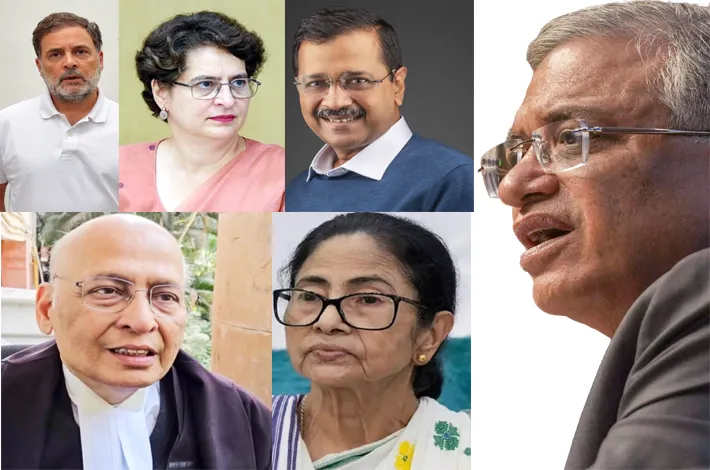
Congress MP and senior spokesperson Abhishek Manu Singhvi led the party’s response in a press briefing. He accused Chief Election Commissioner Gyanesh Kumar of misleading colleagues and the public while sidelining the other Commissioners. “By hijacking the Election Commission, he, in a way, sidelined his colleagues from serving in it. He hijacked his own ECs.
This is an example of an internal bulldozer,” Singhvi said. He described the episode as a “disgusting” partnership between external and internal pressures on constitutional bodies and noted the 14 recorded objections, including Sandhu’s characterisation of Form 6 changes as unauthorised and illegal, which met with silence. Singhvi further charged that the BJP had “opened an office for the murder of democracy,” placing the CEC on one side and the Home Ministry on the other.
Congress leader Priyanka Gandhi Vadra characterised the reported internal differences as extremely serious and an assault on democracy. Speaking in Nilambur, she stated that if elections are unfair or rigged in any manner and the ECI is aware and allows it, “it is a very very serious assault on democracy.” She described such conduct as “treachery with the nation” and “an act of treason,” calling for those responsible to be held accountable through impartial investigation.
Priyanka noted that her brother, Leader of the Opposition Rahul Gandhi, had repeatedly flagged bias and injustice in the Commission’s functioning, and that the Election Commissioners themselves had now brought concerns to the CEC’s attention. She emphasised that unfair elections threaten the foundations of the democratic system.
Rahul Gandhi reinforced the critique, describing “vote chori” as a crime against the Indian people and a direct attack on the Constitution. He held the BJP, RSS, and elements within the EC responsible for an “act of treason,” asserting that justice would be served. The Congress party as a whole framed the developments as confirmation that the Commission had been captured, with Gyanesh Kumar portrayed as acting at the ruling party’s behest. Other voices aligned with the broader Opposition discourse have also weighed in on the ECI’s functioning around SIR and voter lists.
Cockroach Janta Party spokesperson Saurav Das has described the Election Commission as a “completely compromised body,” alleging collusion with the government rather than mere pressure. He pointed to issues with EVMs, name deletions, the speed of Commissioner appointments, and the overall handling of SIR notices as evidence of eroded independence, warning that those responsible would face accountability from the public and youth.
The Election Commission has responded that differing views form a normal part of internal deliberations and that all final decisions on the SIR were unanimous and approved by the full body. Officials indicated that written notes and observations are standard checks for transparency and legal compliance, arguing that selective focus on certain notes over 10 months presents an incomplete picture.
The Commission maintains that the process remains lawful and that the three members continue to function collectively. These developments occur against the backdrop of sustained political debate over electoral integrity. The SIR was intended as a clean-up of rolls, removing duplicates, deceased voters, and other ineligible entries. Critics, however, argue that the scale of deletions—coupled with reported centralisation of software control and procedural changes—risks disenfranchising legitimate voters, particularly first-time applicants and those in contested states.
The internal objections from two of the three Commissioners lend institutional weight to concerns previously voiced mainly by Opposition parties and civil society. The episode underscores questions about the operational independence and collective decision-making of a constitutional body central to India’s electoral democracy. With the majority of the Commission having placed detailed reservations on record regarding processes affecting who appears on the voter list, the controversy is likely to intensify demands for greater transparency, audits of the software systems, and clarity on the legal basis for specific changes.
How the ECI, the government, and the courts address these documented internal reservations will shape public confidence in the electoral rolls ahead of future polls. The investigation has shifted the debate from external allegations to evidence drawn from within the institution itself, ensuring that questions about process, authority, and accountability remain at the forefront of national political discourse.
Political economist and commentator Dr. Parakala Prabhakar has long described the SIR exercise in far stronger terms as a systemic assault on citizenship itself. He has called it a “bloodless genocide of citizenship,” a “peaceful political genocide,” and a “bloodless massacre,” arguing that it goes beyond routine cleaning of rolls to target and disenfranchise identified groups—particularly minorities, women, poorer sections, and dissenters—in a manner that alters the social fabric of the electorate. Citing disproportionate deletions (for instance, higher shares of Muslim names relative to population share in Bihar examples), he has warned that the process creates two classes of Indians: those with the franchise and those without.
“If you can’t kill a citizen, you kill the citizenship,” he has said, framing SIR as a mechanism that turns voters into second-class participants or excludes them from the political community altogether. Suprme Court Judge Justice Dipankar Datta prima facie expresses that the 2023 law on the appointment of Election Commissioners does not appear to ensure an independent selection process. A nominee of the Prime Minister in the selection committee cannot be expected to defy the PM, Justice Datta says.
"Inclusion of cabinet ministers fails to provide an independent counterweight that a neutral selector would. It becomes largely ornamental."
"Free and fair elections depend on a truly independent ECI. It is not enough for the ECI to be independent; it must appear to be independent," Justice Datta pronounces.
Rahul Gandhi leader of opposition : We will clearly show to the youth and GenZ of the country that Narendra Modi has become Prime Minister by Vote Chori and BJP does Vote Chori
Arvind Kejriwal National convenor, Aam Aadmi Party: The entire SIR exercise be cancelled and that the Chief Election Commissioner Gyanesh Kumar should immediately be arrested.
Abhishek Manu Singhvi Congress leader : The Chief Election Commissioner was misleading the other Election Commissioners. The EC is a multi-member body and that the CEC cannot take decisions individually.
Mamata Banerjee Former West Bengal chief minister : BJP and the poll panel had "looted" the polls held earlier this year. The CEC Gyanesh Kumar must be arrested and fresh Assembly elections with pre-SIR voter list must be conducted in the State. It has now been proven that the BJP and the EC looted the West Bengal assembly polls.”
Priyanka Gandhi, Member of Parliament: It is an act of treason. This is a betrayal of the nation. Those responsible must be held accountable, and a fair and thorough investigation must be conducted