12 October, 2026 | 1:27 AM


El Nino triggers water crisis
12-10-2026 12:00:00 AM
State of affairs
- Government content with report to Centre, but no alternative measures in place?
- Tanker demand surges in cities and towns
- Water wars loom
- Village-level action plan essential for the next eight months
metro india news I hyderabad
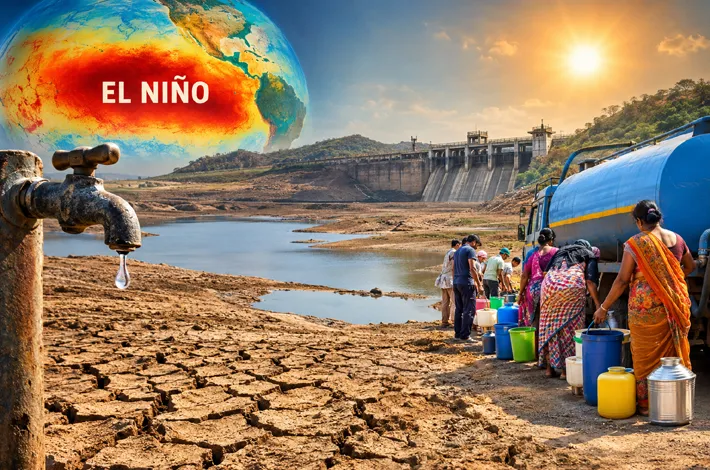
El Niño is tightening its grip, with reservoirs, lakes, tanks and borewells across the State running dry. Although rainfall this season is reportedly 17 per cent below normal, severe drought conditions prevail in nearly 300 mandals. Agriculture apart, even drinking water supplies are at risk of running short.
The government must immediately focus on alternative measures. A high-level committee should be constituted to prepare and implement a comprehensive village-level plan to ensure drinking water for people, livestock and animals. Failure to act decisively could trigger water wars and clashes at water tanker points.
Reservoirs running dry
A look at the major reservoirs in the Krishna and Godavari river basins reveals a grim picture. Poor rainfall and the absence of substantial inflows have left reservoirs with depleted stocks. As of October 10, reservoirs in the Godavari basin had 63.5 TMC of water, of which only 44 TMC was available for use. On the same date last year, October 10, 2025, the basin had 124.4 TMC, including 95.9 TMC of usable water. This means that less than half of last year's usable water is available now.
Reservoirs in the Krishna basin currently hold 297.7 TMC, but only 119 TMC is available for consumption. On the corresponding date last year, the basin had 580 TMC, of which 402 TMC was usable.
Taken together, reservoirs in the Krishna and Godavari basins held 361.3 TMC as of Saturday, with only 163.9 TMC available for use. On the same date last year, the total storage was 704.5 TMC, including 498.2 TMC of usable water. Thus, the volume of water currently available for use is only about 32.89 per cent of last year's level.
Lakes and borewells drying up
Telangana has around 21,000 lakes and tanks with a total storage capacity of 253.8 TMC. However, as of October 4, they held only 96 TMC of water.Temperatures are already at least four degrees Celsius above normal and are expected to rise further. With evaporation rates increasing significantly, the water stored in tanks could soon be depleted.
Borewells, too, are yielding water intermittently. Groundwater levels across the State have fallen by 1.57 metres below normal, with the average water table standing at a depth of 7.77 metres, according to the Irrigation Department.
Tanker demand surges
Water tanker demand has increased sharply in Hyderabad and the municipal corporations of Warangal, Karimnagar, Nizamabad, Mahabubnagar, Khammam and Nalgonda, as well as in other municipalities. With borewells drying up, millions of people are increasingly dependent on tankers. The same situation could soon spread to rural areas.
Disputes over tanker water have already begun in Hyderabad. The city receives water from reservoirs and sources including Osman Sagar, Himayat Sagar, Singur, Manjeera, Akkampally, Nagarjuna Sagar, Srisailam and Yellampally.
As of October 10, these sources had only 9.783 TMC of water available, compared with 25.971 TMC on the same date last year. With borewells in the city running dry, dependence on tankers is growing.
El Nino effect to persist till next monsoon: Met Dept
Meteorologists have warned that El Niño's effects could persist until the next monsoon. The government must now determine how to meet water requirements over the next eight months and put alternative arrangements in place.
Water must be supplied from the Krishna and Godavari basins. If necessary, the State should initiate talks with Karnataka, whose reservoirs reportedly hold around 80 to 90 per cent of their full reservoir level (FRL). Releasing water from these reservoirs could help meet at least drinking water needs.
The government must also prevent Andhra Pradesh from drawing more than its rightful share of water. Reservoirs in AP are reportedly more than 75 per cent full.
Apart from Yellampally, some of the operational pump houses of the Kaleshwaram project should be utilised. The Devadula project should be operated to its full potential, while water could also be pumped from projects such as Sitarama. The government must explore ways to lift and utilise water from downstream locations in the Godavari basin.
A high-level committee comprising officials from the Municipal Administration, Irrigation, Panchayat Raj, Roads and Buildings, Energy and Finance departments should be constituted. It must prepare concrete plans on a war footing and ensure their effective implementation.
Chief Minister must monitor situation
Chief Minister A Revanth Reddy is already reviewing the impact of El Niño. He is scheduled to discuss the situation and possible alternatives with his Cabinet colleagues on October 12. However, the Chief Minister must personally monitor the challenges expected to persist until the next monsoon. If necessary, an all-party meeting should be convened to obtain suggestions and opinions from opposition leaders.
The State government has already submitted a report to the Centre seeking Rs 20,000 crore to tackle the effects of El Niño. However, submitting the report must not become an exercise in merely shifting responsibility to the Centre.