14 November, 2026 | 12:01 AM


Carbon Dioxide: A Molecule Essential for Life Balance
14-11-2026 12:00:00 AM
Science Corner
Carbon dioxide (CO₂) is portrayed as a cause of global warming, melting glaciers, rising sea levels, and climate change. However, it is an essential component of Earth's life-support systems and a part of the natural processes on this planet, much before humans appeared.
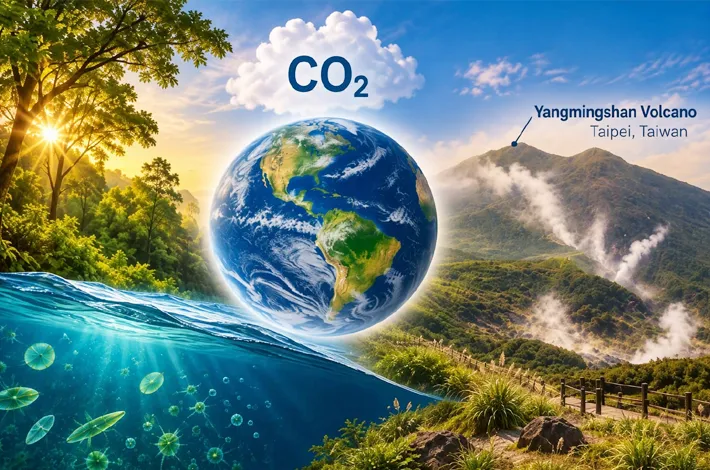
For millions of years, carbon has circulated continuously among the atmosphere, oceans, rocks, soils, living organisms. Oceans exchange carbon dioxide with the atmosphere, while volcanoes release it from deep within the Earth. Underneath the ocean surface, microscopic phytoplankton, algae, and photosynthetic bacteria absorb carbon dioxide and release oxygen to maintain atmospheric balance, like terrestrial plants.
Plants during photosynthesis, convert sunlight, water, and CO₂ into carbohydrates that store solar energy as chemical energy. Humans and animals depend on this process, consuming oxygen and releasing carbon dioxide through respiration. This continuous exchange forms one of the most fundamental relationships that sustain life on Earth.
In the eighteenth century, the French chemist Antoine Lavoisier, conducted a scientific experiment on respiration. He placed a guinea pig inside an insulated ice calorimeter and measured the air entering and leaving the chamber. He observed that oxygen was consumed, carbon dioxide was produced, and sufficient heat was generated to melt a measurable amount of ice. Curious to know more, he repeated the experiment with a smouldering piece of charcoal and obtained similar results: oxygen was consumed, carbon dioxide was released, and heat was produced.
From these observations, Lavoisier concluded that respiration is essentially a slow form of combustion. More than two centuries later, biochemist Nick Lane summarized this elegantly: “In the end, respiration and burning are equivalent; the slight delay in the middle is what we know as life.” Lavoisier's work transformed chemistry from a qualitative to a quantitative science.
Tragically, he was executed during the French Revolution at the age of fifty and officially declared innocent a year later. He pioneered early quality-control methods, including standardizing moisture content in tobacco to improve flavour and shelf life.
Industrialisation dramatically altered the carbon cycle. James Watt’s improved steam engine enabled humans to harness energy stored in plant matter as coal. Fossil fuels powered factories, transport and economic growth, rapidly releasing carbon locked underground for millions of years into the atmosphere.
Natural sources also emit carbon dioxide. Volcanoes release it through eruptions, vents, hot springs, soils and volcanic lakes. However, global volcanic emissions are estimated at just 0.3 gigatons of CO₂ annually, far below the more than 35 gigatons released yearly through human activities.
This reminds me of my visit to Yangmingshan National Park near Taipei, Taiwan, in the Datun Volcano Group. Its hot springs, fumaroles and scenic trails showcase a dormant yet geothermally active landscape. The region also demonstrates how geothermal resources can support sustainable energy development.
Carbon dioxide plays another vital role through the natural greenhouse effect, maintaining Earth's habitable temperature. Without greenhouse gases, our planet would be much colder and life as we know it would not exist. The problem is not CO₂ itself but its rapid increase due to human activities.
Like water and fire, carbon dioxide is neither inherently good nor bad. Understanding its benefits and risks requires evidence, context and balance rather than slogans.

-(Dr Swarnabala Ganti is a seasoned chemist & regulatory affairs specialist. She is consultant at Swaram Biochem, AgriLife India & Som Phytopharma)