26 July, 2026 | 12:17 AM


Bhatti bets big with Rs 3.24 lakh cr plan
21-03-2026 12:00:00 AM
- 5 lakh life insurance coverage to 1.15 crore families starting June
- Rs 50,713 crore has been earmarked for the govt’s flagship six guarantees
- The budget projects a total revenue expenditure of Rs. 2.34 Lakh crore and capital expenditure of Rs. 47,267cr
- Public debt is estimated at 5.62 lakh crore, accounting for 29% of GSDP
Deputy Chief Minister and Finance Minister Mallu Bhatti Vikramarka on Friday presented the Telangana State Budget for the financial year 2026 to 27 in the Legislative Assembly, proposing a total outlay of Rs 3,24,234 crore. The budget reflects a calibrated approach aimed at balancing welfare commitments with fiscal prudence while sustaining economic growth.
The total expenditure includes Rs2,34,406 crore towards revenue expenditure and Rs47,267 crore for capital expenditure. Emphasising responsible governance, the Finance Minister stated that the budget ensures continuity of welfare and development programmes without imposing additional financial burdens on citizens.
Focus on Welfare and Inclusive Growth
The budget places strong emphasis on welfare initiatives, social justice, and inclusive development. A significant allocation of Rs 50,713 crore has been earmarked for the government’s flagship Six Guarantees.
One of the most notable announcements is the launch of the Indiramma Family Life Insurance Scheme, which will provide Rs 5 lakh life insurance coverage to 1.15 crore families starting June 2026. Additionally, Rs 5,800 crore has been allocated for the Rajiv Yuva Vikasam scheme to promote self employment among youth from SC, ST, BC, and minority communities.
In the education sector, the government proposed extending the midday meal scheme to Intermediate students, modernising hostel kitchens with Rs 100 crore, and allocating Rs 1,000 crore for infrastructure development at Osmania University. Plans are also underway to upgrade government schools into Telangana Public Schools with modern facilities.
Social welfare continues to be a priority with substantial allocations including Rs 11,784 crore for SC welfare, Rs 7,937 crore for ST welfare, Rs 3,769 crore each for BC and minority welfare, and Rs 14,861 crore for pensions under the Cheyutha scheme.
Sectoral Allocations and Infrastructure Push
The budget outlines significant investments across key sectors to drive growth and development. Panchayat Raj and Rural Development received the highest allocation of Rs 33,688 crore, followed by education at Rs 26,674 crore and agriculture at Rs 23,179 crore.
Irrigation was allocated Rs 22,615 crore, energy Rs 21,285 crore, and Municipal Administration and Urban Development Rs 17,907 crore. The Medical and Health sector received Rs 13,679 crore, while the Roads and Buildings department was allocated Rs 12,789 crore.
The government also prioritised infrastructure projects such as the Hyderabad Metro Rail expansion and Musi Riverfront development. Housing received Rs 7,430 crore, while industries and IT sectors were allocated Rs 3,490 crore and Rs 875 crore respectively.
Strong Economic Indicators and Fiscal Outlook Highlighting Telangana’s economic strength, Bhatti Vikramarka noted that the state’s Gross State Domestic Product for 2025 to 26 is estimated at Rs 17,82,198 crore, registering a growth rate of 10.7 percent, significantly higher than the national growth rate of 8 percent.
The state contributes 5 percent to the national GDP, reinforcing its role as a major growth engine. Telangana’s per capita income stood at Rs 4,18,931, nearly 1.9 times higher than the national average.
Despite financial pressures, the state has projected a fiscal deficit of Rs 58,458 crore while maintaining a revenue surplus of Rs 6,857 crore. Public debt is estimated at Rs 5.62 lakh crore, accounting for 29 percent of GSDP.
The Finance Minister asserted that Telangana’s consistent growth trajectory reflects the effectiveness of government policies and its commitment to sustainable and inclusive development.
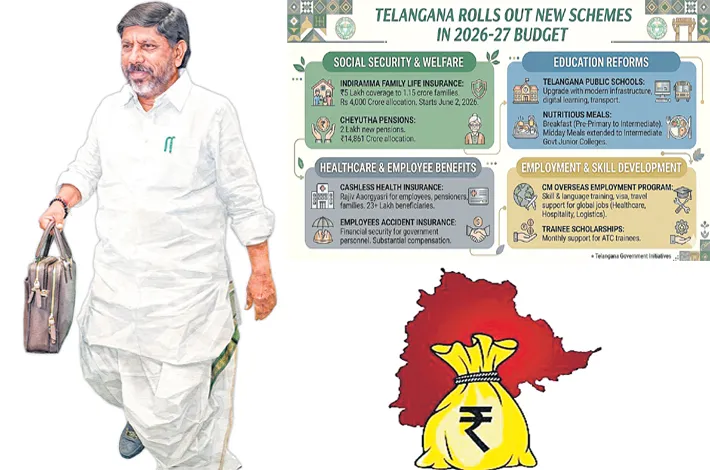
Telangana rolls out New Schemes in 2026 Budget
The Telangana Government, in its Annual Budget for 2026 to 27, has introduced a comprehensive set of new Welfare and Development initiatives aimed at strengthening social security, education, healthcare and employment opportunities across the state.
A major highlight is the Indiramma Family Life Insurance Scheme, which will provide life insurance coverage of Rs 5 lakh to 1.15 crore families irrespective of economic status. The scheme will be launched on June 2, 2026, with a proposed allocation of Rs 4,000 crore.
Under the Cheyutha Scheme, 2 lakh new pensions will be sanctioned to eligible beneficiaries, supported by an allocation of Rs 14,861 crore, reinforcing the government’s commitment to social welfare.
In the education sector, selected government institutions will be upgraded into Telangana Public Schools with modern infrastructure, digital learning facilities and transport support, catering to around 1,500 students per school. Additionally, a breakfast scheme will be introduced for students from pre primary to intermediate level, ensuring nutritious intake. The midday meal scheme has also been extended to intermediate students in government junior colleges.
Healthcare initiatives include a cashless Health Insurance scheme for employees, pensioners and their families, covering over 23 lakh beneficiaries through the Rajiv Aarogyasri Trust. Alongside this, a first-of-its-kind Employees Accident Insurance Scheme offers substantial compensation and insurance coverage, enhancing financial security for government personnel.
To promote global employment opportunities, the CM Overseas Employment Program will provide skill and language training, visa assistance and travel support, enabling youth to secure jobs in sectors such as healthcare, hospitality and logistics. Further, trainees in ATCs will receive a monthly scholarship to support skill development.Deputy CM Bhatti Vikramarka stated that these initiatives reflect a balanced approach towards inclusive growth, focusing on welfare, human capital development and economic empowerment.