13 September, 2026 | 8:05 AM


Why India needs sovereign AI
21-02-2026 12:00:00 AM
Metro India News | DELHI
India's push for sovereign AI took center stage at the ongoing India AI Impact Summit 2026 in New Delhi, where Union Minister for Electronics and Information Technology Ashwini Vaishnaw emphasized building homegrown artificial intelligence systems to ensure data security, transparency, and national control. Sovereign AI, as defined in discussions at the summit, refers to AI models developed, trained on Indian datasets, hosted on domestic servers, and governed under Indian laws—addressing risks associated with over-reliance on foreign platforms like ChatGPT and other global generative AI tools.
Vaishnaw highlighted that India has already launched its own sovereign AI models, which he stated are performing at par with—or in some cases surpassing—global giants on relevant benchmarks, particularly in handling Indian languages, culture, and context. These models mitigate issues such as hallucinations or inaccuracies that can arise when AI lacks local training data. The minister announced plans under the IndiaAI Mission 2.0 to scale up large infrastructure, including additional compute resources like GPUs, to make these sovereign models widely accessible and democratize AI benefits across the population.
A key highlight of the summit was the unveiling of several homegrown sovereign AI models by selected organizations. Twelve organizations and consortia—including startups, industry players, and academic institutions—have been chosen to develop large and small language models trained on Indian datasets. Prominent among them are Sarvam AI, the IIT Bombay-led BharatGen consortium, Gnani.ai, Fractal Analytics, and Tech Mahindra, alongside others such as Soket AI, Gan AI, Avatar AI, GenLoop, Zentieq, Intellihealth, and Shodh AI.
Notable launches include:
Sarvam AI, which introduced advanced large language models (including a flagship 105-billion-parameter model and a 30-billion-parameter variant) trained entirely in India. These models excel in Indian languages, with strong performance in reasoning, instruction-following, document processing, optical character recognition (OCR), and multilingual speech tasks—often outperforming global competitors like DeepSeek R1 and Google's Gemini Flash on specific benchmarks tailored to Indic contexts
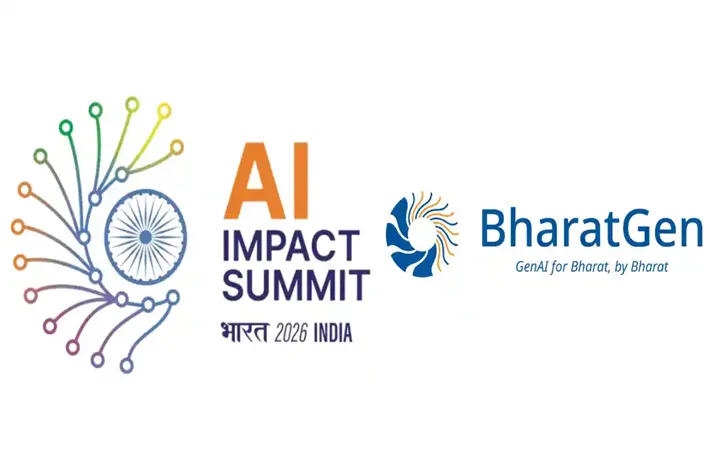
Gnani.ai, which rolled out voice-focused models, such as the Vachana text-to-speech system capable of cloning human voices across multiple Indian languages. BharatGen (led by IIT Bombay), which unveiled the Param2 17B Mixture-of-Experts (MoE) multilingual foundational model, designed to reflect India's linguistic and societal diversity for applications in public services, agriculture, security, and cultural preservation.
Beyond software, sovereign AI encompasses the full domestic stack: local data centers, indigenous hardware, secure cloud platforms, and independent computing power to reduce foreign dependencies. With billions in planned investments, massive infrastructure commitments (including over $250 billion in AI-related infra pledges announced at the summit), and expanding GPU access under the IndiaAI Mission, India's sovereign AI ecosystem is gaining momentum.
The summit, held from February 16-20, 2026, at Bharat Mandapam, has drawn participation from over 100 countries and positioned India as a leader in inclusive, multilingual, and frugal AI development for the Global South. Outcomes include the "New Delhi Frontier AI Commitments" and a forthcoming "Delhi Declaration" on responsible AI, underscoring the nation's ambition to transition from AI consumer to creator while prioritizing sovereignty and scalability.