29 July, 2026 | 2:17 AM


Who is afraid of Cockroaches?
22-05-2026 12:00:00 AM
How a Supreme Court Remark Sparked India’s Viral Satirical Political Movement
V J M Divakar
In the span of just five days, a single judicial remark has transformed into one of the most extraordinary digital phenomena in recent Indian political history. The Cockroach Janata Party (CJP), a tongue-in-cheek satirical movement founded on May 16, has captivated millions of primarily young Indians, amassing over 10 million followers on Instagram—surpassing the official Bharatiya Janata Party’s count on the platform—and drawing tens of thousands of sign-ups through a simple Google form.
The spark was a comment by Chief Justice of India Surya Kant on May 15 during a Supreme Court hearing involving issues of fake degrees and professional misconduct. According to reports of his oral observations, the CJI likened certain “youngsters” who fail to find employment or professional footing to “cockroaches” and “parasites,” suggesting they turn to social media, journalism, or activism to “attack the system.” He later clarified that his remarks targeted individuals entering professions with forged qualifications, not India’s youth at large, and expressed pain over media misquotations while affirming pride in the country’s young generation.
For 30-year-old Abhijeet Dipke, a public relations student at Boston University and former social media volunteer for the Aam Aadmi Party (AAP) from 2020 to 2023, the moment demanded a response. “I woke up from uneasy dreams one morning and found myself transformed into a ‘gigantic cockroach’,” he quipped, echoing Kafka while channeling widespread frustration. The very next day, Dipke launched the Cockroach Janata Party as a playful yet pointed protest.
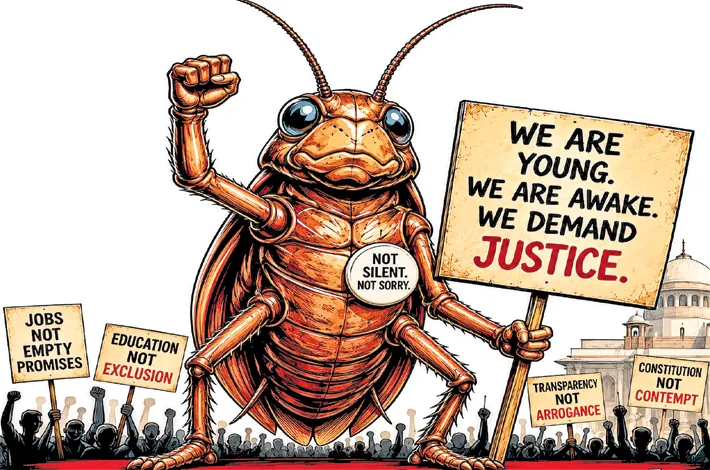
The movement’s website, social media handles, and manifesto embraced the insult with defiant humor. Eligibility criteria for membership? Unemployed, lazy, chronically online, and skilled at professional ranting. Its ideology blends political satire, youth rights, anti-establishment critique, secularism, and socialism. The name itself is a cheeky riff on the ruling BJP—“Janta” meaning “people.” The mascot: a resilient cockroach.
Dipke’s timing was impeccable. India’s youth grapple with stubborn unemployment rates, repeated examination scandals like NEET-UG leaks, rising costs of living, and a perception that institutions sometimes dismiss their struggles. Reclaiming “cockroach” as a badge of honor turned collective irritation into shareable empowe- rment. Memes proliferated overnight: cockroaches in suits, protest imagery, and slogans like “We never go away! Spray us, crush us, flush us down—we come back the very next day!”
The growth has been meteoric. Within days, CJP’s Instagram crossed 10.1 million followers, outpacing the BJP’s 8.7 million. Thousands signed up via the party’s registration form. Opposition voices and cultural figures amplified the buzz. Trinamool Congress MP Mahua Moi-tra cheered its rise, while actor Prakash Raj joked about a future “match on” with the “Bigots Janata Party.” Even a counter-satire, the “Indian National Cockroaches,” eme- rged, underscoring the format’s appeal.
The manifesto mixes serious policy ideas with satire. It demands world-class free education and healthcare, media reforms to curb cronyism (targeting industrialist influence), a 50% women’s reservation in Parliament, an end to cushy post-retirement jobs for judges, and a focus on genuine productivity rather than electoral freebies. “This is the voice of the lazy & unemployed,” the platform declares, positioning itself as a digital-native counter to traditional politics.
Still, beneath the memes lies genuine discontent. Many young Indians see the CJP as validation of their lived experiences—job market rejection, educational stress, and a feeling that elite discourse dismisses them as pests rather than stakeholders in “Viksit Bharat.” Dipke, who was job-hunting in Boston before the frenzy, has told interviewers the project began as satire but has acquired a momentum of its own. In one conversation, he hinted it might evolve beyond a joke.
Political analysts are divided on its longevity. As a registered electoral party, CJP faces steep odds. It lacks organizational structure, grassroots cadre, funding transparency, or regional roots in a system dominated by established players with deep resources. India’s Election Commission registration, symbol allotment, and ground-level campaigning require far more than viral clout.
As a cultural and pressure movement, however, its influence is already evident. It has dominated social media discourse, forced conversations on youth unemployment and institutional language, and demonstrated Gen Z’s power to reshape narratives. Similar hashtag-driven protests have influenced policy or voter sentiment in the past; CJP could pressure mainstream parties to court young voters more seriously or inspire hybrid digital-offline activism.
Critics have raised flags. Some allege bot-driven growth, links to opposition ecosystems given Dipke’s AAP past, or the appearance of problematic symbols (like Pakistani flags) in follower comments—claims the founder has brushed aside. Others worry that sustained momentum requires translating online energy into real-world impact before the novelty fades or accounts face moderation.
For now, the “cockroaches” are thriving. In a country where politics increasingly plays out on smartphones, a movement born from one ill-fated metaphor has reminded everyone of an old truth: resilience is a survival skill, and humor can be the sharpest form of resistance.
Abhijeet Dipke, once just another PR graduate navigating the job market, now leads a phenomenon that has India talking. Whether CJP remains a brilliant meme or seeds something more enduring will depend on its ability to move from viral outrage to structured vision. In the meantime, India’s youth have found a new, unlikely rallying cry: “We are the cockroaches—and we are not going away.”
The Fallout
The account, @CJP_2029, now displays a notice stating it has been “withheld in India in response to a legal demand.” Users in the country see the restriction, while the page remains potentially accessible via VPNs or from abroad. Founder Abhijeet Dipke (also referred to as Abhijit Divekar) confirmed the development on Instagram, calling it “as expected” and sharing screenshots of the blocked profile. Supporters quickly created alternative handles, including @Cockroachisback, with the defiant message that “cockroaches don’t die easily.”
Since today, the entire Godi Media is now suddenly talking about the Cockroach Janata Party.
In this New India, where Godi Media is 100% enslaved by ruling regime and every post, every interview, every coverage is carefully screened by the Big Man's team personally, it's obvious the CJP is a regime prop.
Via Kejri and his chaps.
Indian Godi Media talking in glowing terms about an infant formation that is challenging the regime means only one thing: they want it to happen. Else, all handles would be deleted, promoters arrested and negative stories run 24x7. That is how New India operates.
Sandeep Manudhane @sandeep_PT