10 October, 2026 | 1:36 AM


When scientists became their own subjects
10-10-2026 12:00:00 AM
Science Corner
In the history of medicine, most important developments have come from scientists who were willing to take personal risks. They tested new ideas on themselves or performed hazardous experiments to prove their theories, much before modern research ethics and safety regulations came into force.
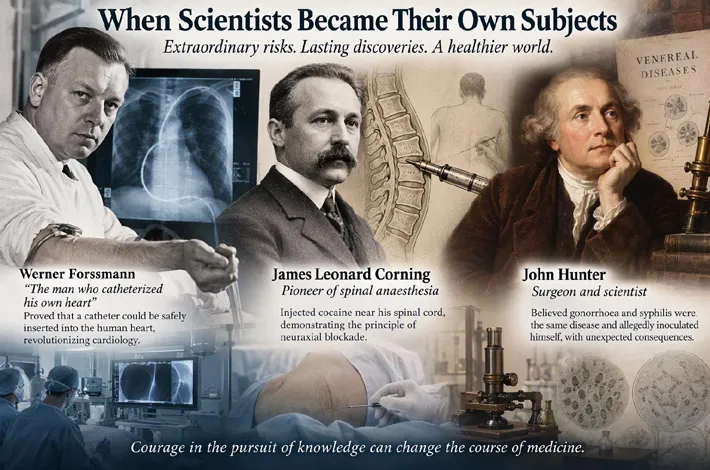
German physician Werner Forssmann catheterized his own heart, a bold self-experiment changed the course of cardiology. During early 1900’s, doctors believed that introducing a catheter directly into the human heart would certainly be fatal. He disagreed and believed that a catheter could be safely inserted into the heart. It can also be used to deliver drugs, inject contrast dyes, or measure blood pressure. To prove his idea, he performed an experiment on himself. He administered local anaesthesia to his arm, inserted a urinary catheter into a vein and carefully pushed it forward toward his heart. With the help of fluoroscopic X-ray, he skilfully inserted the catheter approximately sixty centimetres till it reached the right side of his heart. The X-ray image is the first evidence for safe administration in humans.
Although the experiment was a success, his superiors were angered because he did this without authorization, his career suffered setbacks, and was forced to leave positions at several hospitals. It led him to abandon cardiology, and he later specialized in urology. However, the significance of his discovery became clear over time. Cardiac catheterization revolutionized the diagnosis and treatment of heart disease and modern cardiology. In recognition of this achievement, he shared the 1956 Nobel Prize in Physiology or Medicine with André Cournand and Dickinson Richards. This self-experiment remains the most dramatic examples of scientific courage demonstrating a procedure that saved millions of patients in the world.
James Leonard Corningan American neurologist, is the pioneer for conducting the earliest experiments that led to the development of spinal and epidural anaesthesia. When cocaine was the only available local anaesthetic, he thought that it could be used to block nerve transmission near the spinal cord. He injected cocaine between the vertebrae, producing reduced sensation in the lower body.
He believed that the cocaine reached the spinal cord through blood vessels. Although this explanation was later found to be incorrect, his experiments demonstrated the principle of neuraxial blockade and showed that pain sensation could be interrupted through injections near the spinal cord. His investigations helped the later physicians, particularly August Bier, who developed modern spinal anaesthesia.
John Hunter was a Scottishsurgeon, a most distinguished scientist, an early advocate of careful observation and scientific methods, was considered the leading authority on venereal diseases, and believed that gonorrhoea and syphilis were caused by a single pathogen. A persistent historical anecdote claims that he inoculated himself with gonorrhoealpus from a patient in an attempt to study the disease, but because the source patient was coinfected and so, also contracted syphilis, then he claimed it proved his erroneous theory that they were the same underlying venereal disease and his theory was proved fifty-one years later through research by French physician Philippe Ricord.
Their discoveries transformed medicine, leading to techniques that are now routinely used in hospitals around the world. Today, strict ethical standards protect research participants, and such dangerous self-experimentation is no longer considered necessary. Nevertheless, the achievements of Forssmann, Corning and Hunter remind us that many medical breakthroughs were made possible by individuals willing to challenge accepted beliefs and accept personal risks in the pursuit of knowledge.

(Dr Swarnabala Ganti is a seasoned chemist, regulatory affairs specialist and R&D scientist across, India, Japan, Taiwan and Iran. A Consultant at Swaram Biochem, Agrilife India & Som Phytopharma.)