22 October, 2026 | 1:08 AM


Viksit Bharat banking panel to build 2047 financial architecture
18-08-2026 12:00:00 AM
REFORM BLUEPRINT BECKONS | Public lenders gear up for growth push
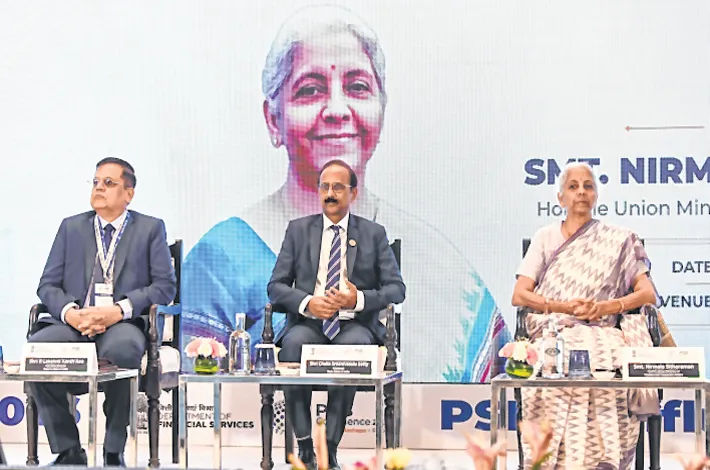
Finance Minister Nirmala Sitharaman on Monday said the government would soon constitute a high-level panel on Banking for Viksit Bharat to draw up a blueprint to create lenders capable of meeting the financing needs of a developed India.
In this year's Budget, the finance minister had proposed a high-level committee on Banking for Viksit Bharat to comprehensively review the sector and align it with India's next phase of growth.
Addressing the two-day Public Sector Bank Confluence, Sitharaman stated that the intensive discussions come at a time when the announcement regarding the high-powered committee is expected soon. She expressed hope that deliberations at the meeting would provide substantive material for the committee. Emphasising that the Viksit Bharat goal of 2047 is not too far away, she noted that non-performing assets are at the lowest level ever seen in Indian banking, providing an ideal position of strength to undertake reforms.
Financial Services Secretary Sanjay Lohia stated that it is imperative for public sector banks to sustain momentum amidst sharpening competition. The two-day deliberation focuses on seven key themes, including deposit mobilisation, banking for youth, supporting the investment cycle, and priority sector lending. The conference brings together approximately 125 participants, including heads of public sector banks and financial institutions.
‘NPA is at the lowest ever Indian banking has seen’
Sitharaman on Monday declared that non-performing assets in Indian banking have fallen to their lowest level, telling public sector bank chiefs at the inaugural session of PSB Confluence 2026 that lenders are now in their strongest position to drive reform.
She stated that the Department of Financial Services had prepared detailed research documents on all seven themes chosen for discussion.
The minister explained that the seven papers, shared in advance with participants, drew on global best practices and were meant to be studied closely so that deliberations could yield concrete, actionable ideas rather than broad statements of intent. "Workable," she stated, "because you have given the ideas you're the ones who are going to take it forward."
Referring to the sharp decline in non-performing assets, she noted that banks have earned credibility through a difficult clean-up process and are now positioned to embrace reform from a place of strength rather than crisis management. The seven themes selected for discussion at the confluence are deposit mobilisation, banking for youth, supporting the investment cycle, global capability centres, agriculture and horticulture value chain infrastructure, priority sector lending, and reimagining the credit card business.