2 June, 2026 | 7:10 AM


Uproar over journalist accreditation norms
12-02-2026 12:00:00 AM
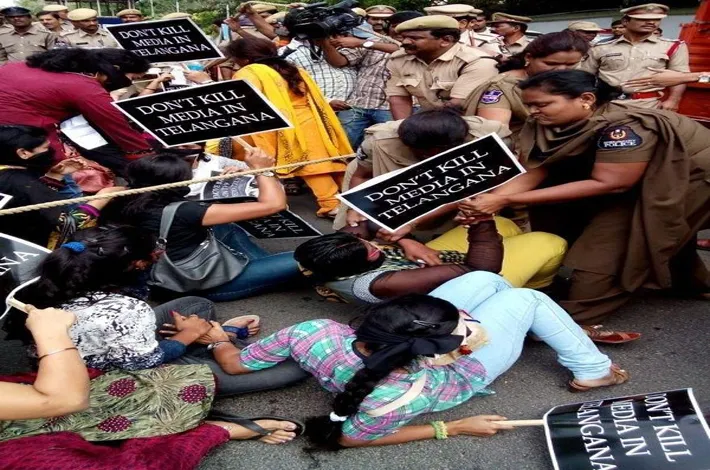
The Congress government, which often brands itself as a “people’s government,” appears to have overlooked the welfare of journalists who act as the bridge between the public and the administration. Across the state, over 15,000 journalists are required to renew their accreditation (journalist identity cards) every two years. However, the recently issued guidelines for issuing these cards are widely criticized for favoring only a few big newspapers, benefiting senior journalists working there, while sidelining those in smaller and mid-level publications.
This issue came to a head on Tuesday, when several journalists protested at the office of the Commissioner of Information and Public Relations (I&PR). Additionally, a petition has been filed in the High Court challenging Government Order (GO) 252 issued on December 22 last year. Journalist associations point to this as an example of systemic discrimination.
Journalists are, in essence, public servants. They work tirelessly without expecting rewards from either the government or the public. Accreditation is not merely a formality; it is the recognition of their role in society. Governments often include journalists in welfare schemes covering health policies and housing allocations. Yet, while the Supreme Court has made certain rulings on housing allotments, the benefits remain largely invisible. Chief Minister Revanth Reddy has promised housing allocations upon his return to office, while other leaders assure that the matter will be resolved soon. Meanwhile, accreditation has become mandatory to access any government office or meet officials, making the new guidelines a significant hurdle for many journalists.
The controversy raises the question: Whose welfare is being prioritized—the journalists’ or the big newspapers’? The I&PR department estimates that more than 15,000 people work across print, electronic, and digital media in the state. From the start, journalists have often been at odds with political leaders and public representatives. Reporting on corruption and irregularities exposes powerful interests, generating frustration among those in authority.
According to associations, the guidelines under GO 252 are heavily skewed toward four large newspapers and a few major channels, leaving mid-level and small newspaper journalists without proper accreditation. Amendments to the GO have been criticized as blatantly biased. Just like in large newspapers, mid and small newspapers also have reporters covering films, sports, and culture. Yet, the new rules deny these journalists recognition, highlighting the discriminatory approach.
The disparity extends to the number of accreditations issued. Guidelines allocate a large number of state, district, and mandal-level accreditations to big and medium newspapers based on circulation, while small and medium newspapers receive far fewer. Circulation has little impact on the workload or dedication of journalists, but the rules effectively penalize those working in smaller setups. Senior journalists who have shifted to smaller newspapers after decades of service are left struggling under these guidelines.
Newer newspapers also face exclusion. Guidelines issued in December 2025 make it nearly impossible for journalists from publications started in the past two to three years to obtain accreditation. Earlier rules from 2016 allowed the audit bureau circulation (ABC) certificate or IRS certificate, or a chartered accountant (CA) certificate for newer publications. The new guidelines remove the provision for CA certificates, effectively blocking journalists from newspapers like Vijayakranti and Telugu Prabha. Adding to the challenge, PRGI and RNI certificate applications are accepted only once a year in March, with verification completed by May-June. With applications being demanded by the end of February, journalists in many publications risk being left without accreditation.
Traditionally, even longstanding publications secured accreditation through CA certificates. Now, the government insists on ABC or PRGI/RNI certificates, leaving journalists in decades-old papers without cards. English-language journalists face similar obstacles.
Examining the new guidelines, it is clear they are designed to benefit only a few large newspapers. GOs classify publications with circulation above 75,001 as large, 25,001–75,000 as medium, and 2,000–25,000 as small. However, an annexure introduced a new category for circulation above 2.5 lakh, allowing them to hoard accreditations. Another category, 15,001–25,000, receives minimal accreditation.
As a result, journalists in small and medium newspapers across the state are being denied access, with nearly half of all journalists likely to remain unaccredited. Associations argue that the guidelines were crafted to favor a few major newspaper owners, treating journalists in smaller papers as if they are not legitimate. They demand that accreditation be granted based purely on professional credentials, regardless of the newspaper, ensuring fair recognition for all active journalists.