16 October, 2026 | 12:44 AM


Universities without Professors
16-10-2026 12:00:00 AM
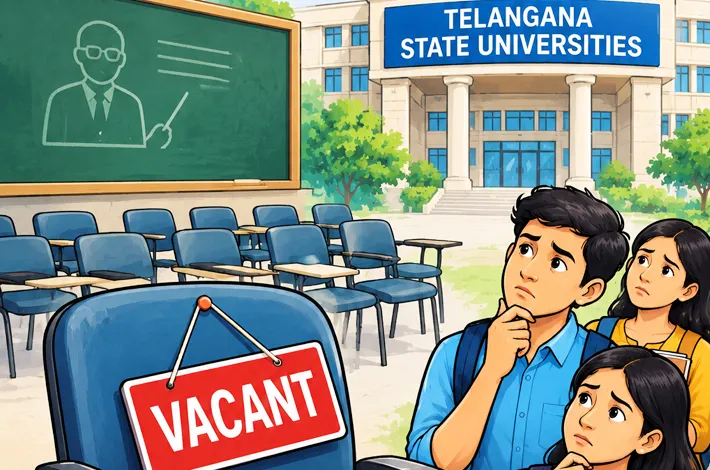
Telangana universities face 75% faculty vacancies due to limited recruitment
The shortage has reportedly affected performance in the National Institutional Ranking Framework (NIRF) and National Assessment and Accreditation Council (NAAC) evaluations, while concerns have also been raised over the declining rankings of state universities
metro india news I hyderabad
Despite more than 70% of teaching posts remain vacant across Telangana’s state universities, the government is yet to begin recruitment, even as it moves to streamline the selection process for Assistant Professors. While nearly 500 appointments had been proposed earlier this year, the latest data published in August 2026 highlights the continuing faculty crisis, with universities increasingly relying on temporary staff and facing disruptions to teaching and research.
There was a time when one had Professors specialising in each area, for instance in the realm of Political Science for instance- there were teachers for political Thought, Indian Government & Politics, Comparative Politics etc. these days contract lecturers are told to complete syllabus and take on more than one area.
Contract faculty
University recruitment has remained largely stalled for 13 years, leaving institutions heavily dependent on contract, part-time and guest faculty. The shortage has reportedly affected performance in the National Institutional Ranking Framework (NIRF) and National Assessment and Accreditation Council (NAAC) evaluations, while concerns have also been raised over the declining rankings of state universities. The previous BRS government had proposed filling approximately 1,060 vacancies, but the recruitment process did not progress.
K Avinash, teaches law in a private college in the city on a condition of anonymity said, “When we were studying in Osmania University contract lectures would plead us to get into class for proper strength so that they could take a class. The state of affairs is no better now.”
After coming to power, the Congress government turned its attention to university vacancies and issued new guidelines in April last year to facilitate Assistant Professor recruitment. However, nearly 1,200 contract and part-time faculty members demanded regularization before fresh appointments and launched protests. The government subsequently permitted recruitment for only 450 posts, with plans to set aside the positions held by existing contractual staff while filling other vacancies. The process nevertheless remained stalled.
The Education Department has now issued revised guidelines under Government Order No. 31, correcting shortcomings in GO No. 21 and aligning the recruitment rules with University Grants Commission (UGC) regulations. Meanwhile, contract faculty members are preparing to renew their agitation, demanding regularisation.
Osmania University has highest number of vacancies
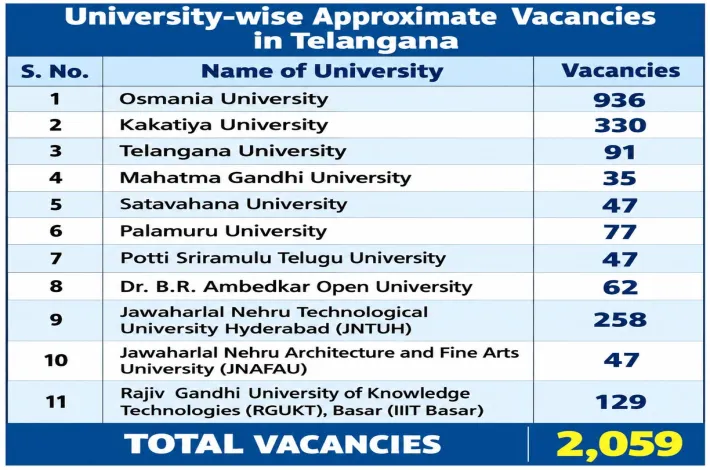
Osmania University has 936 vacancies against 1,267 sanctioned posts, with only 331 faculty members currently working. Kakatiya University has 330 vacancies out of 439 sanctioned posts, while Jawaharlal Nehru Technological University Hyderabad (JNTUH) has 258 vacancies against 410 posts. Other institutions are also facing significant shortages. Telangana University has 91 vacancies out of 152 sanctioned posts, while Mahatma Gandhi University has 35 vacancies against 70 posts. Satavahana University has 47 vacancies out of 63 posts, and Palamuru University has 77 vacancies against 95 sanctioned posts.
Potti Sriramulu Telugu University has 47 vacancies out of 55 posts, while Dr B.R. Ambedkar Open University has 62 vacancies against 86 sanctioned posts. The Jawaharlal Nehru Architecture and Fine Arts University (JNFAU) has 47 vacancies out of 61 posts, while Rajiv Gandhi University of Knowledge Technologies (RGUKT), Basara, has 129 vacancies against 148 sanctioned posts.
The proposed recruitment drive is expected to provide some relief, but the limited number of appointments compared with the overall vacancies has raised questions about whether the measures will be sufficient to address the long-standing faculty shortage.