16 September, 2026 | 1:41 PM


TELANGANA BUDGET 2026- SOCIAL ECONOMIC OUTLOOK
21-03-2026 12:00:00 AM
Macro Economic Trends
Telangana continues to exhibit robust economic performance, as outlined in the Socio Economic Outlook 2026. Gross State Domestic Product (GSDP) represents the aggregate monetary value of all final goods and services produced within the state's geographical boundaries over a year, without duplication. It serves as a critical indicator of economic health, capturing shifts in development across the primary (agriculture and allied), secondary (manufacturing and construction), and tertiary (services) sectors.
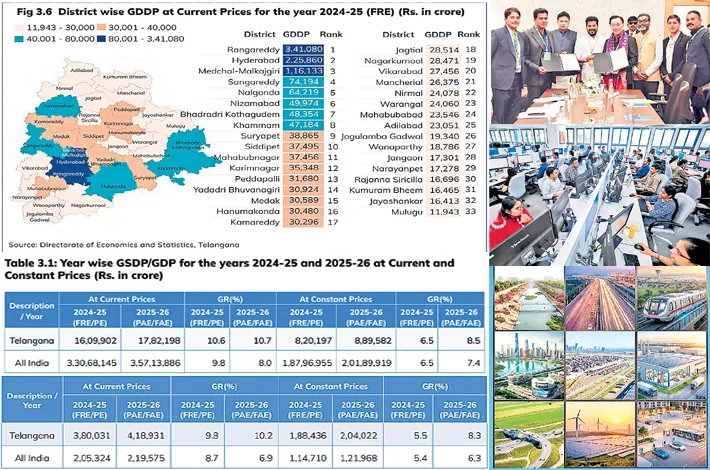
For the financial year 2025-26 (Provisional Advance Estimates, PAE), Telangana's GSDP at current prices is estimated at Rs. 17,82,198 crore, reflecting a solid growth of 10.7% over Rs. 16,09,902 crore in 2024-25 (First Revised Estimates, FRE). At constant prices (accounting for inflation), GSDP stands at Rs. 8,89,582 crore, registering an impressive 8.5% growth compared to Rs. 8,20,197 crore the previous year. In contrast, India's national GDP for 2025-26 (First Advance Estimates) is projected to grow at 8.0% at current prices and 7.4% at constant prices. These figures highlight Telangana's consistent outperformance relative to the national economy.
Per Capita Income (PCI), a vital measure of average living standards, further underscores this strength. At current prices, Telangana's PCI increased from Rs. 3,80,031 in 2024-25 to Rs. 4,18,931 in 2025-26, achieving a 10.2% growth rate. This is nearly double India's PCI of Rs. 2,19,575, which grew at 6.9%. At constant prices, Telangana's PCI rose 8.3% to Rs. 2,04,022, compared to the national 6.3% increase to Rs. 1,21,968. The state's PCI remains significantly higher than the national average, signaling better income levels and economic well-being for its residents.
The primary sector, though smaller in share, remains vital for rural livelihoods and food security. Its GSVA grew modestly by 1.4% to Rs. 2,49,691 crore. Within this, livestock holds the largest sub-sector share at 41.4%, followed by crops (38.2%), mining & quarrying (14.4%), fishing & aquaculture (3.1%), and forestry & logging (2.9%). Government initiatives—such as subsidized seeds, enhanced irrigation under schemes like Indira Solar Giri Jal Vikasam, 24×7 free power for agriculture, mechanization subsidies, soil health programs, and policies linking farming to food processing—have boosted productivity, reduced losses, and supported allied activities.
The secondary sector demonstrated strong momentum, with GSVA rising 9.4% to Rs. 2,68,325 crore. Manufacturing leads at 51.1%, construction at 34.8%, and electricity, gas, water supply & utilities at 14.1%. Supportive measures—including simplified approvals, financial incentives for MSMEs, development of industrial parks and pharma hubs, and increased infrastructure spending—have accelerated industrial activity and value addition.
The tertiary sector remains the primary growth driver, with GSVA reaching Rs. 11,30,596 crore at 13.5% growth. Key sub-sectors include real estate, ownership of dwellings & professional services (34.1%), trade, repair, hotels & restaurants (30.4%), transport, storage, communication & broadcasting (12.2%), other services (12.5%), financial services (7.3%), and public administration (3.5%). Hyderabad's role as an IT and startup hub, bolstered by initiatives like T-Hub, TASK, T-Works, skill development, digital infrastructure, tourism promotion, and ease-of-doing-business reforms (including streamlined regulations), continues to propel high-value services.
Economic activity remains concentrated in the Hyderabad metropolitan region. For 2024-25 (FRE), Rangareddy district tops Gross District Domestic Product (GDDP) at Rs. 3,41,080 crore, followed by Hyderabad (Rs. 2,25,860 crore) and Medchal-Malkajgiri (Rs. 1,16,133 crore), thanks to IT parks, pharma clusters, corporate offices, and superior infrastructure. District-level per capita income follows a similar pattern, with Rangareddy at Rs. 11,29,735, while several rural districts lag below Rs. 2,50,000, highlighting the need for balanced regional development.
Supporting indicators include low inflation—Telangana recorded just 0.2% in 2025-26 (vs. India's 1.7%), aided by stable food prices—and favorable employment trends from the Periodic Labour Force Survey (Oct-Dec 2025). The state's Labour Force Participation Rate stands at 60.7% (India: 55.8%), Worker Population Ratio at 57.0% (India: 53.1%), with notably higher female participation. Services employ 36.3% of the workforce (India: 32.8%), reflecting a more service-oriented structure.
INDUSTRIAL SECTOR
Telangana's industrial sector plays a pivotal role in driving economic growth, fostering value-added manufacturing, boosting exports, and generating employment through Micro, Small, and Medium Enterprises (MSMEs). It creates multiplier effects across sectors, curbs rural-urban migration, and elevates per capita incomes. Under the PURE (Peri-Urban Region) framework of the Telangana Rising 2047 vision, the state is advancing industrial expansion via 13 Strategic Industrial and Advanced Manufacturing Clusters (Bharat Industrial Parks) with plug-and-play infrastructure for high-tech sectors. Additionally, 10 compact, Net-Zero compliant transit-oriented townships promote "walk-to-work" models for the industrial workforce.
According to the Socio Economic Outlook 2026, Telangana's total Gross State Value Added (GSVA) at current prices for 2025-26 (Provisional Advance Estimates, PAE) is Rs. 16,48,613 crore, growing 10.8% over 2024-25 (First Revised Estimates). The industrial sector contributes Rs. 3,04,217 crore, or 18.5% of GSVA, with 8.1% growth from Rs. 2,81,411 crore. Manufacturing dominates at 45.1% (Rs. 1,37,229 crore), followed by construction (30.7%, Rs. 93,404 crore), electricity/gas/water/utilities (12.4%, Rs. 37,692 crore), and mining/quarrying (11.8%, Rs. 35,892 crore). Sub-sector growth includes construction at 11.4%, utilities at 10.8%, manufacturing at 7.7%, and mining at -0.6%.
Employment data from the Periodic Labour Force Survey (Oct-Dec 2025) shows 22.2% of persons aged 15+ engaged in industry under Current Weekly Status—17.7% rural and 30.2% urban. Gender balance is notable, with 21.9% male and 22.8% female participation, outperforming India's 24.0% overall (male 28.5%, female 14.2%), reflecting greater inclusivity in Telangana.
Key governance initiatives include the single-window approval system and infrastructure by Telangana Industrial Infrastructure Corporation Limited (TGIIC). The Factories Department oversees 21,436 registered factories employing 13,00,567 workers as of December 31, 2025, enforcing safety laws and achieving milestones like 1,558 plan approvals, 729 new licenses, and Rs. 20.91 crore revenue. Industrial concentration is highest in Medchal-Malkajgiri (4,095 factories, 2,96,037 employees), Sangareddy, and Rangareddy.
In 2025-26 (up to December), 1,457 manufacturing units received approvals with Rs. 7,338.42 crore investment and 36,919 jobs projected. Incentives under schemes like Telangana State Industrial Development and Entrepreneur Advancement sanctioned Rs. 600.33 crore for 1,857 claims, with targeted support for SC/ST/PHC entrepreneurs.
TGIIC allotted land to 998 units (over 2,195 acres) from December 2023-2025, attracting Rs. 88,534 crore investment and 75,008 jobs. High-investment allotments include Amazon Data Services (Rs. 39,532 crore) and others. Specialized parks span pharma, food processing, textiles, medical devices, electronics, and women's entrepreneurship facilities.
Awards include "Top Achiever" in BRAP 2024 and Swachh Industrial Park for Nacharam. Sectoral highlights include MSMEs under the 2024 Policy (40 interventions for land, finance, tech); Aerospace & Defence with SAFRAN-CFM LEAP MRO inauguration (world's largest), M88 MRO groundbreaking, Skyroot's private rocket launch, and exports surpassing pharma; handlooms/textiles with welfare schemes like Nethanna Podupu (Rs. 13.56 crore for 34,482 beneficiaries) and GI-tagged products; life sciences/pharma with Next-Gen Policy, BioAsia 2026, and major investments (Eli Lilly, etc.); electronics/semiconductors via Photonics Valley; automotive/EV with policy incentives and global outreach; food processing attracting Rs. 7,164 crore proposals; and mining with Rs. 3,205 crore revenue (up to Nov 2025).
The way forward aligns with the 2047 vision: shifting life sciences to value-led growth, aerospace hub status by 2027, top ESDM ranking, agri-food R&D boost, MSME parks, and smart mining. Telangana aims for a resilient, inclusive industrial powerhouse through innovation, sustainability, and equitable development.
INFRASTRUCTURE
Telangana's infrastructure development serves as a cornerstone for economic growth, social inclusion, and enhanced quality of life. Aligned with the Vision 2047 and the CURE–PURE–RARE framework, the state pursues balanced investments in energy, irrigation, transport, digital connectivity, and social infrastructure to foster resilient, inclusive, and regionally equitable progress. In the energy sector, Telangana ensures 24×7 reliable, cost-effective, and eco-friendly power supply.
Contracted power capacity rose from 20,191 MW in 2023-24 to 23,187 MW as of January 25, 2026, with renewables (including hydro) comprising 44.55% (10,329 MW), led by solar. TGGENCO's installed capacity surged 36% to 8,823 MW, driven by Yadadri Thermal Power Station units. Ongoing initiatives include pollution control equipment (FGD/ESPs) across plants (Rs. 6,604 crore investment) and solar additions (245 MW planned). SCCL diversifies into thermal, solar (504.5 MW planned), pumped storage, wind, green hydrogen, and critical minerals exploration.
Under the Clean & Green Energy Policy-2025, the state targets 20,000 MW renewables by 2030 and 40,000 MW by 2035, with net-zero by 2047 (90% renewables/storage). Welfare schemes like Gruha Jyothi (free 200 units/month, Rs. 3,901 crore subsidy) and free power to educational institutions (Rs. 181.68 crore) support households and priority sectors.Irrigation focuses on drought-prone and upland areas for agricultural productivity. Contemplated potential totals 127.69 lakh acres (71.9% major, 20.1% minor), with 74.51 lakh acres created. Major/medium projects (73 total) include 42 completed and 31 ongoing, such as Makthal-Narayanpet–Kodangal LIS.
Minor irrigation covers 44,032 tanks/anicuts, while IDC schemes (647) target 5.33 lakh acres. Groundwater assessment (2025) shows 7% improvement in recharge and extractable resources. Vision 2047 emphasizes efficient, sustainable delivery.Transport infrastructure enhances mobility and connectivity. Road length reaches 1,29,017 km (2024-25), with 74.5% all-weather (excluding NH). National Highways saw Rs. 11,558 crore sanctions and 861 km completed (Rs. 15,564 crore expenditure). State roads received Rs. 7,327 crore for 1,720 km. Rural roads under PMGSY and HAM cover extensive upgradation.
The Regional Ring Road (RRR) advances, with Northern Part (161.52 km) under bidding. TGSRTC operates 9,990 buses (35.06 lakh km/day, 62.26 lakh passengers/day). Maha Lakshmi Scheme enabled 269.68 crore free women trips (Rs. 9,222 crore savings). Electric buses total 875 operational, with 2,800 more planned. Metro Phase II (162.5 km, Rs. 43,848 crore) is proposed. Vehicle population grew 5.9% to 1.81 crore (Dec 2025), with EV incentives boosting penetration. Aviation includes RGIA (2.9 crore passengers, 2024-25) and six new airports in planning.
Vision 2047 targets integrated road-rail-logistics, zero-emission mobility, and 90% area within 10 km of highways.Digital connectivity expands via T-Fiber (424 Mandals, 8,895 Gram Panchayats connected). Telephone subscriptions reached 42.16 million (Sep 2025), with wireless teledensity at 105.57 (above national average). Internet subscriptions hit 37.25 million (98.71% broadband). Public Wi-Fi includes 3,828 hotspots.Social infrastructure advances include 39,500+ schools, new universities (Young India Skills, Earth Sciences, Physical Education), and AAPC-led school maintenance (Rs. 706 crore).
Health investments (Rs. 10,937 crore) cover Warangal Health City, TIMS expansions, and 17 medical colleges. Judicial projects include New High Court Complex (Rs. 2,583 crore) and 12 district court complexes (Rs. 972 crore).The way forward prioritizes integrated, sustainable infrastructure under CURE–PURE–RARE: clean energy dominance, efficient irrigation, seamless multimodal transport, universal digital access, and robust social facilities to realize the $3 trillion economy vision by 2047.
SERVICES SECTOR
Telangana has solidified its status as a dynamic, high-productivity services hub, with the sector dominating the state's economy. As per the Socio Economic Outlook 2026, the services sector contributes Rs. 11,30,596 crore to Gross State Value Added (GSVA) in 2025-26 (Provisional Advance Estimates, PAE), accounting for 68.6% of the total GSVA of Rs. 16,48,613 crore. This marks a significant increase from Rs. 9,96,293 crore in 2024-25 (First Revised Estimates), reflecting robust expansion.
The sector achieved the highest growth rate of 13.5% in 2025-26, outpacing primary and secondary sectors, and serves as the principal driver of Telangana's economic momentum. According to NITI Aayog’s report on India’s Services Sector (2025), Telangana—along with Karnataka, Maharashtra, and Tamil Nadu—accounts for nearly 40% of India’s total services output, fueled by high-productivity areas like Information Technology (IT), finance, and professional services.
Employment trends from the Periodic Labour Force Survey (PLFS) Quarterly Bulletin (Oct-Dec 2025) show the services sector engaging 36.3% of the workforce aged 15+ under Current Weekly Status—higher than India's 32.8%. Urban areas lead at 64.9% (India: 61.9%), while rural stands at 19.7% (India: 20.6%). Gender patterns reveal Telangana's stronger inclusivity: overall male participation at 41.9% and female at 27.3%, with urban female engagement notably high at 64.5%.
Sub-sector contributions highlight diversification: Real Estate, Ownership of Dwellings, and Professional Services lead at 23.4% (Rs. 3,86,043 crore), followed by Trade, Repair, Hotels, and Restaurants (20.8%, Rs. 3,43,249 crore), Transport/Storage/Communication/Broadcasting (8.4%, Rs. 1,38,257 crore), Other Services (8.6%), Financial Services (5.0%), and Public Administration (2.4%).
Growth was led by Trade/Hotels/Restaurants (16.8%), Transport/Communication (14.1%), and Other Services (13.1%).IT and IT-enabled Services (ITeS) remain the cornerstone, with Hyderabad hosting over 1,500 companies. IT exports reached Rs. 3,12,941 crore in 2024-25, growing 16.6%. Employment in the sector stood at 9,39,054. Hyderabad has emerged as India's top Global Capability Centres (GCC) hub, attracting 41 new GCCs from January to November 2025 (46% of national additions). Major players include Vanguard, Eli Lilly, ZS, Medtronic, Amgen, and expansions by Uber, Cognizant, and others.
The state ranks fourth nationally in Generative AI startups, with about 7% of India's total as of H1 2025 (per NASSCOM), behind Karnataka (39%), Maharashtra (14%), and Delhi (9%). Micro, Small, and Medium Enterprises (MSMEs) in services dominate, with 13,74,100 units (79.8% of total 17,22,031 Udyam registrations as of Dec 22, 2025). Concentration is high in Hyderabad (2,38,879 units), Rangareddy (1,63,776), and Medchal-Malkajgiri (1,21,568), though diffusion is occurring in districts like Nalgonda and Karimnagar.Under Telangana Rising 2047, the vision targets a $3 trillion GSDP by 2047 (interim $1 trillion by 2034), with services projected to contribute ~$1.95 trillion.
The Core Urban Region Economy (CURE) within the 160-km Outer Ring Road will become a net-zero services metropolis focused on AI, cloud, DeepTech, and GCCs. Initiatives include the Telangana AI Hub, a 300-acre AI City in Bharat Future City, high-density GPU infrastructure, and supercomputing clusters. Decentralized IT/GCC expansion targets Tier-II cities, alongside skilling over 10 million in AI/digital skills, financial services, tourism (27 Special Tourism Areas), creative industries, and healthcare.
Government efforts bolster this through innovation ecosystems like Telangana Innovation Cell (supporting grassroots innovators, PwDs, and district hosts), T-Hub (world's largest startup facility, launching Google for Startups Hub), and Women Entrepreneurship Hub (197 programs in 2025, supporting 700+ women entrepreneurs). Skilling via Telangana Academy for Skills and Knowledge (TASK) benefited 66,333 students and achieved 5,637 placements. Digital infrastructure advances via T-Fiber connect rural areas, enabling AI labs and farmer advisories.
Awards include SKOCH Gold for ADeX and VanNetra, DigiTech for agriculture AI, and national recognition for TGDeX. Emerging tech pushes include Telangana Quantum Strategy (six pillars for research-to-commercialization) and AI pilots across departments. The way forward emphasizes services-led, inclusive growth: high-skilled jobs, infrastructure (15 million sq. ft. Grade-A office space by 2030), innovation zones, and balanced regional development to achieve the $3 trillion aspiration through technology-intensive, globally competitive activities.