23 October, 2026 | 4:11 AM


Rahul’s Women-Centric ‘Chhatron Ki Goonj’
24-08-2026 12:00:00 AM
Amplifying women’s voices across generations
metro india news I hyderabad
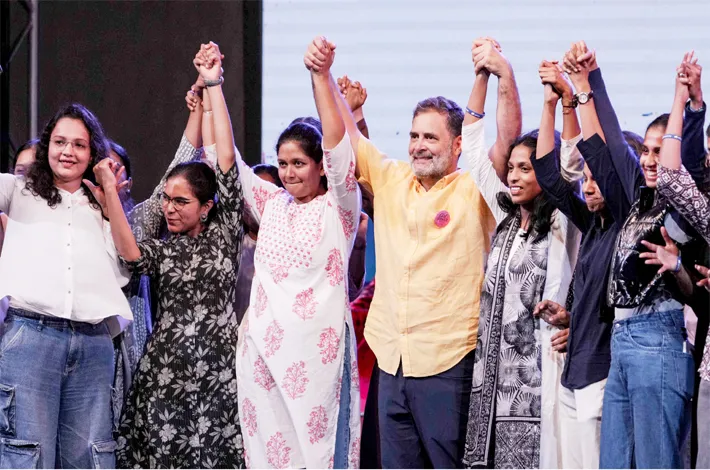
On Saturday, Congress leader and Leader of Opposition Rahul Gandhi held the Pune edition of his ‘Chhatron Ki Goonj’ (Voice of Students) campaign at the AISSMS/SSPMS College ground. Unlike previous legs in Kota, Dehradun and Prayagraj that drew mixed or predominantly male crowds, this event was deliberately designed as an exclusive platform for female students and young women.
Estimates put attendance between 8,000 and 15,000, with women dominating the audience. Gandhi’s address focused on patriarchy, women’s autonomy, safety, education barriers, paper leaks, fees and unemployment, while participants shared personal experiences of harassment and restricted opportunities.
The programme’s emphasis on “now the girls will speak, and the country will listen” and calls to “smash patriarchy” and “break the cage” created a resonant moment. Its potential lasting impact can be examined across generational lines—Baby Boomers, Millennials and Gen Z—by considering how the messaging intersects with each cohort’s lived experiences of gender norms, education and public life in India.
Gen Z: immediate resonance and agency
Gen Z women, largely in their late teens to 20s, formed the core of the Pune audience, creating a rare political space centred on their voices. Gandhi rejected traditional roles of daughter, wife and mother, urging women to “be loud, be proud and fight for your space.”
Participants highlighted harassment, safety concerns, parental restrictions on higher education, financial constraints and limited employment opportunities. Visually impaired students also raised accessibility and safety issues.
For a generation shaped by social media, student protests and growing awareness of gender inequality, the event reinforced collective agency. Its women-focused format could encourage campus organising, greater youth participation and challenges to restrictive norms. Politically, it may strengthen demands for safety, education, jobs and dignity.
Millennials: Bridging aspiration and reality
Millennial women, in their late 20s to mid-40s, have benefited from greater access to higher education and employment but continue to face safety concerns, wage gaps, household responsibilities and social pressures.
Software developers and UPSC aspirants highlighted limited job opportunities and societal restrictions on women’s choices. Gandhi’s call to “smash patriarchy” and his emphasis on identities beyond traditional family roles may resonate with women challenging conventional career and marriage expectations. The campaign could also encourage intergenerational mentoring and stronger demands for workplace safety, fair recruitment and economic opportunities.
Baby Boomers: Reflection and dialogue
Baby Boomer women, broadly in their 60s and older, grew up when gender roles were generally more rigid and educational and economic opportunities for women were more limited. Though not the primary audience in Pune, the campaign’s emphasis on autonomy and equality could prompt reflection on the progress made and the gaps that remain.
Many witnessed the expansion of women’s education, the women’s movement and legal reforms, while also seeing continuing concerns over safety and economic independence. Gandhi’s message could encourage older generations to reassess patriarchal attitudes within families and communities.
Its lasting effect may lie in intergenerational dialogue, with older women sharing experiences while supporting younger women’s aspirations for higher education, mobility and non-traditional careers. Such conversations could gradually influence family decision-making and attitudes towards women’s participation in public life.
Broader political and social impact
The Pune event unfolded amid political controversy, including police conditions, BJP allegations over audience mobilisation and an ABVP-NSUI clash. Yet its strong female turnout highlighted Congress’s effort to expand ‘Chhatron Ki Goonj’ from student issues to gender justice. Its impact will depend on sustained advocacy on education, recruitment, safety and employment. For Gen Z, it offers solidarity and agency; for Millennials, recognition of structural barriers; and for Baby Boomers, intergenerational dialogue. The campaign sought to place women’s voices at the centre of conversations on equality, opportunity and India’s future.
Rahul Gandhi’s recent Pune address, in which he called women India’s “biggest asset” and urged them to “smash the patriarchy,” has raised questions about Congress’s own record on women’s representation. Critics say the party must first put its own house in order.
In Congress-ruled Karnataka, Chief Minister D.K. Shivakumar’s expanded ministry has no women among its nearly 33 members, despite the constitutional ceiling of 34. MLC Gayathri Shanthegowda was reportedly considered for induction, but her swearing-in was deferred. Former Governor Margaret Alva expressed disappointment over the all-male cabinet.
Telangana presents a slightly better picture. Chief Minister A. Revanth Reddy’s 12-member cabinet includes two women—Konda Surekha and Dansari Anasuya Seethakka—accounting for about 16–17 percent.
Women have a somewhat stronger presence in the Congress Working Committee, with around 15 women among its 80-plus members. Yet key organisational and state-level positions remain largely male-dominated.
The contrast between Congress’s gender-equality rhetoric and its ministerial representation in Karnataka and Telangana highlights the gap between political messaging and power-sharing.
Opposition voices and even some Congress veterans have pointed out the gap: talking about empowerment is easy; sharing power is harder. Political observers note that genuine credibility on women’s issues requires visible action where the party holds office. Until more women occupy cabinet seats and core organisational posts in Congress-ruled states, the high-minded calls from the Gandhi siblings risk sounding like selective advocacy.
For a party that has historically produced India’s first woman Prime Minister and continues to demand 33 percent reservation, the current numbers in Karnataka and Telangana offer an uncomfortable mirror. Setting the house in order may be the most persuasive argument of all.