20 September, 2026 | 1:45 AM


Predictions That Came True
20-09-2026 12:00:00 AM
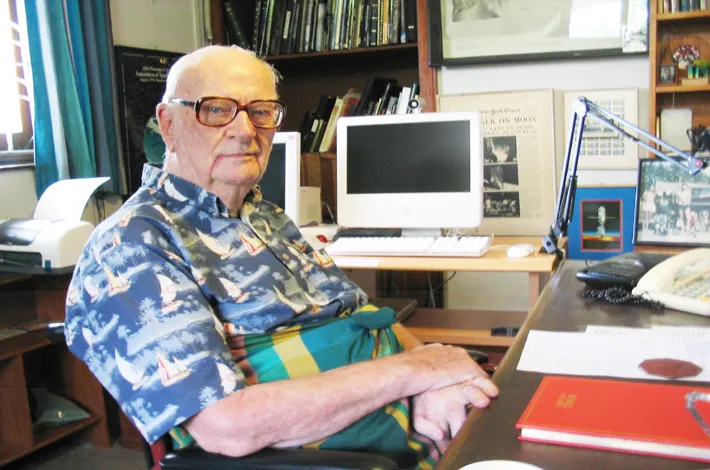
Arthur C. Clarke’s 1964 Vision
metro india news I hyderabad : In September 1964, science fiction writer and futurist Arthur C. Clarke sat before BBC cameras for an episode of Horizon titled “The Knowledge Explosion.” Filmed at the New York World’s Fair, Clarke delivered a calm, measured forecast of the decades ahead. “The only thing we can be sure of about the future is that it will be absolutely fantastic,” he said. “So if what I say now seems to you to be very reasonable, then I’ll fail completely.
Only if what I tell you appears absolutely unbelievable have you any chance of visualizing the future as it really will happen.”More than six decades later, a fresh wave of online interest—sparked by circulating clips of the interview—has prompted renewed appreciation for just how many of Clarke’s “unbelievable” predictions have become everyday reality.
While some of his ideas remain science fiction, several core insights about communication, work, medicine, and machine intelligence landed with startling precision.Clarke’s most accurate vision centered on the transformative power of electronics and satellites. He highlighted “particularly the transistor and, above all, the communication satellite.”
These, he said, would create “a world in which we can be in instant contact with each other wherever we may be, where we can contact our friends anywhere on Earth even if we don’t know their actual physical location.” In an era of fixed landlines and expensive international calls, the notion of location-independent connectivity sounded radical. Today it describes mobile phones, the internet, email, messaging apps, and global positioning systems.
By the 1990s and early 2000s, ordinary people carried devices that kept them reachable almost anywhere, often without needing to know a precise physical address—precisely the world Clarke sketched.From that foundation flowed his forecast of remote work. “It will be possible in that age, perhaps only fifty years from now, for a man to conduct his business from Tahiti or Bali just as well as he could from London,” Clarke declared. “In fact, if it proves worthwhile, almost any executive skill, any administrative skill, even any physical skill, could be made independent of distance.” He went further: “In fact, men will no longer commute, they will communicate.
They won’t have to travel for business anymore, they’ll only travel for pleasure.” The rise of personal computers, broadband, video conferencing, and cloud tools made distributed work feasible long before the COVID-19 pandemic forced a mass experiment. Digital nomads working from tropical islands, fully remote companies, and hybrid office cultures all echo Clarke’s 1964 language. While cities have not vanished, the traditional daily commute has been fundamentally disrupted for millions.Clarke’s medical prediction was equally bold.
“I am perfectly serious when I suggest that one day we may have brain surgeons in Edinburgh operating on patients in New Zealand.” Remote surgery, or telesurgery, moved from concept to reality in 2001 when a surgeon in New York performed a gallbladder removal on a patient in Strasbourg, France, using robotic systems and high-speed links.
Subsequent advances in telemedicine, robotic platforms, and low-latency networks have expanded remote diagnostics, consultations, and procedures, bringing specialist care across continents in ways that match Clarke’s example.Perhaps most striking in light of current technology is Clarke’s discussion of machine intelligence. He noted that the “most intelligent inhabitants of that future world won’t be men or monkeys. They’ll be machines.” Present-day electronic brains were “complete morons,” he said, but “this will not be true in another generation. They will start to think and eventually they will completely outthink their makers.” He framed the development as the beginning of “inorganic or mechanical evolution,” which would proceed far faster than biological change.
While full artificial general intelligence remains debated, the rapid progress of large language models, machine learning systems that outperform humans on specific complex tasks, and ongoing discussions about AI surpassing human capabilities align closely with the trajectory Clarke outlined.Clarke was not infallible. His suggestions of bioengineered intelligent animal servants, the complete obsolescence of cities, widespread suspended animation, and planetary engineering have not materialized on the timelines or in the forms he imagined. He also spoke in the gendered language of his era. Yet the accuracy of his core technological and social forecasts—global connectivity, location-independent work, remote medicine, and advancing machine intelligence—stands out.