29 September, 2026 | 1:07 AM


Poems across time One family three voices
29-09-2026 12:00:00 AM
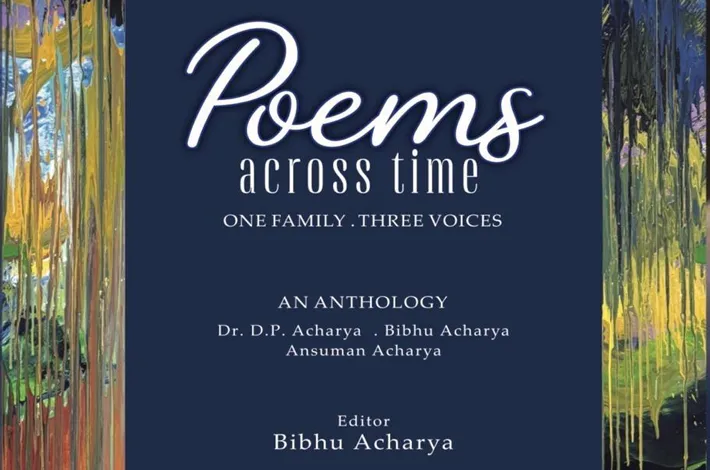
Metro India News | HYDERABAD : "Poems Across Time” is a collection of poems of three poets, two belong to one generation and the third belonging to the next-all from one family. While all three poets explore transforming personal condition into universal reflections, they differ significantly in emphasis. DP Acharya’s poems are while having traces of romanticism; he comes out as a spiritual lyricist exploring love, separation, and transcendence. Bibhu’s poems are more philosophical and reflective, concerned with the duty of professional life, aging, and unrealised ambition, and compromises in public life.
Anshuman’s is a younger voice with sensibility of a globe trotter. His poems combine travel, exile, ambition, self-discovery and gratitude. Together they form two generation’s and three individual’s introspection; romantic, existential and self -transformative. Debi Acharya’s poems are an intimate journey through love, longing, memory, and spiritual transcendence. ‘In Good Night’, ‘ The Void Ahead’ and ‘Telepathy,’ the telephone emerges as a poignant metaphor for connection across distance, simultaneously sustaining intimacy and intensifying loneliness.
Alongside this romantic perception runs a metaphysical quest. ‘The Ocean’, ‘The Awakening’ and ‘Om Tat sat’ invoke cosmic imagery and spiritual aspiration.Bibhu Acharya’s poems are about the hiatus between aspiration and resignation. These poems are marked by emotional authenticity and reflective depth. The tragic awakening associated with maturity is encapsulated in terse unadorned lines below"
‘By the time you
Grow up into
A man of the world
The man in you is dead.’
In” Every day, Friday” , Christ’s crucifixion become a metaphor for daily prosecution of conscience and truth.
‘Every time, your henchman
Nail me to the cross
A muffled sigh goes up
From someone somewhere.’
The psychological cost of modern professional life is so poignantly captured in ‘Haiku of hypertension’ where decades of frustration, buried creativity and bureaucratic absurdity is compressed into sharp, memorable images. The litany like cadence of ‘ For my son’ invest personal regret with spiritual dignity. These poems. are an autobiography of conscience. They are witness to loss, dreams, aging, hopes, and stubborn resilience of human spirit. They are acknowledgements of the existence through a moral seriousness.
The poet remains intensely present to experience. The external journey invariably becomes an inner one too. They are poems of hope, redemption, and renewal.
‘Forget the past
Enjoy today
And if you’ve got will
You’ll find a way’( Scene iv)
‘An open land, and open mind, they say
With solitude plentiful to confide in.’(Icelandic Saga)
These are poems of discovery and renewal of a displaced but reconciled poet. Finally they are poems of quiet hope. This enticingly harmonious collection is like a rich contrapuntal bouquet of roses, blue Iris, and chrysanthemums. This is a book in which red Roses burn at the heart, blue Irises rise like quiet thoughts and the chrysanthemums opening around them in generous profusion. There is an unmissable interplay of difference rather than uniformity among three poets’ creation. Readers are recommended this volume to enjoy the different cadence of human struggle and their acceptance.
Review by Dr Satya Mohanty IAS retd , author and poet , former Secretary Govt of India