23 October, 2026 | 8:44 PM


Personal AI Assistants to Reshape 2027?
08-09-2026 12:00:00 AM
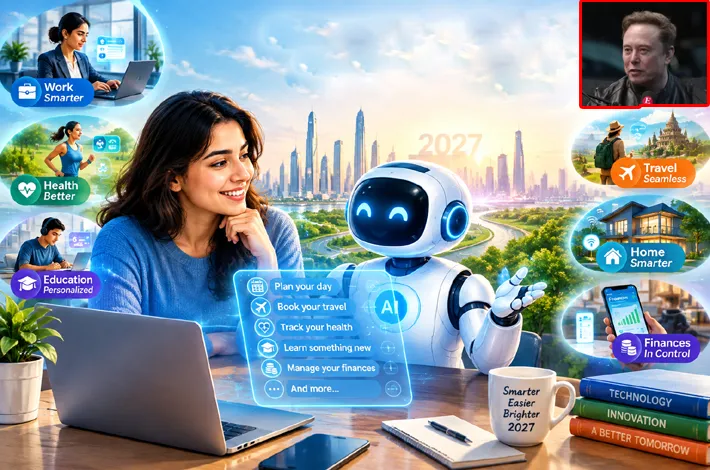
The Agent Revolution
metro india news I hyderabad
As 2025 comes to a close, artificial intelligence had already delivered two standout consumer breakthroughs: highly capable coding tools that accelerated software development and natural voice interfaces that made interacting with machines feel almost effortless. Those advances, impressive as they were, now look like early signals of a far larger shift. By the end of 2026, industry observers and technology executives expect the arrival of super-capable personal AI agents—software entities that handle the full range of tasks people currently perform on phones and computers with a level of reliability and initiative that feels irresistible.
These agents will not simply respond to commands. They will manage calendars, process emails, book travel, reconcile expenses, research options, draft communications, and execute multi-step workflows across applications with minimal supervision. The experience will feel less like using software and more like directing a highly competent digital colleague who already knows one’s preferences, constraints, and priorities.Platform makers are preparing the ground.
Apple is expected to announce formal operating-system access for trusted third-party agents, mirroring the earlier decision to allow external apps to manage calling and spam filtering. That opening would let carefully vetted agents operate with deeper system privileges while preserving Apple’s emphasis on privacy and security. On the Android side, competitive pressure is likely to force a parallel move: opening the platform so that third-party agents can operate at the same depth and integration level currently reserved for Google’s own Gemini system. Without such parity, Android risks ceding the next major interface layer to closed ecosystems.
The practical effect will be profound. When 2027 arrives, many ordinary users—people who never considered themselves early adopters—will rely on personal agents in much the same way that a smaller cohort first embraced smartphones in the early 2010s. What was once a niche productivity tool for technologists will become everyday infrastructure. Non-specialists will experience noticeable gains in output and reduced friction in daily digital life. Checking multiple apps, switching contexts, and manually transferring information will begin to feel archaic. Businesses will follow a familiar historical pattern. Just as organizations once built intranets for internal operations and websites or mobile apps for customer engagement, they will rush to deploy specialized agents. Customer-service agents, sales-support agents, procurement agents, and compliance agents will become standard offerings.
Launching an agent will be as routine as launching a website was in the late 1990s or a mobile app in the early 2010s. The organizations that move quickly will capture efficiency advantages; those that lag will find themselves competing against rivals whose digital operations simply run with less human overhead.Identity itself is poised to evolve.
Today people are reached and recognized through phone numbers, email addresses, or social-media handles. In the emerging agentic environment, individuals and organizations will also be represented by their agents—persistent software entities that negotiate, schedule, transact, and communicate on their behalf within a broader network of other agents. The “agentic world” will become a parallel layer of interaction sitting above traditional apps and websites. This transition promises a genuine leap in aggregate productivity. The volume of routine screen-tapping and mouse-clicking is expected to decline sharply. Just as the rise of smartphones shifted primary interaction from desktop clicking to mobile tapping and ultimately reduced the relative importance of many desktop websites, agents are projected to “eat” apps.
Users will increasingly state goals rather than navigate interfaces. The dominant mode of computing will shift from direct manipulation of software to supervision and exception-handling of autonomous systems.Two additional milestones are expected to crystallize around the same period. By the close of 2026, machine-generated code is widely anticipated to surpass human programmers in volume and, in many routine domains, in practical utility. Professional software development will not disappear, but the balance of labor will tilt decisively toward higher-level design, verification, and orchestration.
At the same time, the cumulative capabilities of these systems—persistent memory, multi-step planning, tool use, and reliable execution across real-world digital environments—will mark the beginning of society’s practical journey toward artificial general intelligence. The agents of 2027 will not yet be AGI, still they will embody enough generality and autonomy that the conceptual distance to broader intelligence feels shorter and more tangible.Skeptics will rightly note the remaining hurdles: reliability in open-ended settings, security against malicious agents, economic displacement in certain job categories, and the governance questions that accompany systems capable of acting with limited human oversight. Platform decisions about access, authentication, and liability will prove decisive.
Still the directional momentum appears strong. The combination of technical progress already visible in coding and voice, the competitive incentives facing Apple and Google, and the historical precedent of platform openings that unlocked mass adoption all point in the same direction.If the trajectory holds, 2026 will be remembered as the year personal agents crossed the threshold from impressive demos into daily infrastructure, and 2027 as the year AI usage finally reached the masses.
Computing will feel less like a collection of apps to be operated and more like an environment populated by capable collaborators. The screen will remain, but the primary interface will increasingly be intent rather than icons. In that sense, the agent era will not merely add another layer to existing digital life; it will redefine how people and organizations experience computing itself.
Elon Musk predicts “Age of Abundance”
Elon Musk believes artificial intelligence and robots will transform the world very quickly. He says AI is advancing so fast that it will soon handle most digital work — anything done on computers, such as writing software, analysing data, or creating content. He has predicted that by the end of next year, AI could do nearly all of this digital work better than humans.
For physical jobs, Musk points to humanoid robots (like Tesla’s Optimus). He expects hundreds of millions or even a billion such robots within about ten years. Each robot could be several times more productive than a human worker. Together, these robots could produce more goods and services than all people on Earth combined.Because of this, Musk thinks traditional jobs will change dramatically.
He has said that in 10 to 20 years, work may become optional — something people do for enjoyment, like a hobby or sport, rather than a necessity to survive. People will no longer need to work full-time just to earn a living. Instead, society could enter an “age of abundance” where AI and robots create so much wealth that basic needs (food, housing, healthcare, transport) become widely available.He also predicts the global economy could grow much faster — possibly doubling in size within five to seven years — because machines will produce far more than humans can today.
Money itself may become less important over time if almost everything becomes cheap and plentiful.Musk describes this future as mostly positive and exciting, though he notes that big changes always carry risks. His core message is that the next decade will look very different from the past: AI and robots will take over most productive work, freeing humans from the need to labour for survival while creating widespread abundance.