23 October, 2026 | 8:45 PM


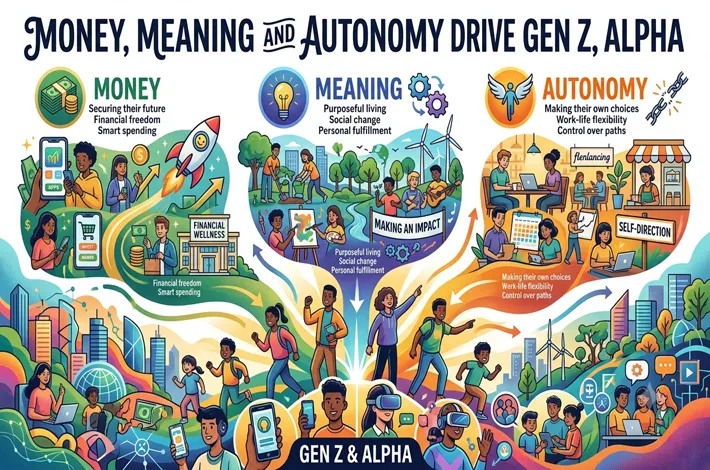
Money, Meaning and Autonomy Drive Gen Z, Alpha
08-09-2026 12:00:00 AM
metro india news I hyderabad
In a rapidly transforming India, Generation Z and the emerging Generation Alpha are rewriting the rules of success, motivation and daily life. Born roughly between 1997 and 2012, Gen Z forms the bulk of the young workforce and university population. Gen Alpha, born from around 2010 onward, is still largely in school but already shaping family decisions and digital culture. Surveys and studies from Deloitte, Randstad India and others reveal a generation that balances pragmatic financial needs with a strong desire for purpose, flexibility, learning and personal well-being — while their younger siblings prioritise autonomy, joy and early financial curiosity in a highly structured world.For India’s Gen Z, the “trifecta” of money, meaning and well-being sits at the heart of career choices.
Deloitte’s recent Gen Z and Millennial surveys in India show that financial security remains foundational. Without it, many report lower well-being and less sense that their work is meaningful. Better pay ranks as a top retention factor, cited by about 37 per cent in a Randstad India study, ahead of traditional perks. Salary is also a leading consideration when choosing careers, according to India Today’s Mood of the Nation findings, though job security and work-life balance follow closely. Yet money alone is insufficient. Nearly all Indian Gen Z respondents in Deloitte data — as high as 99 per cent in the latest figures — say a sense of purpose is important for job satisfaction.
Many are willing to reject employers or projects that clash with their values. Some studies indicate a willingness among a significant share to accept lower pay for more meaningful roles. Continuous learning ranks equally high: 94 per cent of Indian Gen Zs highlight on-the-job learning as the most helpful tool for career growth, outpacing global peers. Real-world experience is valued far above pure classroom theory. Work-life balance and flexibility have become non-negotiable. Randstad’s “Gen Z Workplace Blueprint” found flexible hours (25 per cent) and work-life balance (22 per cent) as stronger motivators than extra leave or similar benefits.
Many prefer a full-time job combined with a side hustle for autonomy and diversified income. Only a small minority plan lifelong loyalty to one employer; a substantial share expect to move within a year, driven by low pay, misaligned values or poor culture. Leadership interest is high in principle, but few list rapid corporate climbing as their primary goal — steady progress with sustainable workloads is preferred. Mental health awareness runs deep. Prioritising well-being over relentless stress, many Gen Z Indians consciously break from older patterns of proving worth through overwork.
Authenticity matters:
They distrust greenwashing, nepotism and empty corporate slogans. Family ties remain strong compared with Western counterparts — close-knit relationships and home meals still hold value — even as they gently shift from pure duty-driven choices toward fulfilment. Digital fluency is near-universal. High adoption of generative AI at work is reported, with most seeing it as a time-saver and productivity booster rather than a pure threat, though job displacement concerns linger. Broader anxieties shape their outlook. Unemployment and job quality top concerns in multiple polls. Many doubt that hard work and merit alone guarantee advancement, citing connections, privilege or simply too few opportunities. Livelihood issues dominate over others for a majority. Some express openness to working abroad for better salaries and prospects, though many still see India as home.
Climate awareness and ethical consumption also feature, influencing preferences for sustainable brands and second-hand markets.Generation Alpha, still largely under 16, shows distinct but related drivers. Structured days filled with school, tuition and homework leave limited free time, so digital spaces — phones, gaming, short-form content — become vital pockets of autonomy and identity, according to a Rukam Capital study. They are not simply “screen-addicted”; technology offers the rare realm not fully controlled by adults.
Peer validation often matters more than influencers for actual decisions. Curiosity about earning money is notable: around 70 per cent explore ways to earn through chores, creative work or digital activities. Many accompany parents on online shopping and influence purchases. Food carries emotional weight — flavour, texture and celebration matter deeply for happiness, sometimes more than pure nutrition. Aspirations lean toward content creation for some, with surveys noting interest in becoming social media influencers. Raised by purpose-oriented millennial parents, they absorb values around sustainability and ethics, though they demand tangible proof over slogans.
Recent student protests in some states over school infrastructure and education quality hint at an early demand for better systems. These motivations carry wide implications. Employers face pressure to offer competitive pay alongside flexibility, genuine purpose, upskilling and supportive cultures or risk high turnover. Educators confront calls for practical skills, quality and reduced pressure. Brands targeting young consumers must prioritise authenticity, local resonance, value and ethical credentials.
Policymakers note that job creation, skill-aligned opportunities and mental health support remain urgent amid India’s demographic advantage.Gen Z and Gen Alpha are not rejecting ambition. They are redefining it on more holistic terms: financial foundations paired with meaning, balance, continuous growth and personal agency. In a nation of vast scale and rapid change, their preferences will shape workplaces, markets, families and the broader social fabric for decades. As one Deloitte India executive observed, these generations are not merely adapting to the future of work — they are actively shaping it. The challenge for institutions is to meet them there.