2 June, 2026 | 5:55 AM


No Crops, No Cash
11-02-2026 12:00:00 AM
Rythu Bharosa Revamp
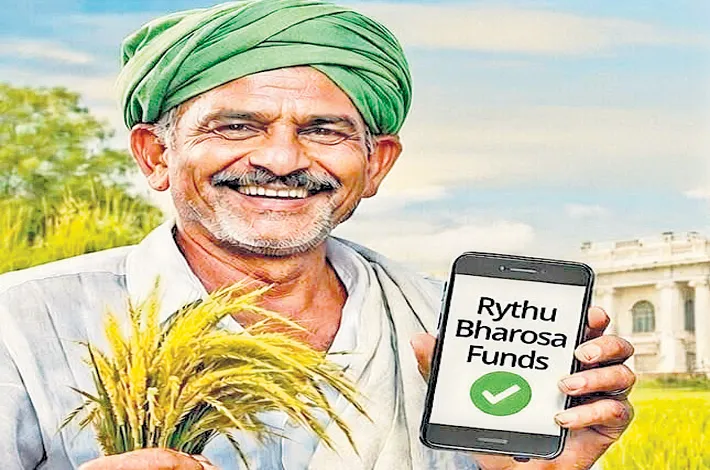
Farmers who leave their land uncultivated may not receive the Rythu Bharosa subsidy anymore, according to the state government. Authorities, under the guidance of the Agriculture University, conducted a satellite survey across 10,600 villages to identify land suitable for cultivation. The survey revealed that out of 1.53 crore acres of arable land, 10 to 12 percent—around 20 lakh acres—remained uncultivated. This means these lands had no crops planted during the previous Kharif season.
The new rules are expected to come into effect from the upcoming Kharif season. Investment assistance under the Rythu Bharosa scheme, which provides Rs 12,000 per acre in two installments directly into farmers’ accounts, will now be given only to farmers who actually cultivate their land. Earlier, under the previous government, even barren, rocky, or uncultivated lands received support under the Rythu Bandhu program. The current administration, however, plans to restrict the assistance exclusively to lands where crops are sown.
To implement this, the Agriculture University carried out a detailed satellite survey across the state. Officials collected data during the last cropping season to identify the extent of cultivation. Out of 1.53 crore acres suitable for farming, nearly 20 lakh acres were found to be uncultivated. The survey excluded 870 villages for which revenue maps were already available.
This pilot project was conducted in 20 districts, including Adilabad, Nirmal, Nizamabad, Kamareddy, Jagityal, Warangal, Hanumakonda, Mahbubabad, Mulugu, Bhupalpally, Khammam, Kothagudem, Vikarabad, Mahbubnagar, Narayanpet, Nagarkurnool, Vanaparti, Gadwal, Nalgonda, and Suryapet. Officials completed the survey in 318 clusters across 114 mandals. The satellite survey, conducted ten times during the four-month cropping season, achieved an estimated 92 percent accuracy, as verified through field inspections.
The survey also revealed the impact of water availability on cultivation. Districts with low water resources had more uncultivated land, while areas with adequate irrigation had fewer fallow plots. For instance, in villages with 500 acres suitable for cultivation, 400 to 450 acres were actively farmed, according to satellite mapping. The Agriculture University collaborated with advanced research centers and remote sensing labs for this comprehensive survey.
Following the survey, the state government plans to provide investment assistance to eligible farmers based on the actual cultivation data. The satellite survey will also enhance transparency in crop procurement, collection, and sales while ensuring timely payouts under crop insurance schemes. The technology will help assess losses caused by pests, floods, or storms, enabling faster compensation.
Officials noted that after submitting the survey data to the government, any errors or discrepancies will be corrected through field inspections by Agricultural Extension Officers (AEOs).
However, some farmers have raised concerns that the new system might unfairly affect those who left land uncultivated during the previous Kharif season but have sown crops in the upcoming season.
This marks the first time in India that satellite-based technology has been used to calculate crop acreage at such a large scale. Experts believe this approach will ensure that the Rythu Bharosa scheme benefits genuinely productive land, improving efficiency and fairness in subsidy distribution while helping farmers recover losses quickly.