29 July, 2026 | 7:51 PM


Naxalite Dreams to Deputy CM
13-06-2026 12:00:00 AM
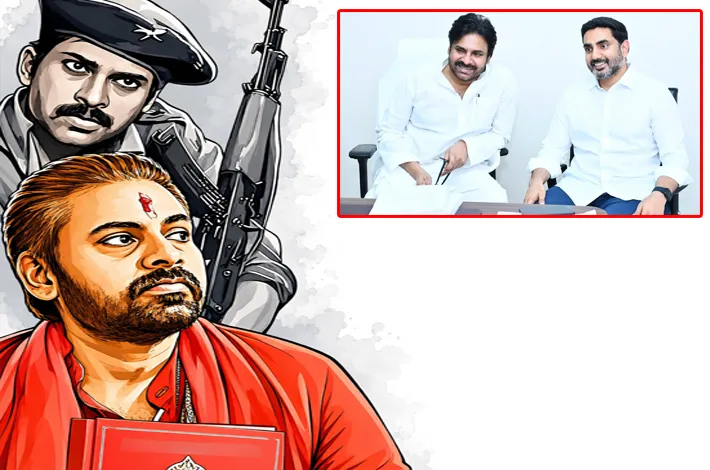
PK’s Journey
■ Pawan Kalyan rejected the growing North-South divide narrative
■ He defended his right to participate in Telangana politics
■ On Andhra Pradesh’s bifurcation, he criticised the manner in which the division was carried
■ Pawan argued that today’s youth are more interested in jobs, governance, opportunity and accountability than in caste, regional or identity-based politics
■ He stressed that many social tensions are actually governance failures
In an era when identity politics, regional assertions, and linguistic debates increasingly dominate India’s political discourse, Andhra Pradesh Deputy Chief Minister Pawan Kalyan used his first major podcast appearance to deliver a message that went far beyond state politics.
The Janasena Party chief spoke on issues ranging from North-South divisions, Telangana politics, caste-based discourse, governance failures, youth aspirations, national integration, and his admiration for Prime Minister Narendra Modi. The interview offered a rare glimpse into Pawan Kalyan’s ideological framework and his vision for India’s future.
More importantly, the conversation revealed a politician attempting to position himself not merely as a regional leader from Andhra Pradesh but as a national voice advocating unity over division.
One of the most striking aspects of the interview was Pawan Kalyan’s unequivocal opposition to the growing narrative of a North-versus-South divide. According to him, such a discourse is dangerous for India’s long-term stability and unity. He argued that political leaders, especially those occupying constitutional positions, should avoid framing issues through a regional lens.
His comments come at a time when debates over language, resource allocation, taxation, representation, and federal rights have increasingly been framed as battles between northern and southern states. Pawan’s argument was simple: disagreements and grievances can be raised and discussed democratically, but turning them into a civilizational conflict between regions threatens the very foundation of the Indian Union.
He reminded listeners that India’s unity was not accidental. More than 570 princely states were painstakingly integrated after Independence to create the nation that exists today. In his view, encouraging regional antagonism risks undoing decades of nation-building.
The remarks are likely to resonate strongly with nationalist sections while simultaneously positioning him as a leader who seeks a pan-Indian identity rather than a purely regional one.
The podcast also touched upon recent controversies surrounding his political activities in Telangana. Pawan Kalyan revealed that some Congress leaders had suggested that he should stay away from Hyderabad and Telangana politics. Responding sharply, he questioned how any citizen could be told where they may or may not enter within their own country.
His response reflected both constitutional and emotional arguments. The Janasena chief emphasized that Hyderabad remains part of his motherland and that nobody possesses the authority to deny him entry into any Indian city. His famous remark that Telangana was not anyone’s “jagir” was directed specifically at those who attempted to question his presence there.
The Deputy Chief Minister made it clear that he was not seeking power or office in Telangana. He repeatedly stressed that he had no plans to contest elections in the state and had no personal political ambitions there.
Yet he also made it equally clear that Janasena remains active in Telangana and that his alliance with the Bharatiya Janata Party continues. His criticism was particularly directed at what he perceived as the contradiction within the Congress party.
Pawan observed that while regional parties may be expected to speak about regional identity, it was surprising to hear a national party promoting narratives that appeared regional in nature. The statement was widely interpreted as a direct challenge to Congress leader Rahul Gandhi and the Telangana Congress leadership.
Revisiting the Andhra-Telangana Bifurcation Debate
Pawan Kalyan once again clarified a position he has maintained for years: he was never opposed to the creation of Telangana. Instead, he argued that the problem lay in the manner in which Andhra Pradesh was bifurcated.
The Janasena leader pointed out that several asset-sharing issues between Andhra Pradesh and Telangana remain unresolved even after more than a decade. He cited the continuing disputes over properties and institutional assets worth tens of thousands of crores.
Drawing parallels with family business separations such as those seen in large corporate families, he argued that even private divisions require extensive planning and negotiations. Given that state bifurcation involves millions of stakeholders, governments should have exercised far greater care. His criticism was directed primarily at Congress, which presided over the bifurcation process in 2014.
According to him, both Andhra Pradesh and Telangana suffered because the division was executed hastily and without adequate preparation. Public expectations were not managed properly, and critical issues were left unresolved.
This balanced approach is politically significant because it allows him to avoid alienating Telangana sentiment while simultaneously addressing concerns that remain alive in Andhra Pradesh.
Referring to what he called the frustrations and anger of contemporary youth, he argued that younger Indians are increasingly disillusioned with traditional political battles centered on region, caste, and identity. Instead, they want governance, opportunity, accountability, and solutions.
Generation Z has grown up in a digital world where employment, entrepreneurship, education, technology, climate concerns, and social mobility often take precedence over older ideological battles. According to Pawan, the new generation seeks leaders who can solve problems rather than merely create divisions.
This message may become central to Janasena’s future political strategy as it attempts to attract first-time voters across Andhra Pradesh and beyond. Pawan Kalyan expressed frustration that many young Indians are still judged first by their caste identity rather than their capabilities.
He questioned why discussions about individuals often begin with caste labels instead of skills, talent, or achievements. At the same time, he acknowledged the reality that caste continues to play an important role in Indian politics.
To illustrate his point, he questioned what special caste privilege had enabled Rahul Gandhi’s political prominence, suggesting that political inheritance and family legacy often matter more than caste-based narratives alone.
The comments were part of a broader argument that merit, governance, and competence should increasingly replace identity-based political calculations.
One of the most insightful portions of the interview involved a discussion about public health and local governance. Pawan cited an example from a village in Vizianagaram district where health problems were prevalent.
At first glance, the issue appeared to be linked to social divisions. However, upon closer examination, he argued, the real problem was poor drainage infrastructure and administrative neglect. Dirty water remained stagnant, drainage systems were blocked, and sanitation failures created health crises.
His point was that many issues often portrayed as social conflicts are actually governance failures.
This distinction reflects a technocratic approach to politics that focuses on identifying root causes rather than exploiting symptoms for political gain.
The interview concluded with a discussion about Prime Minister Narendra Modi. Pawan revealed that Modi often communicates with him in both Hindi and English, though Hindi is used more frequently. More importantly, he explained why he continues to admire the Prime Minister.
For Pawan, language is merely a tool of communication. What matters is whether a leader unites people or divides them. He argued that India requires leaders capable of building national cohesion rather than encouraging fragmentation. In his view, Narendra Modi represents such leadership.
The remarks reaffirm Janasena’s ideological proximity to the BJP and suggest that Pawan sees himself as part of a broader national political project centered on unity and development.
The most important takeaway from Pawan Kalyan’s first podcast may not be any single statement. Rather, it is the larger political image he appears to be crafting. Unlike many regional leaders who derive strength from regional identity, Pawan is increasingly presenting himself as a leader whose politics transcend state boundaries.
His emphasis on national integration, constructive politics, governance reforms, youth aspirations, and rejection of divisive narratives reflects an attempt to occupy a unique political space. Whether this positioning translates into greater political influence remains to be seen.
But one thing is clear: Pawan Kalyan’s first podcast was not merely an interview. It was a carefully articulated political statement about the India he wants to see, an India united by opportunity, strengthened by governance, and protected from the forces of division.
The naxal turn that never was
Among the most personal revelations in the podcast was Pawan Kalyan’s admission that he once contemplated becoming a Naxalite during his youth. Like many young people frustrated by social inequalities and governance failures, he was attracted to revolutionary ideas. However, he credited his elder brother, megastar Chiranjeevi, with steering him toward a more constructive path.
The anecdote reveals a recurring theme in Pawan’s political philosophy: anger may be justified, but destruction is not the answer. Throughout the interview, he repeatedly emphasized constructive engagement over confrontation, reform over revolution, and institution-building over ideological warfare.
Perhaps the most future-oriented portion of the interview concerned youth and emerging political trends. Pawan Kalyan observed that every 25 to 30 years a new generation emerges with different aspirations and expectations.
Pawan quashes Lokesh rivalry talk
Pawan also addressed growing speculation regarding future leadership within the ruling alliance in Andhra Pradesh. With Nara Lokesh emerging as a key leader within the Telugu Desam Party, political observers have increasingly speculated about a future rivalry between Lokesh and Pawan.
The Janasena chief dismissed such narratives. He stated clearly that there is no inheritance battle between him and Lokesh and suggested that such speculation is largely a media creation. The statement is significant because it reinforces coalition unity at a time when discussions about the 2029 political landscape have already begun.