20 September, 2026 | 11:57 PM


Alliance under strain?
29-07-2026 12:00:00 AM
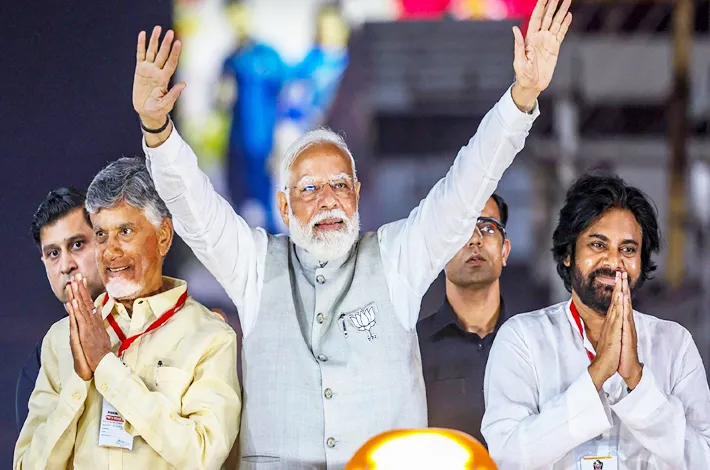
SEAT SHARING BUZZ SPARKS UNEASE AHEAD OF AP LOCAL BODY POLLS
KIRANMAI TUTIKA | AMARAVATI
Even before the Andhra Pradesh State Election Commission has formally announced the schedule for the long-awaited local body elections, political conversations within the ruling NDA alliance have begun shifting from governance to seat sharing. While leaders of the Telugu Desam Party (TDP), Jana Sena Party (JSP) and Bharatiya Janata Party (BJP) continue to publicly assert that the alliance remains intact, recent statements from senior leaders have fuelled speculation over emerging fault lines.
Within the alliance, each party enters the negotiations with different expectations. The TDP, being the largest partner with an extensive organisational network across villages and towns, is expected to seek the lion’s share of seats. Jana Sena, buoyed by its role in the coalition government and keen to convert its growing political visibility into grassroots representation, is expected to press for a larger allocation than it received in previous elections. The BJP, despite its relatively limited organisational presence in many parts of the state, is also likely to seek a respectable share to strengthen its cadre and expand its local base.
Political observers note that the challenge before the alliance leadership is not merely distributing seats but managing aspirations. Thousands of local leaders who worked for the coalition’s victory in the 2024 Assembly elections are now expecting electoral opportunities. If denied tickets because of alliance compulsions, dissatisfaction among grassroots workers could become inevitable.
The issue is particularly sensitive for Jana Sena. Since joining hands with the TDP, the party has repeatedly stressed that alliance politics should not come at the cost of its organisational expansion. Its leaders have consistently argued that local body institutions are essential for building a long-term political structure and nurturing future leadership. The BJP, too, has on several occasions maintained that alliance arrangements should reflect its contribution to the coalition and provide room for organisational growth.
For the TDP leadership, however, balancing alliance unity with demands from its own cadre will be equally challenging. The party’s district leaders have already begun internal exercises to identify prospective candidates, many of whom expect the ruling party to contest a majority of seats based on its electoral strength.
Despite the growing speculation, none of the three parties has publicly spoken of any disagreement. Senior leaders continue to maintain that seat sharing will be resolved through consultations and consensus. However, political circles believe the real test of the NDA alliance will begin not during campaigning, but at the negotiating table, where local ambitions, caste arithmetic and organisational interests will intersect.
As the election notification draws closer, the coalition’s ability to accommodate competing aspirations without triggering rebellion at the grassroots could determine whether the alliance enters the local body polls as a united front or with simmering internal discontent. In Andhra Pradesh politics, where local elections often shape future political equations, the coming weeks may prove as crucial inside alliance meeting rooms as they are on the campaign trail.
Uneasy questions
Jana Sena Political Affairs Committee chairman and Civil Supplies Minister Nadendla Manohar, who indicated that seat sharing would be decided only after discussions among alliance partners and that Jana Sena workers should prepare to contest in a significantly larger number of seats than before. Though he stopped short of demanding a specific quota, the message was widely interpreted as an indication that the party is seeking a greater political footprint in the grassroots elections.
The remarks assume significance because local body elections are fundamentally different from Assembly or Lok Sabha polls. Unlike parliamentary elections, where victory depends largely on state-wide political narratives, panchayat, municipal and corporation elections revolve around local leadership, caste equations and cadre strength. Every seat becomes politically valuable, making negotiations far more complicated.