25 September, 2026 | 8:01 PM


Modi in Israel-A step in right direction?
28-02-2026 12:00:00 AM
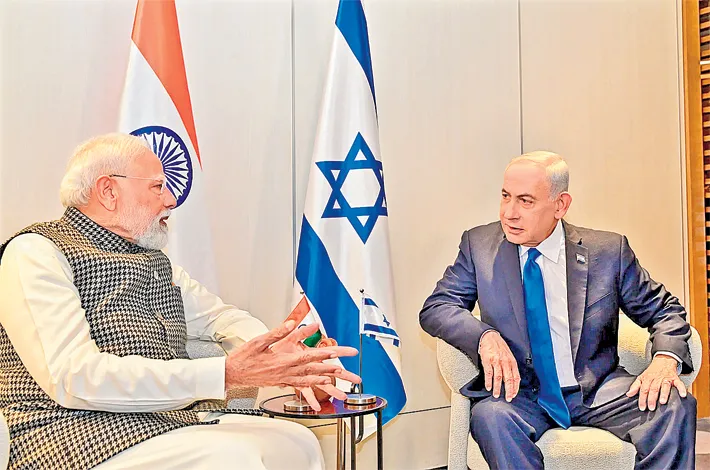
Prime Minister Narendra Modi's recent historic address to Israel's parliament known as Knesset during his visit to Israel has sparked widespread discussion in India. The speech, delivered on February 25, 2026, condemned terrorism unequivocally while expressing support for peace efforts in Gaza, drawing applause in Israel and igniting a fierce debate back home. In his address to the Israeli parliament—the first by an Indian Prime Minister—Modi condemned the October 7, 2023, Hamas attacks as "barbaric," stating clearly that "no cause can justify the murder of civilians" and "nothing can justify terrorism."
He emphasized India's zero-tolerance policy toward terrorism with no double standards, drawing parallels to India's own experiences, such as the 2008 Mumbai attacks. Modi reaffirmed India's firm support for Israel, saying the nation stands "firmly with full conviction" in this moment and beyond. He also backed the Gaza Peace Initiative (endorsed by the UN Security Council), describing it as offering a pathway to "just and durable peace" for the region, including by addressing the Palestine issue. He stressed that humanity must never become a victim of conflict and called for sustained global action against terrorism.
Back in India, however, the speech triggered sharp political reactions. Pro-government voices hailed it as masterful statesmanship that outmanoeuvred critics who had been pushing Gaza-related imagery and slogans to corner Modi. They argued that by calling out Hamas terror directly from the Israeli parliament while endorsing the peace plan, Modi demolished opposition narratives. Supporters pointed to international praise and accused the opposition—particularly Congress and associated groups—of denial, cynicism, and propaganda,
However, opposition leaders from the Congress party unleashed sharp criticisms, accusing the government of abandoning the Palestinian cause amid the ongoing conflict in Gaza. Priyanka Gandhi Vadra, in a pointed social media post, expressed hope that Modi would address what she termed a "genocide" in Gaza during his speech. She urged him to demand justice for the victims, invoking India's historical stance on truth and justice. Other Congress figures, like Jairam Ramesh, echoed these sentiments, labelling the government's approach as "moral cowardice" and highlighting the violence in Gaza.
India's foreign policy under Modi, the BJP emphasized, has been balanced and pragmatic. They made it clear that government advocates for peace, humanitarian aid to Gaza civilians, and a two-state solution while maintaining strong ties with Israel. As per a BJP spokesperson, Modi's visit is not an endorsement of one side but a pursuit of India's interests in a multipolar world. Attempts to pressure him into one-sided statements ignore the details of diplomacy, the spokesperson contended, labelling such outrage as grandstanding that serves neither justice nor peace.
A BJP aligned writer and journalist highlighted Israel's crucial support during key conflicts: supplying ammunition in 1971 against Pakistan despite Arab allies siding with the adversary, and providing laser-guided munitions during the 1999 Kargil War amid U.S. sanctions. He argued that standing with Israel is not only moral but imperative, repaying a debt of friendship. He accused the Congress ecosystem of ignoring genocides against Hindus in Bangladesh, Kashmir, and Pakistan, as well as Uyghur Muslims in China—where, he claimed, 1.5 million are interned in concentration camps, force-fed pork, and sterilized, with 1,700 mosques demolished in the last decade.
A pr-Congress political analyst countered aggressively, defending the Palestinian perspective by framing the conflict as spanning 70 years rather than a single incident. He condemned the October 7 attack but accused Israel of fascism and capitalism, displacing Palestinians since 1948. He criticized Modi's silence on global issues, referencing Donald Trump's claims of brokering deals where Modi allegedly agreed to reduce tariffs and halt Russian oil purchases without rebuttal. He dismissed criticisms of China as fake news and emphasized India's historical support for Jews during the Holocaust while decrying Palestinian displacement.
In the end, the discussion underscored deep divisions: one side viewing Modi's visit as strategic repayment to a steadfast ally, the other as moral compromise ignoring Palestinian plight. Amid historical grievances and global comparisons, the panel exposed the politicization of foreign policy, with calls for nuance clashing against demands for outright condemnation. As Modi engages Israel, the domestic echo chamber reveals how international conflicts fuel India's partisan battles.