29 July, 2026 | 12:47 PM


Millers cry foul over ‘double standards’ in paddy rules
21-05-2026 12:00:00 AM
metro india news I hyderabad
Rice millers across the state are expressing strong dissatisfaction, alleging that unrealistic and contradictory regulations are being imposed on them by the Food Corporation of India (FCI) and Civil Supplies department. They claim that while rules exist on paper, ground-level implementation is completely different, leaving them financially burdened and frustrated.
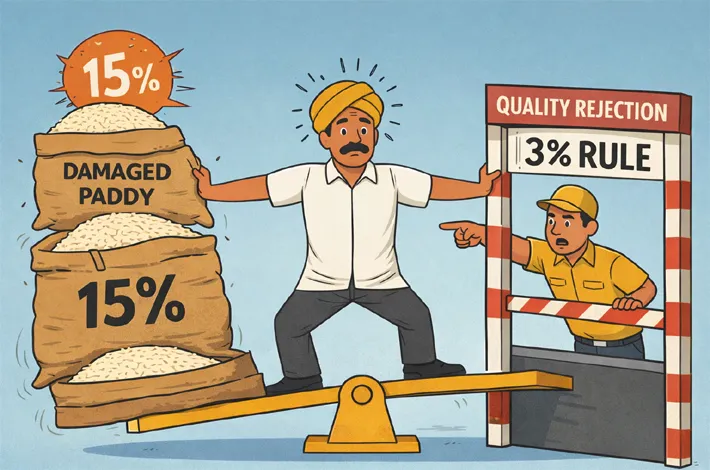
Millers argue that they are being forced to operate under strict Fair Average Quality (FAQ) norms, which state that only up to 3 percent discoloured, broken or damaged paddy should be accepted during procurement. The same 3 percent limit is also applicable when rice is supplied back to FCI and Civil Supplies after milling.
However, according to the millers, the actual situation at procurement centres is very different. Due to weather conditions, procurement practices, and other field-level issues, the paddy arriving at purchase centres often contains more than 15 percent discoloured, damaged, or wet grains. They say that although such consignments should not be supplied to them under rules, pressure from political sources and administrative officials forces them to accept the substandard stock.
Millers allege that they are being made scapegoats to avoid public dissatisfaction among farmers. They claim that authorities push them to accept paddy with 15 percent or even more damaged grains, despite the official limit being 3 percent.
At the same time, they point out a major inconsistency in the system. When they process this paddy and supply rice back to FCI and Civil Supplies godowns, even minor deviations are not tolerated. According to them, even if the rice contains as little as 0.5 percent discoloured or broken grains, it is rejected and sent back.
This double standard, they say, is causing severe losses. On one side, they are forced to accept poor-quality paddy far beyond permissible limits, and on the other side, their processed rice is rejected for even minimal defects.
Millers are questioning how they are expected to survive under such conditions. They argue that while procurement norms are relaxed in practice to accommodate field realities, the same flexibility is not being extended when it comes to rice acceptance.
They describe the situation as being “caught on both sides,” where they are suffering losses in both procurement and supply stages. According to them, government agencies appear to be shifting the burden entirely onto millers, making them bear the financial impact of quality mismatches.
The millers further state that they are not opposing quality standards, but are demanding uniform implementation. They insist that if 15 percent discoloured or damaged paddy is being supplied to them, then the same level of tolerance should be applied when rice is delivered back to government agencies.
They have urged authorities to ensure consistency in rules so that the same standards are applied equally to both procurement and supply chains. Otherwise, they warn that the current system continues to place them in a “double loss” situation, making rice milling operations increasingly unsustainable.