24 September, 2026 | 5:43 PM


Lamborghini crash in Kanpur- Outrage over VIP privilege and judicial failures
14-02-2026 12:00:00 AM
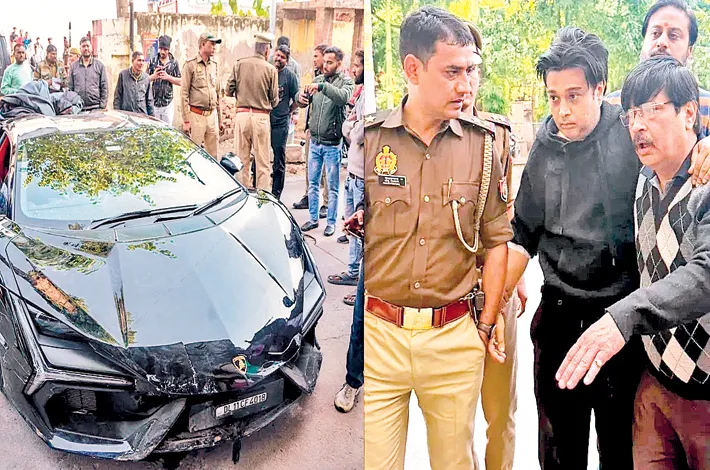
In a dramatic development that has ignited public fury across India, Shivam Mishra, the son of prominent tobacco baron KK Mishra, was arrested four days after his Lamborghini —valued at over 10 crore rupees—crashed into an auto-rickshaw, a motorcycle, and pedestrians on VIP Road in Kanpur. The high-speed collision injured six people, with police alleging that Shivam was driving, fled the scene, and attempted to evade responsibility by presenting a dummy driver who surrendered.
CCTV footage and eyewitness accounts reportedly confirmed Shivam in the driver's seat, with bouncers seen pulling him from the wreckage. The initial FIR named an unknown person, fuelling accusations of a cover-up orchestrated by his influential family. After reportedly hiding in a hospital, Shivam was arrested and produced in court, but was granted bail within hours on a personal bond of just 20,000 rupees—a decision critics have labelled a mockery of justice. The case has drawn parallels to other high-profile incidents involving wealthy individuals and supercars, highlighting systemic issues in law enforcement and judicial processes.
A former IPS officer pointed out the procedural lapses that delayed the arrest. He noted that the investigation began with an unknown driver but eventually identified Shivam based on CCTV and circumstantial evidence. He questioned why it took four days to locate and arrest him, suggesting possible alibis being fabricated by the family. He mentioned that the SHO of the local police station was suspended for these lapses, but emphasized that the offenses charged—such as rash driving—were bailable, limiting the police's options. Sahai argued that while the delay was unjustifiable, the case's simplicity from an investigative standpoint means it could be resolved quickly if prioritized.
A consultant surgeon at Bengaluru, delved into the dangers posed by supercars on Indian roads. He described these vehicles as unsuitable for local conditions, with speeds up to 350-450 km/h and heavy builds of around two tons, creating immense momentum in crashes. He highlighted how human reaction times falter above 120 km/h, leading to loss of control in unexpected situations like tire bursts or slippery surfaces.
He criticized parents for providing such cars to underage or inexperienced youth, who often lack respect for the vehicle's power or the value of life. In cases like this, he said, families use wealth and influence to derail investigations, such as delaying blood samples to check for alcohol or drugs—as seen in the Pune Porsche case where a mother's sample was substituted. He stressed that victims, often from poorer backgrounds, bear the brunt, while perpetrators escape accountability.
A Supreme Court advocate lambasted the criminal justice system for its leniency toward the powerful. She argued that the police should have registered the case under culpable homicide rather than milder sections like negligent driving and endangering life, which allowed for quick bail under the Bharatiya Nyaya Sanhita (BNS). She criticized the mandatory notice for offenses punishable by less than seven years, which enabled Shivam's swift release. She highlighted the missing chain in evidence collection and the blame-shifting tactics, noting that the court would later evaluate who was truly driving.
Drawing from past cases like Pune and BMW incidents, she predicted that loopholes in the system would likely lead to Shivam's acquittal after years of delays. She called for the lifting of bans on stricter provisions like Section 106 of the BNS, which penalizes fleeing the scene, to prevent mob lynching fears among transporters while ensuring accountability. She advocated for fast-track courts and deterrent punishments beyond mere compensation, emphasizing that every life—whether of a rickshaw puller or pedestrian—holds equal value, and police must enforce law without bias.
A social activist echoed these concerns, focusing on the victims' plight and the broader societal implications. She questioned what message the quick bail sends to injured poor people reliant on streets for livelihood, portraying the incident as emblematic of impunity for the elite. She accused the police of complicity due to fear of influential figures like Shivam's father, despite evidence from technology and witnesses pointing to Shivam as the driver. She decried the lack of "sabka vikas" (development for all) and safety, arguing that justice favors the rich.
She also highlighted how appeals to higher courts often dilute punishments, raising doubts about judicial integrity. She praised the judge for rejecting the dummy driver's surrender and demanding the real culprit, but lamented that such "courageous" actions are rare 79 years post-independence. She urged close monitoring of the case's progress to set an example, warning that without accountability, lessons from similar incidents nationwide would go unlearned.
The IPS officer reiterated that each case, while involving "brats" from wealthy families, differs in terms of investigation. He defended the bailable nature of the charges given the simple injuries involved, but acknowledged disturbing procedural delays. He stressed that bail denials typically hinge on flight risk or evidence tampering, neither of which the court deemed applicable here, as the vehicle was seized promptly. However, he agreed on the need for swift trials, suggesting this case could be resolved in 8-10 days via a fast-track court, delivering justice within months rather than years—preventing the denial of justice through delays.
The doctor proposed preventive measures, urging the government to mandate safety technologies in supercars, such as GPS-based speed limiters tailored to road conditions and breath analyser ignition interlocks to prevent drunk or drugged driving. He placed responsibility on vehicle manufacturers for enabling such risks, arguing that these features could mitigate accidents before they occur.
As the discussion concluded, the opinions expressed unanimously called for systemic reforms to instil fear of the law in privileged offenders. The Kanpur Lamborghini case underscores ongoing debates about VIP culture, police accountability, and judicial efficiency, with hopes that public scrutiny will drive change and protect vulnerable road users.