24 September, 2026 | 6:44 PM


Congestion Tax: Potential fix for urban traffic chaos
14-02-2026 12:00:00 AM
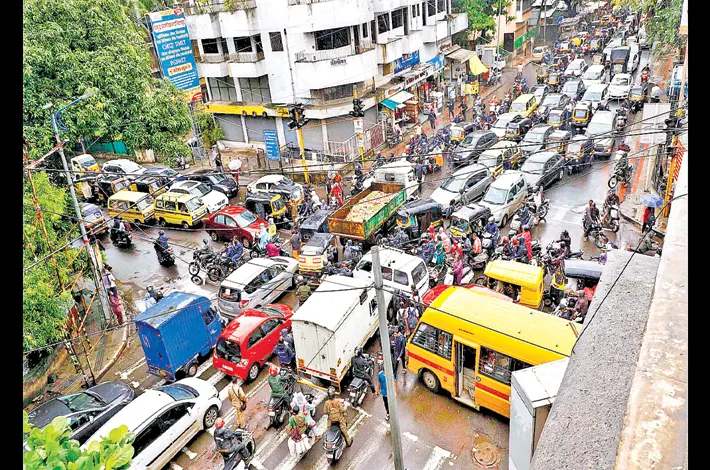
Traffic congestion is choking India's major cities, a reality that commuters face daily. The idea of a congestion tax—charging vehicles to enter the most crowded urban areas, especially during peak hours—has resurfaced as a potential solution to reduce traffic and pollution. Cities like London and Singapore have successfully implemented similar systems, where collected funds are reinvested into public transport. However, in India, this concept often stalls at the debate stage, never progressing to action. This discussion explores why, examining the feasibility, challenges, and expert perspectives on whether congestion pricing could work in cities like Mumbai.
The core argument for congestion taxes lies in their proven track record abroad. In London, Singapore, Stockholm, New York, and several Latin American and European cities, these taxes have discouraged unnecessary car use, easing traffic flow. Revenue generated is typically funnelled back into improving public infrastructure, such as buses and subways, creating a virtuous cycle. Yet, sceptics in India point out that public transport options remain inadequate. Buses are overstretched, metro lines are still expanding, and last-mile connectivity is patchy, making private vehicles a necessity for many. As a result, a congestion tax feels less like a solution and more like an unfair penalty on commuters who have no viable alternatives.
Experts emphasize that simply building more roads or flyovers hasn't solved the problem. Adding road space often induces more demand, leading to even greater congestion—a phenomenon known as induced demand. A retired professor of Civil Engineering argues that congestion pricing must be introduced after—or alongside—public transport improvements, but not delayed indefinitely. "You have to start small," she says, suggesting fixed timings like peak hours (e.g., 8-11 a.m. and evenings) and limited zones. Initial impacts might be modest, reducing traffic by just 5-10%, but over time, as systems stabilize, benefits accrue. People can adjust by shifting travel times or modes, especially since not all jobs follow rigid 9-to-5 schedules.
Drawing from global examples, a retired bureaucrat noted that London debated the idea for nearly 20 years before implementing it in the early 2000s. Early studies showed higher operational costs than benefits, but expansions and reinvestments turned it around. Crucially, proceeds must be transparently directed toward upgrading public transport, particularly buses for short trips, to enhance frequency, comfort, and reliability. He highlighted that certain cities’ geography—compact and linear—makes the tax proposal more feasible than sprawling cities like Delhi, where demarcating zones would be harder.
From a citizen's perspective, activists and citizen’s groups raise concerns about equity and social impact. Congestion taxes aren't just traffic tools; they're social contracts that could disproportionately affect lower-income commuters if public transport isn't robust. "It risks becoming a fast-lane fee for the rich," an activist warns, citing global research on how such pricing can exacerbate inequalities by pricing out the poor. For it to work in big cities, she insists on three guarantees: reliable, clean, frequent and safe public transport as a genuine choice; visible reinvestment in buses, footpaths and last-mile connectivity; and fairness through tiered pricing, exemptions or revenue rebates to avoid regressive effects.
An advocate of Bombay High Court who also takes up civic issues pointed out the trust deficit plaguing Indian urban governance. Citizens often view new policies with skepticism, assuming poor implementation or corruption. "Mumbai doesn't just have a traffic problem; it has a planning and governance problem," he states. Air quality is unhealthy; buses are shrinking, footpaths disappearing, and metros expanding unevenly, while roads are perpetually under construction.
When governments propose paying more to drive, it feels like punishment for their failures to build alternatives. Breaking this mental block requires transparency: where will the money go? Without it, resistance builds, leading to rollbacks as seen in past proposals dating back to 2013. Implementation challenges extend beyond equity. The informal sector, small businesses, and shops in congested areas could suffer if accessibility drops, leading to economic losses. Citizens activists warn that a poorly executed tax could turn into a "class policy," where the rich pay and drive, the middle class resents it, and the working class suffers most.
Ultimately, the debate boils down to packaging and execution. Congestion taxes won't solve everything overnight but must be part of a broader strategy tailored to Indian realities. Transparency, accountability, and reinvestment are key to building public buy-in. For cities with millions relying on public transport and walking amid rising vehicle ownership, the tax could foster sustainable mobility—if introduced with honesty and equity. Without addressing these concerns, it risks remaining another good idea lost in endless discussion.