25 November, 2026 | 12:01 AM


Karthigai Deepam row: Vijay turns Stalin?
25-11-2026 12:00:00 AM
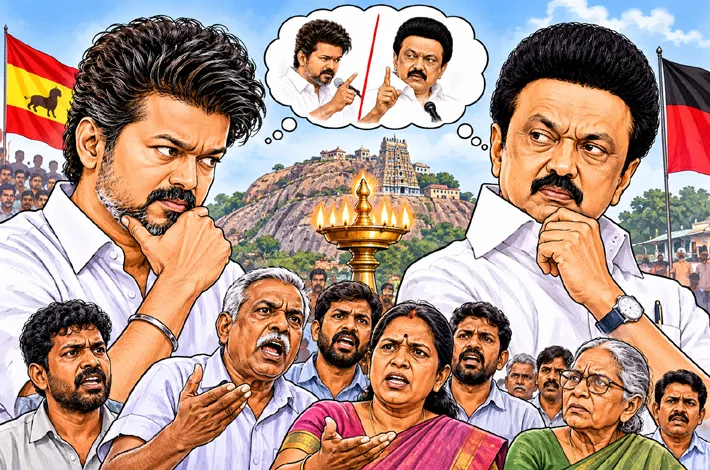
DMK-style resistance to hindutva
Vijay’s TVK government is accused of adopting the same confrontational legal strategy as the previous Stalin regime instead of taking a fresh approach to the Deepam controversy
Tradition versus communal sensitivities: The government has defended its stand on grounds of established temple practice, proximity to the dargah and the need to maintain communal harmony and public order
Congress Backing off: Rahul Gandhi’s silence is indicative of Congress moving away from Hindus
Supreme Court order challenged: Despite the apex court permitting a strictly one-time, tightly regulated lighting of the lamp at the Deepathoon, the government chose to seek a review, prolonging the dispute
* Critics argue that Vijay's perceived retreat from an inclusive approach, coupled with Congress's silence is creating a political vacuum that could benefit the BJP in Tamil Nadu
metro india news I Chennai/New Delhi : People in the country in general and in Tamil Nadu particular are criticising Tamil Nadu Chief Minister C Joseph Vijay’s handling of the Thiruparankundram Karthigai Deepam controversy, accusing his TVK government of following the same confrontational path as the previous DMK regime led by M.K. Stalin.
Discussion on several platforms, social media focused on the state government’s decision to file a review petition in the Supreme Court against the top court’s November 20 interim order. That order permitted a strictly one-time lighting of the ceremonial lamp at the disputed Deepathoon stone pillar atop Thiruparankundram hill in Madurai on November 24 — the day of Karthigai Deepam — under tight restrictions, with no public access, processions or demonstrations allowed. Only a restricted team authorised by the temple administration, supervised by officials, was to perform the ritual. The court simultaneously stayed broader findings of the Madras High Court on customary rights.
Many people noted that the Vijay government’s review plea, filed by the Hindu Religious and Charitable Endowments (HR&CE) Department commissioner, rested on arguments familiar from the Stalin years: that lighting the lamp at the Deepathoon is not an established temple tradition; that the traditional site is the Deepamandapam near the Uchipillaiyar temple; that the pillar lies close to the Hazrat Sultan Sikandar Badusha Auliya Dargah (roughly 50 metres away); and that permitting the ritual risks communal harmony and sets a problematic legal precedent
Critics highlighted the continuity. Under the earlier DMK government, the state had opposed High Court directions to light the lamp at the pillar, citing the same concerns of tradition, law and order, and multi-faith sensitivities on the hill that houses both the Arulmigu Subramaniaswamy Temple and the dargah. The programme suggested that CM Vijay, despite coming to power with a different political identity, had chosen not to accept the Supreme Court’s carefully limited one-time arrangement and instead prolonged the legal fight — an approach panellists described as echoing Stalin-era resistance rather than a fresh administrative stance.
Critics featured in the discussion argued that the Supreme Court had already provided what some called an “escape route” by making the permission explicitly temporary, non-precedential and tightly controlled. By seeking review and a stay instead of facilitating the limited ritual, the Vijay government, they said, appeared more interested in preserving the status quo and signalling continuity with previous secular-alliance politics than in implementing a court order. BJP leaders and other opposition voices have made similar points outside the studio, with some accusing the administration of minority appeasement or of manufacturing a controversy.
The state government’s position, as reflected in its petition and public statements covered in the programme, is that it is acting as a responsible custodian of both temple tradition and public order. Officials have maintained that the Deepathoon lacks the character of an established ceremonial site, that decades of practice point to the lower location, and that any change near the dargah requires caution. Security has been massively ramped up in Madurai, with prohibitory orders, a red-zone declaration, drone bans and thousands of police personnel deployed ahead of the festival.
The dispute dates back years, intensifying in late 2025 when a single judge of the Madras High Court directed lighting at the pillar in addition to the customary site. A division bench largely upheld that approach in early 2026. Successive state governments — first DMK, now TVK — challenged these directions. The Supreme Court’s November 20 order tried to thread the needle for this year’s festival while leaving the larger questions open. Vijay’s decision to seek review has now become the latest flashpoint, drawing fire from the BJP, AIADMK and others while drawing support or cautious alignment from some alliance partners concerned about communal peace.
Several wonder whether the new chief minister was prioritising continuity of governance culture over a decisive break. One strand of commentary suggested that accepting the one-time, heavily regulated lighting would have allowed the government to claim respect for the judiciary while still contesting the broader claims on merits. By contrast, the review petition has kept the issue alive and invited direct comparisons with Stalin’s earlier legal battles on the same hill.
As Karthigai Deepam arrived on November 24, the legal and political temperature remained high. Chief Minister Vijay’s government is operating with the same instincts and legal strategy that defined the preceding DMK administration. Whether that continuity is prudence or political choice remains the subject of sharp partisan disagreement. The Supreme Court’s response to the review petition, and the ground situation on the hill, will determine the immediate next chapter.
Even as the controversy gains momentum, Rajiv Gandhi’s silence is indicative of Congress moving away from Hindus. Earlier, the perception among people was that the TVK Government would take all sections along but with this action, it is creating a gap, a void which suits perfectly for the entry for the BJP.