24 April, 2026 | 1:33 AM


Justice Unanswered as Ayesha Case Ends
22-02-2026 12:00:00 AM
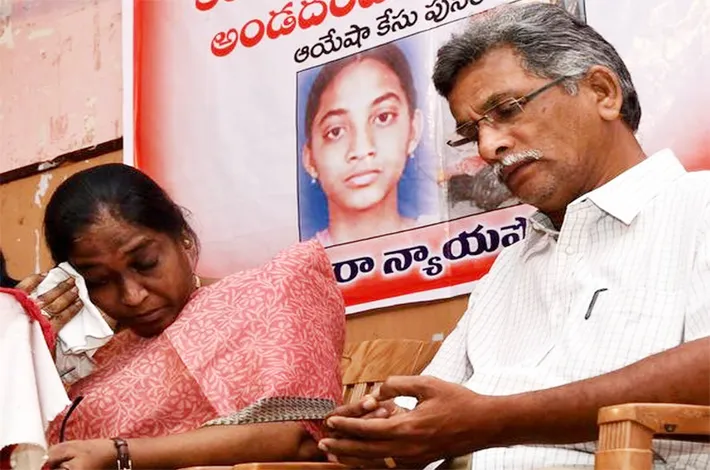
Legal proceedings formally conclude nearly 19 years after the crime
TIMELINE
■ Dec 27, 2007
Ayesha Meera (17½), a B.Pharmacy student, is found brutally raped and murdered in the bathroom of Sri Durga Ladies Hostel, West Ibrahimpatnam, near Vijayawada.
■ Early 2008
Investigators recover a handwritten note allegedly left by the killer claiming the crime was committed after the victim rejected a love proposal
■ August 2008
Police arrest Pidathala Satyam Babu, arrest triggers controversy due to his medical condition (Guillain-Barré Syndrome).
Human rights groups and Ayesha’s parents allege he was falsely implicated.
■ 2010
Vijayawada Women’s Special Sessions Court convicts Satyam Babu under IPC Sections 302 and 376. He is sentenced to imprisonment.
■ March 31, 2017
Hyderabad High Court acquits Satyam Babu.
■ Nov 2018
AP High Court orders a fresh CBI probe following petitions by Ayesha’s parents. Concerns raised over destruction of trial court records.
Case transferred to the Central Bureau of Investigation.
■ 2019-2014
CBI conducts reinvestigation. Forensic evidence re-examined. Second postmortem conducted with experts from Gandhi Hospital, Hyderabad.
Multiple individuals questioned.
■ June 2025
CBI files final closure report. States no legally sustainable evidence found to prosecute any individual.
■ Feb 2026
CBI Special Court in Vijayawada accepts closure report.
Court orders Ayesha’s preserved remains be handed over to her parents.
Final rites scheduled under official supervision in Tenali.
kiranmai tutika I amaravathi
Nearly nineteen years after the brutal rape and murder of B.Pharmacy student Ayesha Meera shook undivided Andhra Pradesh and triggered widespread public outrage, a CBI Special Court in Vijayawada has formally closed the case, ordering that the victim’s mortal remains be handed over to her parents for last rites, bringing legal closure to one of the most debated and disputed criminal cases in the Telugu states.
The court accepted the Central Bureau of Investigation’s final report stating that no conclusive evidence could be found to identify the perpetrators, effectively ending the investigation that spanned multiple probes, court battles, and persistent demands for accountability.
The court directed the CBI to hand over the remains to Ayesha’s parents, Shamshad Begum and Syed Iqbal Basha, and ordered that the final rites be conducted under government security in Tenali on February 27, in accordance with religious customs. Authorities were instructed to video record the entire process in the presence of officials and religious representatives.
Ayesha Meera, aged 17 and half, was pursuing B.Pharmacy while staying at the Sri Durga Ladies Hostel in West Ibrahimpatnam near Vijayawada. On December 27, 2007, the teenager was found brutally raped and stabbed multiple times inside the hostel bathroom. The gruesome nature of the crime sent shockwaves across Andhra Pradesh, sparking fear among families whose daughters lived in hostels for education.
Investigators recovered a handwritten note allegedly left by the killer, claiming the crime was committed after the victim rejected a love proposal. The incident quickly became one of the most sensational criminal cases in the state, drawing intense media attention and public protests.
In August 2008, police arrested Pidathala Satyam Babu, presenting him as the accused. However, the arrest immediately became controversial. Satyam Babu suffered from Guillain-Barre Syndrome, a neurological disorder that severely affected his mobility. Medical reports from the Nizam’s Institute of Medical Sciences (NIMS) indicated that he could barely walk. Despite this, investigators alleged that he scaled compound walls, entered the hostel, attacked the victim, dragged her to the bathroom, and committed the crime, a sequence that critics and activists described as physically improbable.
Human rights groups and civil society activists alleged that Satyam Babu, a poor man from a marginalised background, was made a scapegoat to shield influential individuals. Even Ayesha Meera’s parents publicly rejected the police version from the beginning, insisting that the real culprits had not been identified. Several activists had alleged that the police arrested Satyam Babu only as they could let Koneru Satish, the grandson of former deputy CM Koneru Ranga Rao off the case. Ayesha's parents also alleged that Koneru Satish and his friends were a regular visitors to the girls hostel as it was owned by his relative, Koneru Padma.
In 2010, a Vijayawada women’s special sessions court convicted Satyam Babu under IPC Sections 302 (murder) and 376 (rape), sentencing him to imprisonment. With limited resources and legal support, he spent nearly eight years in jail. The turning point came on March 31, 2017, when the Hyderabad High Court acquitted him, citing lack of credible evidence and serious investigative lapses. The court strongly criticized the police investigation and awarded him compensation for wrongful incarceration, calling the prosecution deeply flawed.
Following petitions filed by Ayesha’s parents and public interest litigations,
the Andhra Pradesh High Court in November 2018 ordered a fresh probe by the CBI. A High Court-monitored Special Investigation Team had earlier found that trial court records were destroyed even before the appeal process concluded, raising serious concerns about procedural irregularities.
The CBI reopened the investigation, conducted extensive questioning, revisited forensic evidence, and ordered a second postmortem examination with forensic experts from Gandhi Hospital in Hyderabad. Several individuals, including persons previously linked to allegations in public discourse, were questioned during the reinvestigation. The fresh probe raised hopes that the long-pending mystery would finally be solved.
However, after years of reinvestigation, the CBI submitted its final closure report in June 2025, stating that despite exhaustive efforts, investigators could not gather legally sustainable evidence to prosecute any individual.
The court has now accepted that report, formally ending the criminal proceedings. As part of the investigation process, Ayesha Meera’s preserved remains had been kept under court custody for forensic purposes. Her parents approached the court seeking their release to perform long-delayed funeral rites, a plea now granted. Speaking to ‘Metro India’, Ayesha Meera’s father Syed Basha said “Our daughter did not lose her life by accident, she was murdered.”