14 July, 2026 | 8:37 AM


Judicial infrastructure not optional but essential: CJI Surya Kant
06-04-2026 12:00:00 AM
I have always viewed this not just as a legal requirement, but as a solemn commitment by the Republic”
Justice Kant
metro india news I hyderabad
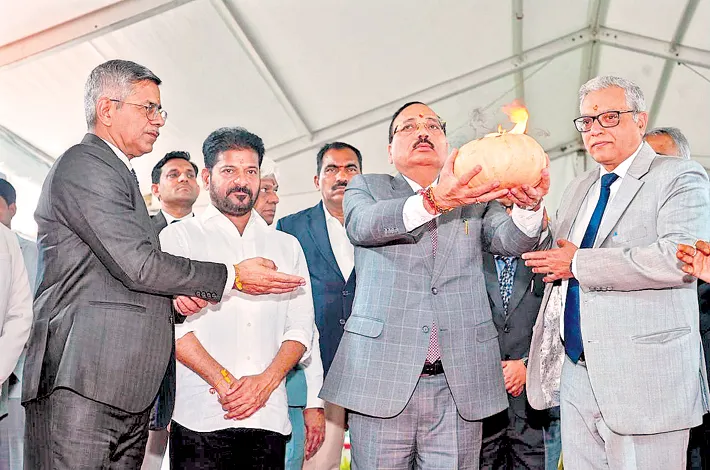
State governments across the political spectrum recognise that strengthening judicial infrastructure is not optional but essential, Chief Justice of India Surya Kant said on Sunday. Addressing a gathering after laying the foundation stone for Telangana High Court Zone II—which includes residential buildings for judges and the Chief Justice—Justice Kant said that when the judiciary and the executive align in purpose, the Constitution truly comes alive.
“The momentum across the country gives me great confidence. In the past few months alone, I have had the privilege of laying foundation stones for judicial court complexes in Uttar Pradesh, Himachal Pradesh, Andhra Pradesh, Assam, and now Telangana,” he said.
“State governments across the political spectrum recognise that strengthening judicial infrastructure is not optional, but extremely essential,” he added.
He further said the Constitution makers firmly believed in the principle of access to justice and, therefore, made it a constitutional obligation to establish a High Court for every state.
“I have always viewed this not just as a legal requirement, but as a solemn commitment by the Republic,” Justice Kant said.
Referring to the existing High Court building, he said that while it is historic and monumental, it has undoubtedly fallen short of meeting present-day requirements.“Therefore, creating infrastructure that caters to the needs of the next hundred years, as rightly pointed out by the Chief Minister (Revanth Reddy), is not just a goal—it is a mandate,” he said.
Referring to the proposed facilities in the new High Court complexes, Justice Kant said they would include multi-storeyed parking, chambers and offices for lawyers, bar rooms, and residential facilities for judges and the Chief Justice.
“The judiciary here will operate on its own terms. That is what institutional self-sufficiency looks like when you translate it from theory into brick and mortar,” the CJI said.
“A judiciary that ceases to learn will stop evolving,” he added.
After viewing the conceptual drawings and models, Justice Kant said the proposed 100-acre High Court complex would be among the best in the country.
He also said that during his discussions with Chief Minister A Revanth Reddy, he was assured that the entire High Court complex, including residential and other infrastructure, would be completed within two years.
“I congratulate the state government for this level of commitment,” he said.
The Telangana government had earlier allotted 100 acres for the new High Court complex, which is planned in two phases, and accorded administrative sanction of Rs 2,583 crore for its construction.
The foundation stone for Zone I of the Judicial Court Complex was laid on March 27, 2024, and construction is already underway.
Zone I comprises the main court complex and office buildings, while Zone II will house residential bungalows, ancillary structures, and a central record room, spanning approximately 60 acres.
Supreme Court judges P S Narasimha, Ujjal Bhuyan, S V Bhatti, Alok Aradhe, and Telangana High Court Chief Justice Aparesh Kumar Singh also addressed the gathering.
CM for mutual respect among democratic pillars
Hyderabad: Telangana Chief Minister A Revanth Reddy on Sunday said that in a democracy, the three branches—legislature, executive, and judiciary—operate with autonomy, interdependence, and mutual respect.
Speaking at an event where Chief Justice of India Surya Kant laid the foundation stone for Telangana High Court Zone II (residential buildings for judges and the Chief Justice), Reddy said it is the duty of the executive to provide the best infrastructure to the judiciary so that it can deliver justice swiftly.
"We believe all pillars must work with mutual respect and avoid confrontations. Hence, we give the highest respect not only to all verdicts and judgments but also to various observations and feedback," Reddy said.
"In India, building a temple, mosque, church, or gurudwara is a rare opportunity. But building a court complex—a campus for justice—is like establishing a space that upholds justice for people of all faiths," he said.
"In our democracy, the three branches operate with autonomy, interdependence, and respect for each other: legislature, executive, and judiciary," he added.
For a common citizen, the court represents the final door to knock on—the last resort, Reddy said.
The CM said it is a great opportunity for him—perhaps once in a lifetime—that his government could initiate the project to build a new High Court complex for Telangana.
He said many governments and CMs in the past could have taken up this project, but for some reason, it was left to his government to undertake this noble task.
The new High Court will become an icon and a functional lifeline for society and democracy. It will serve as a platform where the poor and the weak can seek justice, he said.
"For the next 100 years, the poor, the weak, the voiceless, and the oppressed will come to this temple of justice, seeking to be heard and hoping to find justice," he said.
Reddy further said the current High Court building, which is of great historical significance, is no longer able to support the needs of all stakeholders. "For this reason, we decided to build a new High Court almost immediately after taking charge," he said.
"Beyond legacy, this building reflects my government’s views and values of democracy. We believe that all pillars must work collaboratively, with mutual respect," Reddy said, adding that his government gives the highest respect to the judiciary.
He said it is the duty of the political executive to provide the judiciary with the best modern facilities to perform at its highest level.
"What we are building here will not only be one of the largest High Court buildings in India but also a benchmark of modernity and excellence in public infrastructure," he said.
Reddy said that when the Congress formed the government in Telangana in December 2023, one of its first decisions was to create the new High Court complex at Rajendra Nagar.
The government has handed over 100 acres of land for the project. Work on Zone I of the project is already in progress, he said.
"Today, as we lay the foundation for Zone II, comprising residential buildings, we aim to complete it in record time by December 2027. This is my and my government’s commitment," Reddy said.
He said that work is underway on several new projects, including 49 courts and residential quarters in various towns and districts across the state. He said today is a red-letter day for Hyderabad. "We are taking a step to create a monument for the next century—a crucial pillar of public life," the chief minister said.
The Telangana government had earlier allotted 100 acres for the new High Court complex project, which is planned in two phases.
The state government has accorded administrative sanction of Rs 2,583 crore for the construction of the new High Court building.