25 September, 2026 | 10:23 PM


Job cuts due to AI- Now a reality?
01-03-2026 12:00:00 AM
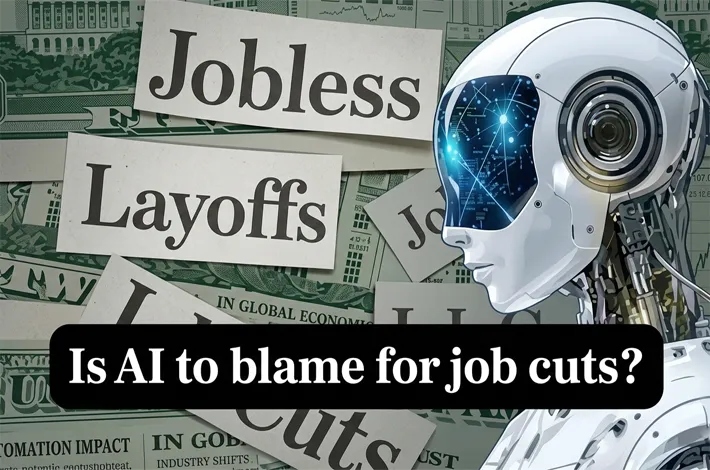
The recent announcement by Jack Dorsey, CEO of Block (the parent company of Square and Cash App), has sent shockwaves through the global workforce. In a public memo that quickly went viral, Dorsey revealed that Block is laying off approximately 4,000 employees—nearly 40% of its roughly 10,000-strong workforce—in a single, decisive move. The explicit reason: advances in artificial intelligence ("intelligence tools") that have dramatically boosted productivity, allowing a much smaller team to achieve more and perform better.
Dorsey described this as a fundamental shift in how companies can operate, with AI capabilities compounding rapidly week by week. He framed the mass layoff as more humane than gradual "death by a thousand cuts," opting for one sharp reduction to enable faster adaptation and growth. The company's stock surged in response, reflecting investor approval of the efficiency gains. This dramatic decision marks a tipping point in the ongoing AI-driven transformation of work.
Unlike previous rounds of tech layoffs often attributed to economic pressures or overhiring, Block's cuts are openly and directly linked to AI taking over tasks previously done by humans. Dorsey's memo emphasizes that AI is already changing the very nature of building and running a company, and he predicts that many other firms will follow suit soon. For employees worldwide—including those in India, where Block employs a significant number—this event serves as a stark wake-up call. If a profitable fintech giant generating billions in revenue can eliminate nearly half its staff overnight due to AI, few sectors or roles seem immune.
Indian companies are responding in real time. Major players like Tata Consultancy Services (TCS) have seen their workforce shrink by about 20,000 from 2022 peaks, while others like Infosys have slowed hiring significantly. Surveys suggest nearly two-thirds of Indian firms have decelerated recruitment after deploying AI tools. White-collar sectors—particularly IT services, BPO, coding, and development—are among the most vulnerable, with tools like advanced language models already handling tasks that once required large teams of coders.
Beyond tech, AI is disrupting law (drafting briefs and analyzing contracts), finance (generating reports and models), software development (building full applications end-to-end), content creation, and even medicine (supporting diagnostics and analysis). In media and creative industries, entire processes are being automated at a fraction of the cost, raising questions about sustainability for human roles.
An AI tech and policy expert, who agreed the situation demands a wake-up call but framed it optimistically. She likened AI's impact to the invention of cars displacing horse-drawn carriages, predicting 70-80 million jobs transformed and 110 million new ones created. She emphasized upskilling from boardrooms to curricula, mandating AI training through collaborations between industry and academia.
She praised India's position, with its demographic dividend and initiatives like the India AI Mission, which provides affordable compute (280 rupees per hour) and focuses on data intelligence, IP creation, and global capability centers (GCCs). Rejecting Western or European models, she advocated for India-specific frameworks, highlighting government consultations and use cases tailored to the Global South, such as critical infrastructure via digital public infrastructure (DPI).
Few other AI related entrepreneurs echoed the call for alertness without panic. They acknowledged over-hiring in tech (citing historical 30% benches in IT firms) but urged individuals to focus on creating value through skills. Some of them encouraged viewing AI as an opportunity for all to become creators, not requiring PhDs or engineering degrees.
With only 4-5 million software engineers in India amid a 500-600 million employable population, he saw room for growth. They advised expanding horizons beyond current jobs, innovating in fields like physical AI, teleportation, or sensory tech (e.g., transmitting smell or touch). They further expressed skepticism about achieving god-like AI soon, insisting human knowledge and creativity remain irreplaceable.
The AI policy expert expanded on job fears, affirming concerns like "Will my job be replaced?" but redirecting to "What can I do?" She highlighted demand for roles in AI/ML engineering, prompt engineering, NLP, computer vision, MLOps, and data engineering, emphasizing human-centric skills like critical thinking and interpersonal communication per the World Economic Forum. She noted AI's limitations in original storytelling or handling geopolitical nuances, advocating for guardrails to ensure conscious adoption. India's approach, she said, avoids one-size-fits-all models, focusing on productivity enhancement for SMEs and MSMEs through diffusion of innovation.
The path forward requires treating AI not as a gadget but as essential survival training. Individuals must continuously learn, become creators of AI solutions, and expand horizons to invent new fields and opportunities. Governments, academia, and industry must collaborate on updated curricula, responsible frameworks, and human-centric policies to ensure equitable transition. While anxiety is justified—roles may shrink, salaries plateau, and value erode without adaptation—the Block layoffs signal that large-scale AI-driven change is now acceptable, practical, and accelerating.