23 September, 2026 | 8:25 AM


Hyd’s Rs 2 Lakh Crore Bet
15-07-2026 12:00:00 AM
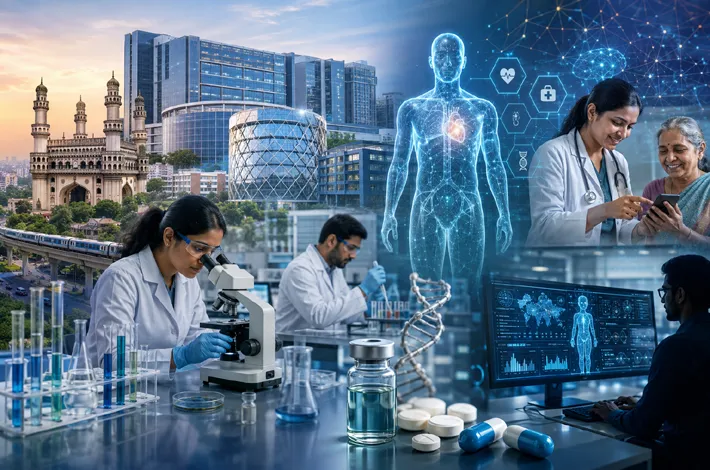
It built the world’s medicine, can it build the world’s health?
Hyderabad already makes the world’s medicine. The harder, and greater, task is to build the architecture of the world’s health — and that is a task the city is unusually equipped to attempt
Dr M Vaman Rao
In January, on a stage at Davos, Telangana placed a bet. Unveiling its Next-Gen Life Sciences Policy 2026–30, the state set a target of drawing Rs 2 lakh crore — roughly $25 billion — in investment over five years, and creating half a million high-quality jobs, with the stated ambition of ranking among the world’s top life sciences clusters by the end of the decade. It was not an idle announcement.
Over the preceding two years, Telangana had already attracted close to Rs 73,000 crore in life sciences investment. The capital is real, the momentum is real, and the world is watching. The question that matters now is not whether Hyderabad can attract the money. It plainly can. The question is what the money builds. Can build something the world does not yet have: an architecture of health that begins with the individual and rewards prevention over treatment. The choice is being made now.
Pharmacy of the World
For three decades, Hyderabad has earned a title few cities can claim: The Pharmacy of the World. It supplied vaccines to billions and formulated the generics that made essential medicines affordable across continents. Telangana today accounts for roughly a third of India’s pharmaceutical production and nearly a fifth of its exports, hosts one of the highest concentrations of USFDA-approved manufacturing sites anywhere on earth, and supplies close to a third of global vaccine demand. Home to more than 2,000 life sciences companies, the city did not merely participate in the global pharmaceutical economy. It helped hold it up.
That legacy has lately drawn a new kind of investor. Beyond manufacturing, the world’s largest life sciences companies — Novartis, Eli Lilly, Roche, Sanofi, Bayer, Bristol Myers Squibb, Amgen, and others — now run global capability centres in Hyderabad, the high-value hubs where scientific depth meets digital engineering. The concentration is so dense that the city has begun to be called the Silicon Valley of Life Sciences. This is the ground on which the next decision will be made.
From molecules to intelligence
The world has changed beneath the industry that Hyderabad mastered. Healthcare is no longer only about molecules, milligrams, and manufacturing throughput. It is increasingly about intelligence — predictive, personalised, preventive, and continuous. The value in health is migrating from the pill that treats an illness to the system that prevents it: the capacity to detect metabolic risk before it becomes disease, to organise a person’s health over years rather than episodes, and to reward the hospitalisation that never happens rather than the one that does.
This is where the policy’s own language is telling. The Next-Gen framework speaks not only of manufacturing but of precision medicine, digital health, diagnostics, and a decisive shift from volume-led growth to value-driven, innovation-centric development. The state has recognised that the next wave of life sciences growth will be defined by research capability, digital integration, and the convergence of life sciences with artificial intelligence. A Rs 1,000 crore Life Sciences Innovation Fund has been created to catalyse early-stage, deep-science ventures. R&D units are now recognised as industries in their own right. These are not incremental adjustments. They are architectural choices.
The convergence few cities possess
What makes this more than aspiration is a convergence that is genuinely rare. In most of the world, the people who build software and the people who build medicines occupy different cities, different institutions, and different cultures. Hyderabad holds both. It houses some of India’s most sophisticated information-technology capability alongside its most advanced life sciences infrastructure. Engineers and biologists, AI researchers and pharmacologists, data scientists and clinicians share the same campuses and the same talent pool. That convergence is the raw material for something genuinely new — not merely better drugs, but better health intelligence.
The digital foundations are already laid, and they are national. India’s Unified Payments Interface has made frictionless digital payment ordinary for hundreds of millions. The Ayushman Bharat Digital Mission has created a national health identity and consent architecture, with nearly 80 crore health accounts generated. Messaging platforms are the everyday interface for over half a billion Indians. These are not consumer conveniences. They are the rails for a fundamentally different model of care — one that can move, in a phrase, from ‘Find It, Fix It’ to ‘Predict It, Prevent It.’
The conditions for trust
None of this can be built on hype. An architecture of health must be governed by clinical oversight, not by autonomous algorithmic decision-making. Health data must be treated as a trust asset — consent-specific, transparent, revocable, and understandable to the person it belongs to. Distributed networks of diagnostic labs, clinics, and pharmacies only create value if they are credentialled, audited, and measured against outcomes. Hyderabad’s fragmentation is not a flaw to be apologised for; it is the starting material. But raw material becomes infrastructure only when it is assembled with discipline.
The city should also resist the assumption that healthcare maturity means importing every feature of Western regulatory architecture wholesale. Catastrophic care must be better pooled and public health systems strengthened; on that there can be no compromise. But preventive and consumer-facing services should not be forced prematurely into the rigid claims machinery that has made healthcare in the developed world so expensive and so slow to change. Better models — built around subscriptions, transparency, and consent — can be constructed instead. India never laid the wire of six decades of billing-code bureaucracy. It need not lay it now.
The choice before the city
The world is ageing. Chronic disease is rising in every geography. Health systems everywhere are struggling to shift from reactive treatment to proactive prevention. If Hyderabad builds the right architecture now, it can export not merely drugs and vaccines, but health intelligence, care protocols, and real-world evidence drawn from one of the most diverse patient populations on earth. The Rs 2 lakh crore is the means. The half-million jobs are the measure. But the prize is larger than either: to build a health infrastructure the world has not yet seen — one that begins with the individual, rewards prevention, and uses artificial intelligence to extend good care to many more people, not to replace the doctor who delivers it.
Hyderabad did not become the Pharmacy of the World by accident. It required deliberate policy, entrepreneurial risk, and a willingness to build where others hesitated. The same qualities are required now, for a harder task. The capital is committed. The companies are here. The talent and the digital rails are in place. What remains is the rarest ingredient of all — the architectural discipline to connect them, and the ambition to see that the task is no longer to make the world’s medicine, but to help build the world’s health. The wire of the old system was never laid here. The city is free to build the new one. Few places on earth are freer, or better prepared, to try.
(Dr. M. Vaman Rao is a Boston based scientist,
serial entrepreneur, innovator and investor)