25 August, 2026 | 1:33 AM


Historian identifies ‘Hinduraya Suratrana’ title at Kadiri Temple
10-07-2026 12:00:00 AM
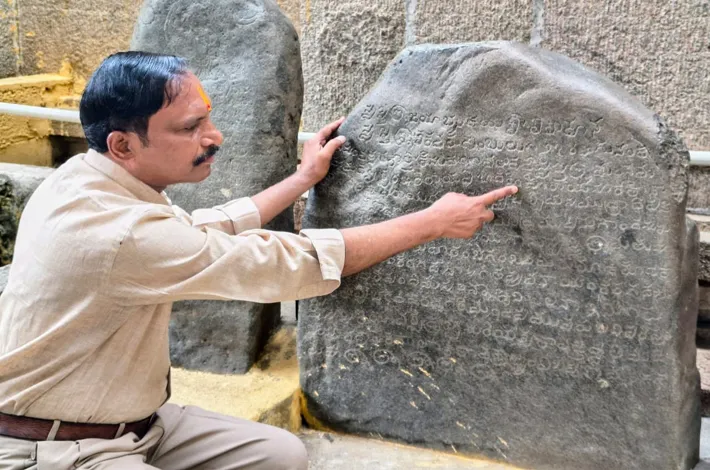
- A 1352 CE Telugu inscription at Kadiri is the earliest known record of the title ‘Hinduraya Suratrana’
- The title later appears in the 1354 Penukonda Fort inscription and Krishnadevaraya's 1513 Sri Kalahasti inscription.
- The title, meaning ‘Protector of the Hindu Kingdoms/Deities’ reflected the Vijayanagara rulers' role in safeguarding temples, religion and cultural heritage.
Metro India News | KADIRI
In a significant breakthrough in epigraphical and historical research, the earliest recorded instance of the title ‘Hinduraya Suratrana’ has been identified within the precincts of the famous Sri Lakshmi Narasimha Swamy temple at Kadiri in Sri Sathya Sai district(A.P.). Historian MyNaa Swamy on Wednesday announced that recent historical studies have brought to light rare and ancient epigraphic evidence containing the distinct title inscribed in a stone inscription dating back to 1352 CE, issued during the reign of the Vijayanagara monarch, Bukka Raya I.
According to MyNaa Swamy, this marks the absolute first occurrence of the prestigious title on a stone inscription, written in Telugu. The historian further noted that the title subsequently reappears in the Penukonda Fort construction inscription of 1354 CE—a stronghold of immense strategic importance to the Vijayanagara Empire—and later during the golden age of the empire in the Sri Kalahasti inscription issued by Krishnadevaraya in 1513 CE.
Historian Swamy emphasized that the usage of ‘Hinduraya Suratrana’ was not merely confined to architectural projects like temples, forts, and palaces, but was also extensively employed in donative inscriptions granting lands and resources to temples, hereditary priests (Archakas) and spiritual preceptors (Sthanacharyas). Elaborating on the socio-political and cultural significance of the phrasing, Swamy explained that ‘Hinduraya Suratrana’ is a Sanskritized term translating to "Protector of the Hindu Kingdoms" or "Protector of Hindu Deities."
He observed that the rulers of Vijayanagara were pioneers in effectively resisting the aggressive military expansions of contemporary sultanates, thereby successfully asserting their political sovereignty. "The absolute truth remains that the Vijayanagara kings never harbored intent to arbitrarily annex foreign territories or plunder external wealth," Swamy remarked. "Their strategic military maneuvers were driven purely by the necessity to defend their realm, their subjects, and their cultural heritage."
He added that these monarchs transcended the conventional role of mere rulers, operating as devout guardians of Hindu dharma, dedicating immense resources toward its preservation and cultural renaissance. MyNaa Swamy, who has been conducting extensive, long-term research on the temple architecture, fortifications, royal palaces, and epigraphy of the Vijayanagara era, also shared that his comprehensive monograph, titled 'Temple Architecture and Art of Vijayanagara-Hampi', is slated for release shortly.