4 October, 2026 | 1:23 PM


Extraordinary Life of Dr Karan Singh
14-03-2026 12:00:00 AM
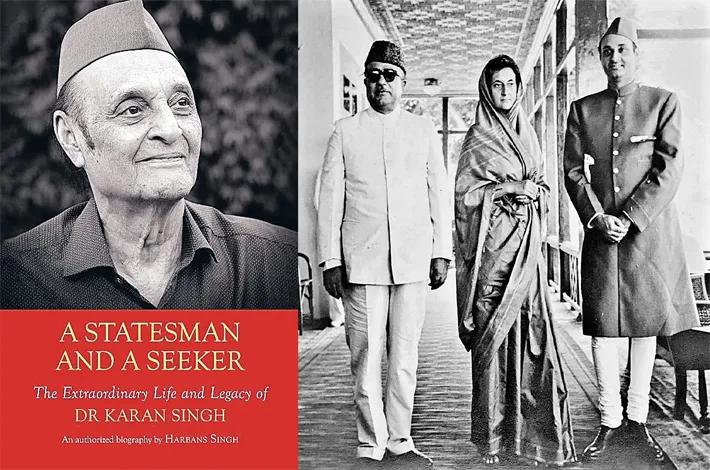
Regent of Jammu & Kashmir at 18, Sadar-e-Riyaasat at 21 under Prime Minister Jawaharlal Nehru, Governor at 34 under Lal Bahadur Shastri, Union Minister at 36 under Indira Gandhi, and Indian Ambassador to the United States at 58 under Rajiv Gandhi, Dr Karan Singh’s political life spans over half a century. Eighteen years in Jammu & Kashmir alone mark a unique record of leadership.
Harbans Singh’s authorized biography, A Statesman and a Seeker: The Extraordinary Life and Legacy of Dr Karan Singh, was released at the India International Centre in New Delhi on March 6, 2026, three days before Dr Karan Singh’s 95th birthday. At the event, he spoke with former Union Minister Shashi Tharoor and Malavika Singh of Seminar magazine, showing remarkable memory and wit.
Nehru and Indira Gandhi
A lifelong admirer of Jawaharlal Nehru, Dr Karan Singh read Discovery of India and Nehru’s autobiography before meeting him. Nehru, whom he regarded as a mentor and guru, fondly called him “Tiger” in correspondence. He also maintained a long-term correspondence with Indira Gandhi, later published as Kashmir and Beyond: 1966–84. He supported her Progressive Agenda during the 1969 Congress split and represented India in Iran during the 1971 war, predicting the eventual downfall of Shah Reza Pahlavi before the 1979 Islamic Revolution.
Dr Karan Singh was present during the 1975 Indira Gandhi–Sheikh Abdullah Pact and supported the Emergency, consistently remaining with the Congress. Sonia Gandhi later appointed him President of the Indian Council for Cultural Relations (2005–2014) and secured his Rajya Sabha election.
Erudition and Scholarship
A PhD on Sri Aurobindo’s political thought, Dr Karan Singh leads Auroville and can recite long passages of Savitri. He has met philosophers such as Aldous Huxley and Jiddu Krishnamurthy (though he disagreed with the latter) and learned Hinduism and Vedanta from S Radhakrishnan.
In Parliament, his speeches demonstrated profound erudition. On August 21, 2008, discussing Nalanda University, he highlighted its global historical significance, noting that it housed 10,000 students and 2,000 teachers for 800 years, paralleling Harvard and Oxford of the ancient world.
Arts and Music
Dr Karan Singh is a trained lyricist, composer, and singer of Dogri folk and devotional songs, while enjoying Western rock and Abba. A devotee of Bharata-Natyam, he admires Yamini Krishnamurthy and is deeply engaged in cultural pursuits.
Jammu & Kashmir: Integration and Controversies
Dr Karan Singh’s life is intertwined with Jammu & Kashmir’s political evolution. The state joined India post-Independence via the Instrument of Accession, and he issued the 1949 Proclamation accepting the Indian Constitution. Though personally close to Sheikh Abdullah, Dr Karan Singh, following Nehru’s guidance, ordered Abdullah’s arrest in 1953 when he opposed national interests.
He navigated nomenclature issues—Sadar-e-Riyaasat and Wazir-e-Azam—without threatening unity, transitioning to Governor in 1965. Central jurisdiction extended gradually under his tenure. He criticizes later political moves that created unnecessary controversies over Jammu & Kashmir’s status, arguing that Statehood should at least be restored after Article 370’s abrupt abrogation.
The 1975 Delhi Declaration under Indira Gandhi, which he witnessed, ended Abdullah’s demand for self-determination, merging the Plebiscite Front into the National Conference while reaffirming constitutional authority. Dr Karan Singh emphasizes that Article 370’s original “temporary” nature justified its eventual removal but should have been done sensitively.
Democratic Commitment
Choosing Nehru over his father, Maharaja Hari Singh, Dr Karan Singh embraced democracy and gave up the Privy Purse ahead of Indira Gandhi’s abolition of princely privileges. He served Jammu & Kashmir from 1948–1967 before moving to national politics, elected from Udhampur in 1967, joining Indira Gandhi’s Cabinet in Tourism and Civil Aviation, later Health and Family Planning. During the Emergency, he was one of three MPs in North India re-elected despite Congress losses.
He also attempted a Presidential bid in 2007 but lost due to opposition from UPA allies and political misperceptions about his past, including the brief Virat Hindu Samaj initiative in 1981, aimed at social reform.
Pluralism and Values
Dr Karan Singh stands out for emphasizing pluralism and tolerance. He stresses Hinduism’s inclusivity, allowing individuals to choose their preferred deities, contrasting it with narrow communal interpretations that concern him deeply.