10 October, 2026 | 3:44 AM


Everyone has AI, what’s your edge?
10-10-2026 12:00:00 AM
Startups On Saturday
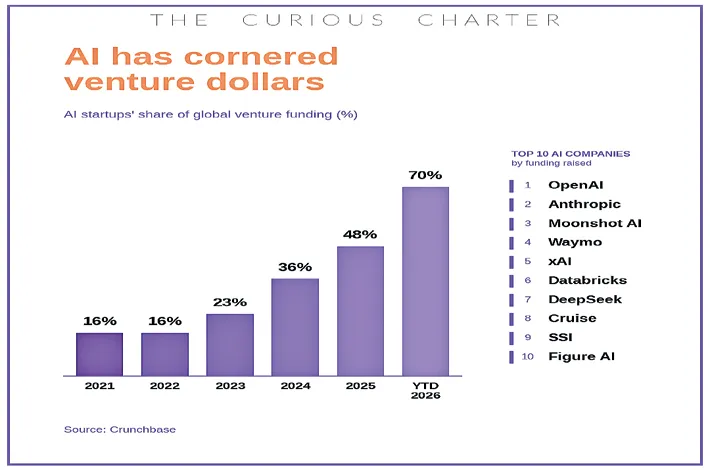
Two vowels are more special than others in 2026 – they are A and I. In fact, the Caribbean island of Anguilla is making millions from the AI boom, because it owns the .ai domain. It is tough to find a pitch these days without these letters in prominence. It is the biggest mass-accessible technology change since the internet, and therefore prompts this very pertinent question – “If every startup has AI, what makes your startup special?”
History may or may not repeat, but it rhymes. Early 2000’s afforded a similar question, “If everyone has access to the Internet, what makes your startup special?” Back then, in the beginning, a website would have been a badge of honour, then ecommerce, then mobile commerce and so on. AI evolution is similar and much faster. So the question is not “Are you an AI startup or an AI business?”, it is “What do you own that a challenger cannot copy even with AI?”. Here are a few that are worth owning and tough to unseat.
I will name one transient advantage, four lasting moats and one X-factor.
First, the transient advantage. This is the temporary discontinuity in business models. Businesses that can raise capital aggressively and capture scale through first mover advantage will win here. However, there is absolute power law at AI scale at play here. For every one that succeeds, hundreds or even thousands will fail.
Second, four lasting moats
Deep Technology. Deep science, hard engineering, patents. An application can be vibe coded in a weekend. A drug discovery lab or a factory producing physical goods at scale cannot be. This is a lasting moat. This is one of the factors driving the interest in deep tech startups.
The data moat. Systems of Record or Proprietary data. The information that is not available to everyone, but is uniquely available to a business makes it valuable. A startup that holds a unique and constantly updated record, the official ledger of who owns what or who paid whom, owns what the industry calls a "system of record".
Network Effects. There are some categories of business models where each new user makes the product more valuable for the next one. Uber, Ola and Rapido fall into this category. A new rival with AI cannot build the network with speed.
Brand, Trust and (Customer) Relationships. When every platform can do the same trick, people buy from brands they trust. Trust is earned in drops, one promise at a time. You cannot download brand, trust and relationships with AI.
And now the X-factor, Embedded Systems. This is what I would bet on. To become the place where work actually happens and service gets delivered. A business that is deeply embedded into the customers workflows. A business that is deeply embedded with compliance and regulatory understanding. A platform with embedded finance or embedded liquidity. Once these embedded systems are built, switching them requires re-wiring the house. The product becomes stronger with every use.
A moat is what every startup chases to survive. So if you work at an AI startup, invest in one, or are thinking of starting one, ask a simple question. Which of these will you own? Why it matters: When everyone has the same intelligence, the winner is whoever owns the record, the relationship and the workflow around it. Ask of any startup, including your own: what gets stronger every time someone uses it?

(Ravi Ravulaparthi is the CEO & Cofounder of Qapita.)