28 June, 2026 | 1:43 AM


DPI 2.0 targets MSME, agri output via faster policy push
29-04-2026 12:00:00 AM
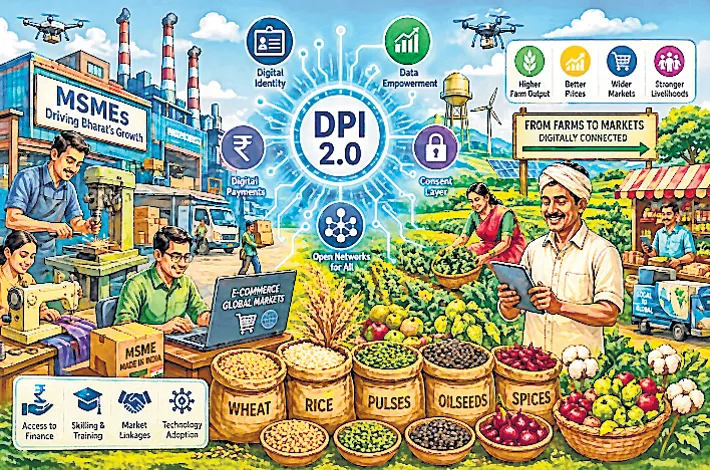
Decentralised rollout, pilot cycles and global partnerships aim to boost livelihoods, scale innovation, strengthen inclusive growth nationwide
Commodity Desk MUMBAI
NITI Aayog has outlined a detailed roadmap for the rollout of Digital Public Infrastructure (DPI) 2.0, emphasising decentralised execution, sector-focused transformation cycles, and stronger global engagement to accelerate India’s journey towards a $30 trillion economy by 2047.
According to the report, India’s DPI initiatives are already contributing nearly 1% to GDP and have the potential to reach 4% by 2030, making rapid implementation critical. It noted that DPI 2.0 should be driven through decentralised initiatives, with the Centre and NITI Aayog acting as catalysts by providing funding, coordination, and policy guidance. The report highlighted that India’s diversity necessitates localised strategies, where regional and district-level administrations play a central role in building self-sustaining economic ecosystems. While execution will be decentralised, the Centre will support through ecosystem collaboration and institutional backing.
To ensure effective implementation, the report proposed adopting structured two-year iterative cycles for sectoral transformation. In the first year, pilot projects will be rolled out in selected districts, followed by scaling up successful models and strengthening ecosystem capacity in the second year.
This approach aims to create replicable solutions and accelerate nationwide adoption. The first transformation cycle, planned for 2026–27, will focus on MSMEs and agriculture, identified as sectors with the highest potential for large-scale livelihood impact and productivity gains. The plan recommends working with six “champion” regions or Union Territories, each identifying one or two districts for pilot implementation, ensuring representation across all parts of the country. Key milestones include pilot design and rollout, demonstration of measurable impact at the district level, development of transformation playbooks, and expansion of successful models to at least five additional regions. This phased approach is designed to build scalable and adaptable frameworks.
To support execution, the report recommended establishing an institutional framework led by the Ministry of Electronics and Information Technology and NITI Aayog. This includes forming a coordination team, an expert advisory group, and engaging specialised DPI organisations to guide sectoral transformation efforts.