26 October, 2026 | 1:17 AM


Democracy at crossroads?
26-10-2026 12:00:00 AM
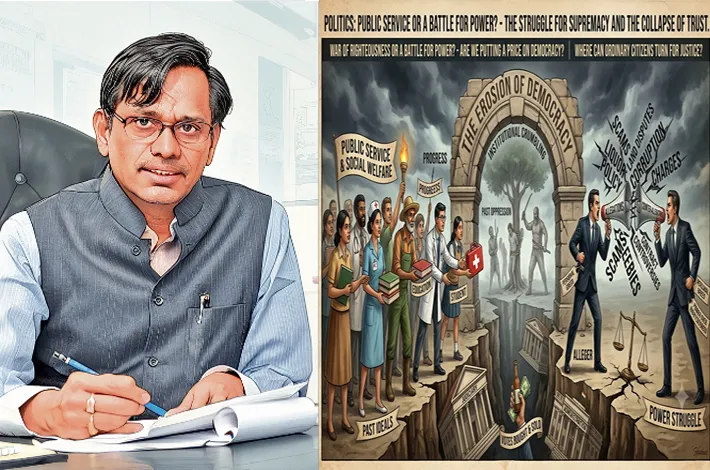
Democracy cannot survive on allegations alone; it requires accountability, transparency, and tangible results
C L RAJAM
There was a time when politics was regarded as a means of public service and social welfare. Those days seem to have disappeared. Today, politics has transformed into a bitter and destructive battle for power. In this struggle for supremacy, where moral values and public interests are increasingly side-lined, the institutions that hold society together are gradually crumbling. Public trust in these institutions is eroding. The growing dominance of injustice over justice and unrighteousness over righteousness has become a serious cause for concern. The conflict between right and wrong, justice and injustice, and public service and personal greed has come to define the disturbing reality of contemporary politics. Although people elect their representatives in a democracy, they ultimately become victims of political decisions, administrative negligence, and institutional failures.
Once, politics served as a platform for addressing public grievances and advancing social development. Elected representatives were expected to resolve people's problems and lead society towards progress. Today, however, political discourse is dominated by allegations and counter-allegations, contract controversies, land disputes, liquor policy scandals, corruption charges, and promises of freebies. These issues have increasingly become the centre of democratic politics. When one leader accuses another of being a thief, the response is often an even harsher counterattack, with accusations of greater wrongdoing. Amid this endless exchange of allegations, the questions that genuinely matter to the public remain unanswered. The people are neither hearing convincing explanations nor seeing meaningful solutions.
A war of righteousness or a battle for power?
The war between the Pandavas and the Kauravas in the Mahabharata was not merely a struggle for a kingdom. It symbolised the eternal conflict between righteousness and unrighteousness. Observing contemporary politics, it is difficult not to draw parallels with this epic battle. Every political party claims to stand on the side of righteousness while portraying its opponents as forces of evil. But who is genuinely standing with the people? Who is fighting for the truth? Who is protecting public money? These are fundamental questions that political parties must answer.
Political debates today revolve around alleged fraud, land scams, contract irregularities, controversies surrounding liquor policies, and the announcement of free schemes to attract voters. Those who make allegations must substantiate them with evidence, while those accused must explain the facts to the public. Investigative agencies must function independently and impartially. If genuine public concerns are buried beneath the noise of political accusations and counter-accusations, nothing meaningful will remain at the end of the day. Democracy cannot survive on allegations alone; it requires accountability, transparency, and tangible results.
A price on democracy?
The vote is the most powerful weapon available to an ordinary citizen in a democracy. However, when the practice of buying votes for as little as Rs. 500 or a bottle of liquor becomes widespread, the very foundations of democratic values are endangered. Citizens who sell their votes for temporary benefits may subsequently find themselves running from pillar to post for five years, seeking solutions to the very problems that their elected representatives promised to address. This is a reality that is increasingly visible in our society.
The greatest danger lies in the mind-set of those who purchase votes. Instead of viewing public office as an opportunity to serve society, they may treat electoral victories as investments from which they expect to recover their money, often through corrupt or unlawful means. When politics becomes a business transaction, public welfare inevitably takes a back seat.
Welfare schemes can undoubtedly improve people's lives and provide essential support to vulnerable sections of society. However, such schemes must be implemented with fiscal responsibility and a clear vision for long-term development. If political parties compete with one another by announcing increasingly attractive benefits in the name of welfare while neglecting education, healthcare, employment, roads, sanitation, and other essential services, the ultimate losers will be ordinary citizens. Genuine welfare must empower people and improve their quality of life, not merely serve as an electoral strategy.
Role of administrative institutions
The weakening of public institutions raises an uncomfortable question: are we gradually slipping back into a form of subordination reminiscent of British colonial rule? During the British Raj, district collectors wielded considerable administrative authority. Today, despite living in a democracy, elected representatives such as MLAs and MPs sometimes behave as though they exercise similar, unchecked control over the administration in their constituencies.
In such circumstances, district collectors and other administrative officers risk being reduced to the role of subordinates who are expected to follow political instructions rather than discharge their statutory responsibilities independently. The constitutional distinction between elected representatives and the administrative machinery becomes blurred. Some public representatives appear to have forgotten that their primary responsibility is to serve the people, while treating the misuse of public resources and the accumulation of wealth through unlawful means as though they were entitled privileges.
In a democratic system established after independence, elected representatives and government officials must perform their respective duties while remaining accountable to the public. MLAs and MPs have every right to question administrative performance, raise public grievances, and press officials to resolve problems. However, administrative decisions must be taken lawfully and in accordance with established rules and procedures. There must be a clear distinction between the authority of elected representatives and the responsibilities of government officials. Political oversight must not become political interference, and public administration must not be reduced to a system of personal obedience.
If the widespread practice of illegal collections, bribery, and other forms of corruption across government departments and local bodies were effectively curbed, citizens would experience greater relief than they might from many other development programmes. Eliminating such malpractices would restore public confidence and provide genuine relief to ordinary people. Every rupee of public money must be accounted for, and every legitimate complaint must receive a response. Yet, despite the urgent need for reform, meaningful efforts to repair the system remain inadequate.
Learning lessons from the past
A look back at history reminds us of the brutal exploitation suffered by ordinary people under feudal landlords and powerful local elites. In earlier times, landlords and village authorities subjected innocent people to severe cruelty, sometimes tying them to trees and beating them mercilessly. Such oppression created an environment in which radical movements, including the Naxalite movement, emerged in response to exploitation and the denial of justice.
The disturbing reality is that, even in the age of democracy, some forms of injustice and oppression appear to persist in altered forms. In the past, feudal lords often exercised their power through direct violence and intimidation. Today, powerful political figures may exploit administrative structures and institutional weaknesses to disadvantage the poor and vulnerable. The methods may have changed, but the suffering of ordinary people can remain painfully similar.
History teaches us that when institutions fail to protect citizens, frustration and resentment grow. A democratic society must ensure that no individual or group is allowed to wield power without accountability. The purpose of democracy is to eliminate arbitrary authority, not to allow it to re-emerge under a different name.
Where do ordinary citizens turn for justice?
Administrative institutions, which should form the backbone of democracy, are increasingly facing questions about their effectiveness and credibility. Public confidence in departmental heads and senior officials is diminishing. IAS and IPS officers, who are expected to serve with integrity and impartiality, may find their independence compromised by political pressure. When officials cannot act freely in accordance with the law, the quality of governance suffers and citizens lose confidence in the administration.
The judiciary, which should serve as the final refuge for those seeking justice, is also burdened by prolonged delays. Even relatively straightforward disputes can take years or decades to resolve. Worse still, people who spend years navigating the courts may remain uncertain about whether they will ultimately obtain justice. For ordinary citizens, prolonged litigation can mean enormous financial costs, emotional distress, and the loss of valuable time.
When administrative institutions fail, officials come under political pressure, and the judicial process moves at a painfully slow pace, where can the common citizen turn for protection? Whom should they approach to have their grievances heard? A democracy cannot claim to uphold justice if it’s most vulnerable citizens are left without an effective remedy. Institutions must not merely exist on paper; they must function in ways that people can trust and access.
The ultimate measure of democracy is not how fiercely political parties fight for power, but how effectively they protect the rights, dignity, and well-being of the people they represent. It is time to restore that principle to the heart of Indian politics.
Generation Z must rise to the challenge
If society is to escape this dark and disheartening situation, one source of hope lies in the younger generation, particularly Generation Z. Young people have the potential to challenge outdated political practices and demand a new approach to public life. They can look beyond narrow interests based on caste, religion, money, and traditional political loyalties. Their willingness to question established practices and expose institutional failures could become a powerful force for democratic renewal.
However, change will not come through criticism alone. Young people must participate actively in civic life, educate themselves about public policy, demand transparency, hold elected representatives accountable, and reject the politics of bribery and divisiveness. They must recognise that democracy is not limited to casting a vote once every five years. It also requires continuous public participation, informed debate, and a commitment to protecting constitutional values.
The younger generation must come forward to help reform failing institutions, restore the importance of righteousness and justice, and guide society and the nation towards a better future. This does not mean replacing one set of political personalities with another while leaving the system unchanged. It means transforming the culture of politics itself, from one driven by personal ambition and the pursuit of power to one rooted in integrity, public service, and responsibility.
Restoring the spirit of democracy
When politics becomes nothing more than a struggle for power, democracy inevitably weakens. Justice for the people becomes possible only when public service once again takes centre stage. For righteousness to prevail, the country needs honest leadership, impartial administration, an efficient judiciary, and an alert and responsible civil society. These are not optional ideals; they are essential foundations of a functioning democracy.
Generation Z must take the initiative in bringing about this transformation. Young citizens must refuse to accept corruption, question abuses of authority, and insist that public institutions serve the people rather than those who control them. They must demand a political culture in which accountability is the norm, public money is protected, and every citizen is treated with dignity.
Only when the younger generation rises to this challenge can the destructive political battle that has overshadowed public service begin to end, paving the way for genuine justice for ordinary citizens. When ordinary people receive justice, institutions begin to change. When institutions change, society changes. And when society changes for the better, the future of the nation becomes brighter.