6 October, 2026 | 3:38 PM


Congress BJP’s B-team, says Keralam CM Pinarayi Vijayan
24-03-2026 12:00:00 AM
Reflection of changing political equations
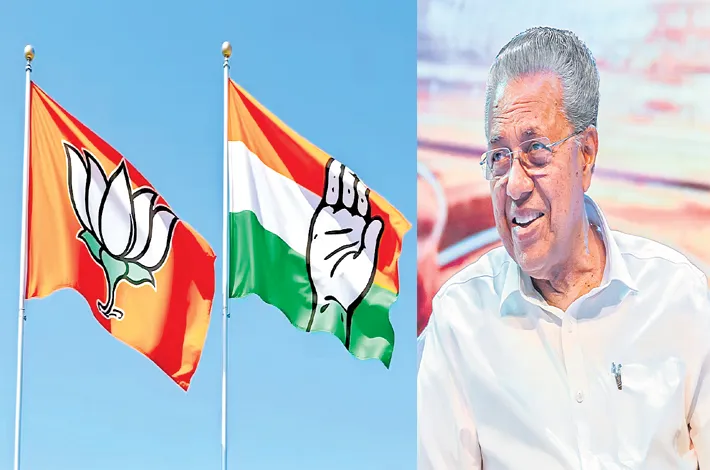
The political landscape in Kerala has intensified ahead of the April 9, 2026, Kerala Legislative Assembly elections, with sharp exchanges between the ruling Left Democratic Front (LDF), led by the CPI(M), and the opposition United Democratic Front (UDF), led by the Congress. In an interview, Kerala Chief Minister Pinarayi Vijayan accused Congress leader Rahul Gandhi of effectively acting as the "B-team" of the BJP. Vijayan suggested that the Congress's actions and positions indirectly benefit the BJP, describing it as a diversion from real governance issues.
Vijayan highlighted specific examples to support his claim of Congress-BJP collaboration. He noted that in the Delhi assembly elections, several Congress MLAs reportedly crossed over to support the BJP, helping it secure additional seats. In Kerala, he observed that the Congress rarely criticizes the BJP directly, instead focusing its attacks on the Left Front. According to Vijayan, this pattern demonstrates an explicit compromise at the national level and a tacit understanding in state politics, where both parties oppose the Left.
This remark sparked immediate backlash from the Congress. AICC general secretary and prominent Kerala MP KC Venugopal, who is close to Rahul Gandhi, strongly condemned the statement. He described Vijayan's allegation as "pathetic" and beneath the chief minister's stature. Venugopal expressed sympathy for Vijayan's situation, questioning his mental state over such comments. He emphasized that Rahul Gandhi has consistently been at the forefront of criticizing Narendra Modi's failures and opposing the BJP's policies on democracy, institutions, federalism, and the Constitution. Venugopal argued that labelling the Congress as the BJP's B-team is not a serious political argument but a tactic to divert attention from the LDF government's alleged failures and growing public dissatisfaction in Kerala.
A Congress national spokesperson defended his party vigorously, asserting that the Indian National Congress has been the principal ideological and political opponent of the BJP nationwide. He highlighted the Congress's consistent fight against the BJP on issues like secularism, minority rights, and constitutional protection. He dismissed the B-team allegation as pure hypocrisy and diversionary tactics, pointing out that in Kerala, the CPI(M) spends more time attacking the Congress than opposing the BJP. This, he claimed, divides the anti-BJP vote space and indirectly benefits the saffron party.
CPI(M) leaders defended the Left's position by emphasizing India's unity in diversity, acknowledging that political contradictions exist between states. They explained that while the Left and Congress unite nationally in the INDIA bloc to oppose the BJP's "communal and fascist" government, in Kerala, the primary contest is between the LDF and UDF, with the BJP remaining a minor player. They urged the Congress to control its leaders' statements and criticized certain Congress figures for their foreign policy views, linking Kerala's economic woes to the Modi government's Gulf-related policies and alleged withholding of funds from anti-BJP states.
A BJP spokesperson countered by agreeing with Vijayan on one point: that some political figures fail to learn from past mistakes. She highlighted the BJP's growing footprint in Kerala, citing milestones like Suresh Gopy's Lok Sabha win in 2024, a BJP mayor in Thiruvananthapuram, and increased vote shares in recent elections. She rejected any A-team or B-team alliances, insisting the BJP stands independently. She pointed to Supreme Court observations on Kerala's borrowing limits and fiscal mismanagement under the LDF, urging the state to take responsibility rather than blame the Centre. She also listed alleged scams under Vijayan's tenure, including those involving his family members, to question the Left's governance.
A BJP spokesperson in turn countered by framing the situation as a "fixed match" between the Left (LDF) and Congress (UDF), with both parties acting as each other's B-team. He criticized both for failing to address radicalization in Kerala, noting no strong protests against events like a conference involving former Hamas chief Khaled Mashal shortly after attacks on Israel. He accused Rahul Gandhi of silence on issues like the gold smuggling case, showing leniency toward corruption, and delayed response to landslides compared to quicker RSS efforts. He portrayed both fronts as incompetent and destined for rejection, with BJP aiming to boost its vote share to 18-20% as a step toward becoming the future alternative in the state.
The discussion touched on internal Left rifts, notably the case of veteran CPI(M) leader G Sudhakaran, who quit the party after 63 years and announced his independent candidacy from Ambalappuzha. Vijayan labelled him a "traitor" and "class renegade," while Sudhakaran denied receiving calls from the CM and defended his move. A CPI(M) spokesperson predicted Sudhakaran would fade politically like others who left the LDF.
The discussion revealed the complex and often contradictory nature of political alliances in India. While Congress and the Left share stages and cooperate nationally against the BJP, state-level rivalries in Kerala lead to bitter exchanges. Historical context was invoked, including the Congress's dismissal of the world's first democratically elected communist government in Kerala in the 1950s, as well as periods of support and withdrawal during events like the Emergency and UPA governments. Ultimately, the heated exchanges underscore a temporary estrangement driven by electoral necessities.