3 July, 2026 | 1:33 PM


Battle at Hyd Beverly Hills!
25-04-2026 12:00:00 AM
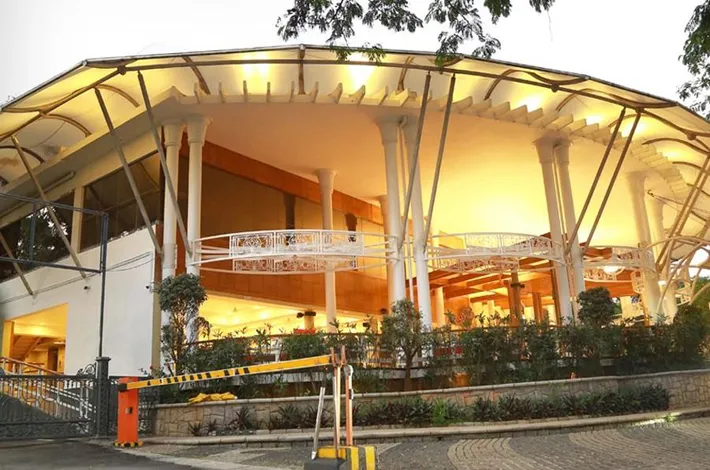
One of India’s largest and wealthiest housing societies is mired in controversy as rivals turn it into an ugly legal and political slugfest
The state government should think of appointing a honest member from retired IAS, IPS, Judge, Journalist, legal expert or CA or from any section of the society to control corruption and save the richest society in Hyderabad, a place for top politicians, businesspersons, cinema starts, top professionals
metro india news I hyderabad
The high-stakes battle for control of Jubilee Hills Cooperative House Building Society (JHCHBS) — one of India’s largest and wealthiest housing societies — has turned into an ugly legal and political slugfest. What should have been a routine democratic exercise has been derailed by court cases, bitter accusations, and a fierce tug-of-war over voter lists. Behind the scenes, it is also shaping up as a proxy war between two prominent media houses, NTV and TV5, each backing rival factions in this battle for one of Hyderabad’s most prized real estate assets.
Bollineni Ravindranath, who served as President of the society from March 2021 to March 2026 under the Jubilee Hills Development Society (JHDS) banner, has described the delay in elections (originally scheduled for April 5, 2026) as unfortunate but inevitable. He blamed “certain members with vested interests” for approaching the courts to stall a more inclusive electoral process. The next hearing is fixed for April 29. Despite the legal hurdles, Ravindranath insists his committee was fully prepared and remains committed to democratic norms and institutional stability.
At the heart of the dispute lies the voter list and transparency. Ravindranath pointed out that for 15 years (2005–2020), elections were contested or conducted with just around 250 members on the voter rolls, effectively sidelining thousands of genuine stakeholders. His team, after assuming office in 2021, launched a two-year rigorous KYC verification drive. This exercise expanded the verified voter base dramatically — first to 3,159 and later to 4,039 members. The JHDS panel claims this was a landmark step toward genuine inclusivity, eliminating duplicates and inactive entries while giving actual members a voice. The rival group has challenged this expanded list in court, accusing the committee of arbitrary removals and improper inclusions.
Ravindranath defended the removal of nearly 800 members as a procedural necessity after an 18-month KYC process. All members were repeatedly asked to submit Aadhaar and identity proofs. Names that existed only on paper and could not be traced were removed after discussion in multiple General Body Meetings. He questioned why objections were not raised during the entire verification period and alleged that the sudden court intervention was a tactic to delay elections. However, he clarified that his team remains open to re-including any genuine members who come forward now with proper KYC documents.
Reflecting on his five-year tenure, Ravindranath presented a story of remarkable financial turnaround. When his committee took over in 2021, the society was in dire straits — a bank balance of just Rs 11 lakh, debts of Rs 26 crore, and liabilities of Rs 10 crore. Through disciplined management and a turnover of Rs 107 crore, the committee cleared all debts. Today, the society boasts Rs 42 crore in fixed deposits with zero liabilities. This achievement has been documented in a first-of-its-kind “White Paper” for members and government reference.
Transparency, he claimed, was the hallmark of his administration. Major decisions were taken before Annual General Body Meetings rather than in closed rooms. The committee introduced digitized identity cards to prevent impersonation, issued regular official circulars, and maintained third-party audits. On asset protection, the team recovered nearly 8,000 square yards of prime society land from encroachment and brought it back under control.
Ravindranath also justified the controversial Manchirevula Phase IV housing project. With the last plot allotment having taken place nearly 35 years ago, around 1,975 members remained non-allottees. The high-rise project on a cost-to-cost basis was designed to address this backlog, giving priority to 1,200 existing non-allottees. He maintained that Rs 5 lakh collected from each was properly accounted for and that the Telangana RERA penalty was based on incorrect claims, which the society has contested. He dismissed allegations of large-scale irregularities, asserting the project was driven by a service motive, not profit.
In a strong counter-offensive, Ravindranath announced that if re-elected, he would push for a CBCID or Special Investigation Team probe into the affairs of the Jubilee Hills Club and related financial matters from 1991 onwards. He claimed this would expose decades of alleged large-scale corruption under previous administrations.
If given a fresh mandate, the JHDS panel promises to shift focus from financial recovery to development: building high-rise apartments for the remaining 1,906 members on cost-to-cost basis, further land acquisition, digital governance, a world-class hospital, a convention centre, safeguarding Jubilee Hills Public School land, modernizing club governance, and introducing a “One Jubilee Hills One Card” system. Ravindranath urged members to judge his team on its “transparency track record” and to prevent any return to what he called an era of limited participation and opaque functioning.
Former secretary flags irregularities
T. Hanumantha Rao, who served as Secretary under the Narendra Chowdary panel from 2005 to 2021, mounted a strong defence of his own tenure while launching a blistering attack on Ravindranath’s leadership.
Hanumantha Rao clarified that the small voter list of 250 names during his period was not manipulation but strict adherence to society rules requiring members to attend at least two General Body Meetings annually to qualify as voters. Elections in 2010 and 2015 were unopposed, and the 2021 list followed the same norm. The sudden expansion to over 3,000 voters in 2021 happened only after a court granted relaxation due to Covid-19.
He strongly defended the Rs 26 lakh spent on legal expenses, stating it was necessary to protect 179 long-standing members who faced arbitrary removal of nearly 880 names from the rolls on grounds of being “untraceable.” Hanumantha Rao termed these removals high-handed and said the legal fight was essential to safeguard veteran members’ rights.
His sharpest criticism was reserved for the Manchirevula Phase IV project. He alleged that long-time members (some associated for over 40 years) were removed and replaced by new entrants in violation of bylaws. Promotional material portrayed the project as a premium high-rise with around 1,910 flats, yet the society neither owns the land nor acts as the developer, raising serious questions about its authority to market flats or collect advances.
Hanumantha Rao pointed to Telangana RERA proceedings, which flagged the collection of Rs 5 lakh (plus alleged cash components) from prospective buyers without mandatory project registration. The authority viewed the society’s role as that of a “promoter,” triggering regulatory scrutiny. The High Court has stayed admission of new members linked to the project and restrained further agreements until proper procedures are followed. He claimed the project remains stalled, with funds running into potentially thousands of crores under question.
Additional material circulated by his group accuses the current leadership of large-scale financial irregularities, lack of transparency in managing committee meetings, and deviations from cooperative norms in membership expansion and decision-making.
Hanumantha Rao insisted his group did not stall the elections; aggrieved members approached the court after the February 11, 2026 voter list was published. He demanded elections on the “original” membership list of 4,976 and objected to the inclusion of 271 newly admitted members, suspecting they would tilt the outcome in favour of the ruling panel.
The Jubilee Hills Cooperative House Building Society, established in 1962 on 1,398 acres (later reduced to 1,167.27 acres after allocations to neighbouring societies), remains one of India’s most prestigious housing societies. Its prime location has made it a magnet for Hyderabad’s elite. With 4,976 members on record, control over its lands, assets, and development potential is nothing short of control over a goldmine.
What is playing out in Jubilee Hills is more than an internal society election. It is a naked battle among the rich and influential for dominance over one of the city’s richest cooperative societies. The legal tangles over voter lists and membership are merely instruments in this power struggle. The involvement of rival media narratives (NTV and TV5) only adds to the spectacle. As the April 29 court hearing approaches, members can only hope that the democratic process ultimately prevails over vested interests — whoever they belong to.
The state government should think of appointing a honest member from retired IAS, IPS, Judge, Journalist, legal expert or CA or from any section of the society to control corruption and save the richest society in Hyderabad, a place for top politicians, businesspersons, cinema starts, top professionals.