25 August, 2026 | 9:24 AM


Ancient 'Sri Rama' Inscription Found
30-06-2026 12:00:00 AM
Metro India News | Sathya Sai Dist
A rare Sanskrit micro-inscription from the Vijayanagara period has been discovered at the Yogabhi Ramaswamy Temple in Kalipi village of Roddam mandal in Sri Sathya Sai district, shedding fresh light on the empire's sculptural precision and devotional traditions.
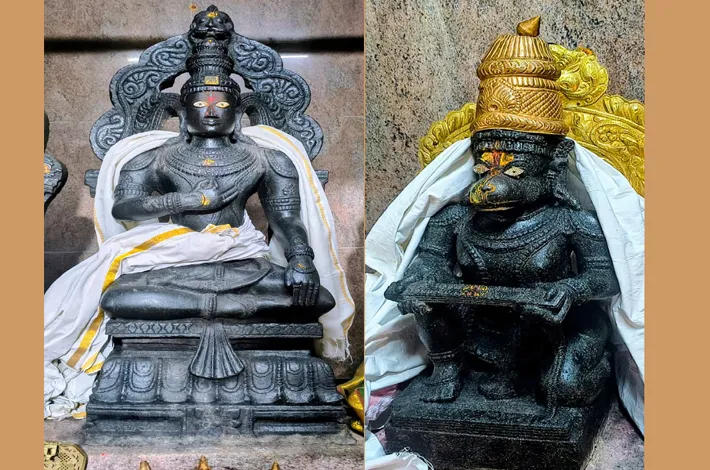
The discovery was made by historian MyNaa Swamy, who identified and deciphered the inscription engraved on a stone palm-leaf held by the Hanuman idol in the temple's sanctum sanctorum. The temple is located near Penukonda, once the second capital of the Vijayanagara Empire. The idol is an exquisite example of Vijayanagara-style sculpture. It depicts Hanuman seated at the feet of Lord Rama, holding a stone palm-leaf manuscript with both hands. Upon close examination, the palm-leaf was found to bear the sacred words "Sri Rama," engraved in two neat rows.
According to Swamy, the inscription is written in Nandinagari, the script traditionally used in Vijayanagara royal seals and scholarly manuscripts. This, he noted, suggests that the idol may have been crafted by artisans associated with the royal court. Swamy explained that in the Vaishnava and Madhva traditions, the name "Rama" is regarded as the supreme Taraka Brahma Mantra. The inscription, consisting solely of the words "Sri Rama," is interpreted as a symbolic representation of this sacred invocation rather than a full textual engraving.
Despite the palm-leaf measuring only four to six inches, artisans succeeded in carving the inscription with fine chisels, demonstrating remarkable craftsmanship. Swamy also pointed out that the sculpture reflects the tradition of preserving knowledge through palm-leaf manuscripts, recreated in stone.
The representation of Hanuman is interpreted as "Jnana Anjaneya," portraying him not only as a symbol of strength but also of wisdom and Vedic scholarship. The sculpture emphasizes intellectual depth over physical prowess, in keeping with Vijayanagara artistic philosophy. Swamy further noted that the temple's sanctum also houses idols of Lord Rama, Lakshmana, Sita Devi, and Hanuman, representing the finest traditions of Vijayanagara architecture.
Historian MyNaa Swamy, accompanied by history lecturer Dr. Pratap, visited the temple on Monday. Temple committee members Radhakrishna, Sanjeevanna, Narasimhulu, and Venkateswarlu received the research team and facilitated their study. The discovery adds a significant new dimension to the understanding of Vijayanagara-era devotional art, scriptural traditions, and temple craftsmanship in the Penukonda region.