24 October, 2026 | 2:14 PM


Witnessing history through haunting images
24-10-2026 12:00:00 AM
Venkat Parsa | NEW DELHI
Images haunt minds and hearts, far more than any engaging narrative does. An image can become the defining feature of the understanding of an event; like Mahatma Gandhi lifting a fistful of salt in Dandi on April 6, 1930, finally announcing breaking of the Salt Law.
Senior journalist Binoo K John's latest book, ‘All in a Flash: News Photography in India’ brings together news photographs that have become part of the nation’s visual memory. Without the photographs, what happened may well seem to be abstract; it is the photographs that bring events to life.
Choosing 150 photographs, with his text to illustrate and put these in perspective, his book shows how photographers often stand at the frontline of history, at great personal risk, to make visible what words alone cannot adequately convey. Binoo K John was with India Today and Indian Express. He is the founder and director of Kovalam Literary Festival.
India Today TV Consulting Editor Rajdeep Sardesai, former Economic Times and Business Standard Editor T N Ninan and Prof Sabeena Gadihoke, teaching Digital Media Arts at Jamaia Millia Islamia, realsed the book at the India International Centre (IIC) in the Capital on Thursday.
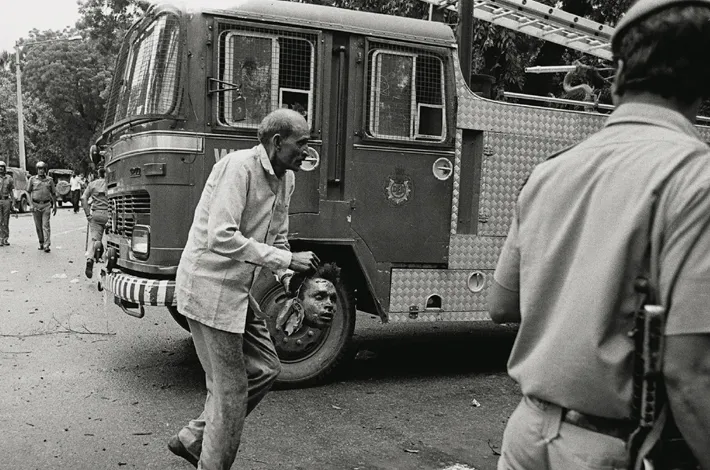
The book-cover has a gory photograph of a policeman carrying a severed head, following the dastardly attack on the then Indian Youth Congress (IYC) President Maninderjit Singh Bitta in 1993, who had a miraculous escape, in front of the IYC office on Raisina Road, adjacent to the Press Club of India, in the Capital.
Author Binoo John explains, “Virendra Singh at that moment became the epitome of a news photographer. He did not flee from the scene, like many other photographers in the history of this most difficult art. Another bomb could have gone off, who knows… It is the photographer’s calling: to unwaveringly stand his ground and freeze a moment of history. Fear, apprehension, anxiety are for lesser mortals.”
Rajdeep Sardesai commended the book as special, because it tells the story of the nation. Professional photographers, Rajdeep said, document what they feel the people must see.
Illustrating his point, he recalled covering an election for The Times of India in Mumbai in the early 1990s, when ballot boxes were being filled up, as part of massive rigging. The photographer moved forward to take pictures. The goons, who saw they were being photographed, came out and badly thrashed him. Next day, bandaged head of the photographer, with the photo of rigging, were front-paged. No amount of writing can convey what the two photographs did; the election was countermanded.
The iconic photographs cover Partition holocaust; Dalit women grieving over burning alive of 11 Dalits in Belchi in Bihar in 1977, when Indira Gandhi made her iconic visit, by plane up to Patna, then by jeep, tractor and finally on elephant-back to reach the remote village; Khalistan Secessionist Movement in Punjab in 1984 that ultimately claimed the life of Indira Gandhi on October 31, 1984; Bhopal Gas Tragedy on December 3, 1984; Hashimpura riots massacre in 1987;
Babri Masjid Demolition in 1992; migrant labourers walking thousands of miles to reach their faraway homes in the wake of Covid pandemic; and drone shot of mass graves that claimed over 40,000 lives.
Perhaps, the most iconic is the photograph of Princess Diana sitting alone in front of Taj Mahal in February, 1992, which says much more about the falling apart of her marriage with Prince Charles; long before the formal announcement of separation made by British Prime Minister John Major on December 9, 1992.
Author Binoo John pointed out, for long time, photography was not considered to be art, because of the mechanical recording. It involves less physical or traditional skills or craft than painting. No Art Gallery allowed photographic exhibitions. It required a movement to elevate photography as fine art equal to painting and sculpture.
Sabeena Gadihoke described photographers as visual chroniclers of events. Although video cameras seem to have overtaken, she sounded confident that photography cannot lose its relevance; it is the still image that remains etched in memory, while moving image passes by.
T N Ninan cautioned on the ethics of photography. Respecting values, he said, photography should remain faithful to documentation and not recreate or re-enact scenes for dramatic impact. Besides, it is also pausing to think of the impact, before clicking the shutter.
Binoo John points out, without pictures, history would seem to be so much guesswork. These photographs show everything, bringing alive the events, creating a feeling of being a witness to that history.
Taj Mahal in Agra, not the Humayun's Tomb in Delhi that predates and is original model of the Taj Mahal, has emerged as a historic monument, which has become an essential part of the itinerary for visiting statesmen and celebrities. Only a photograph can reveal the majesty of Taj Mahal, as the Monument of Love and symbol of the Composite Indian Culture, showcased to the visiting leaders.
(Venkat Parsa is a senior journalist)