5 October, 2026 | 12:46 AM


Telangana’s debt gathers pace
05-10-2026 12:00:00 AM
metro india news I hyderabad
Telangana’s growing reliance on borrowings has once again become a major issue in discussions over the state’s finances. Within the first few months of the 2026 financial year, the state government has raised substantial funds through market borrowings. Including the proposed borrowing on October 7, the state’s market debt is expected to reach Rs 48,900 crore, against an annual market borrowing target of Rs 58,458.71 crore for the financial year. This means the government would have utilised nearly 84% of its annual market borrowing target by October. 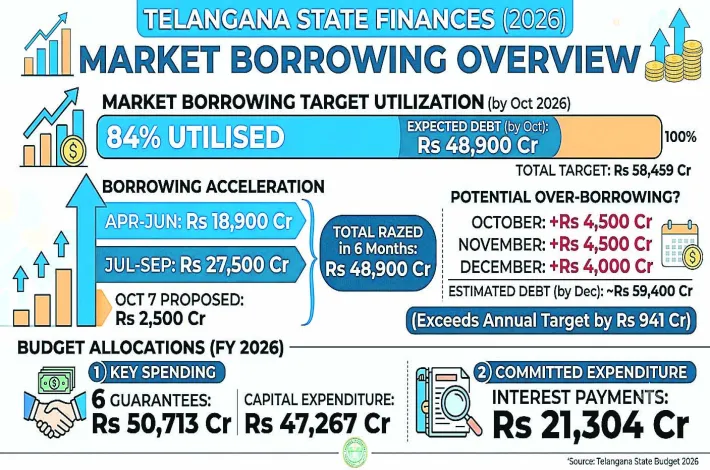
Heavy borrowing within six months
Telangana raised Rs 18,900 crore during the April-June quarter and another Rs 27,500 crore during the July-September quarter. This brought total market borrowings to Rs 46,400 crore within the first two quarters. With the proposers 2,500 crore borrowing on October 7, the figure would rise to Rs 48,900 crore. As a result, the state would have used around 80% of its annual market borrowing target before even half of the financial year has been completed.
The state’s annual market borrowing target for 2026 has been set at Rs 58,458.71 crore. However, the government has plans to borrow another Rs 4,500 crore in October, Rs 4,500 crore in November and Rs 4,000 crore in December. If these borrowings go ahead, total market debt could reach approximately Rs 59,400 crore by December—around Rs 941 crore above the annual target.
Borrowing supports welfare?
According to the 2026 state Budget, Telangana has estimated gross borrowings of Rs 79,984 crore for the year. This figure includes market borrowings as well as loans from the Centre and other sources. The state’s fiscal deficit has been estimated at Rs 58,459 crore, equivalent to 3% of its Gross State Domestic Product (GSDP).The government has allocated around Rs 50,713 crore for the implementation of its six guarantees, according to Budget analyses.
At the same time, the government has allocated Rs 47,267 crore for capital expenditure with the aim of strengthening development and infrastructure spending. However, the state has to balance welfare programs and development projects with committed expenditures such as salaries, pensions and interest payments. The Budget estimates that approximately Rs 21,304 crore will be required for interest payments alone during 2026.
More borrowing inevitable?
Overall, Telangana’s finances during the 2026 financial year will be closely watched for how effectively the government balances welfare commitments, development spending and debt servicing. Key questions remain over how additional fiscal resources will be managed, how much will be available for capital expenditure, and whether the state can maintain sufficient headroom for essential spending in the coming years.
Financial analysts, however, argue that the debate should not focus solely on the size of the debt. A more important consideration is how the funds are utilised and whether they contribute to economic activity, create productive assets or generate future revenue.
Spending on irrigation, roads, industrial infrastructure and other development projects could strengthen the state’s economic base and potentially improve its revenue-generating capacity over time. In contrast, using a significant share of financial resources for recurring expenditure could leave fewer assets or returns to support future finances.
The state’s rising interest burden is another factor that could influence its fiscal flexibility. As debt-servicing obligations increase, the government may have less room to expand development programmes or respond to unforeseen financial pressures.
Ultimately, the sustainability of Telangana’s fiscal strategy will depend on whether expenditure translates into long-term economic gains and whether future revenues are strong enough to meet existing and emerging financial obligations.