23 October, 2026 | 11:50 PM


Steel Flyover @ Snail’s pace
02-09-2026 12:00:00 AM
metro india news I hyderabad
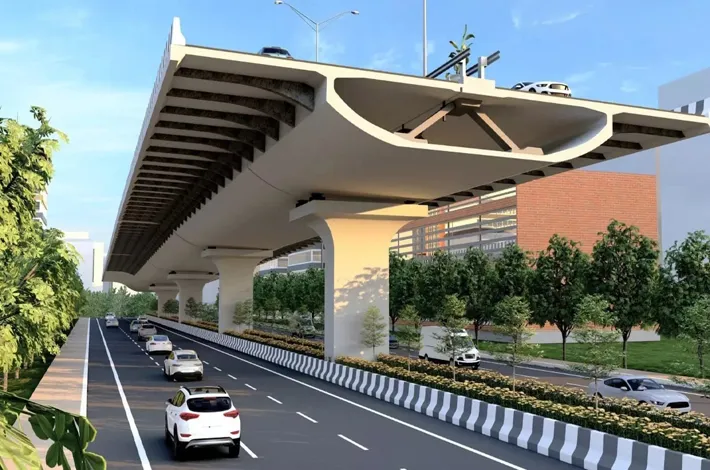
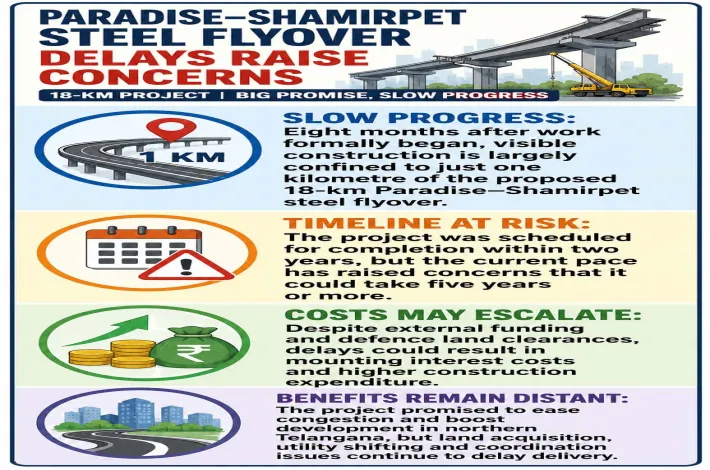
What was unveiled with considerable fanfare as a transformative infrastructure project for northern Telangana is now progressing at a pace that has raised concerns about timelines, costs and delivery. The 18-kilometre steel flyover connecting Paradise to Shamirpet, announced by the Chief Minister as the second largest of its kind in Asia, was projected as a lifeline that would ease congestion and open up development in the northern parts of the state. Eight months after the formal commencement under the tender, however, visible work remains confined largely to a single kilometre stretch.
The project carries significant political and developmental weight. Officials and the state government highlighted that it is financed through external agencies under the BRICS framework, ensuring that funding constraints would not hinder execution. The administration also secured long-pending permission to utilise Central government defence lands that had obstructed alignment planning for years. These clearances were presented as major breakthroughs that removed key bottlenecks.
Under the tender conditions, the flyover was to be completed within two years. At the current rate of progress, independent assessments and observations on the ground suggest the timeline could stretch to five years or more, potentially extending beyond the tenure of the present government. Site visits and local reports indicate that construction activity is sporadic and limited. While preliminary works, surveys and some foundation-related activities have taken place in isolated sections, continuous, large-scale steel erection and elevated corridor construction across the full 18 km have not materialised.
Delays are repeatedly attributed to lingering land acquisition issues and coordination challenges among administrative departments. Even after the defence land permissions were obtained, residual acquisition processes, utility shifting, and inter-agency clearances appear to be slowing mobilisation by the contractor. Observers note the paradox: with external funding secured and high-level political backing for the project, the pace remains sluggish. Interest costs on the borrowed funds continue to accumulate, while escalation clauses in construction contracts are expected to push the overall outlay higher with every month of delay.
For residents and businesses in areas expected to benefit—commuters travelling between the city and Shamirpet, and communities in northern Telangana looking for improved connectivity—the promised relief remains distant. The flyover was intended to reduce travel times significantly, support economic activity and integrate the northern corridor more effectively with Hyderabad’s expanding urban footprint. Those benefits are now deferred. Questions are being raised about accountability. The slow progress has prompted calls for the government to identify whether the contractor, executing agencies, administrative officers or other stakeholders bear primary responsibility for the lag. Land acquisition delays and administrative coordination problems are cited frequently, yet critics argue that these should have been anticipated and mitigated given the project’s priority status and the advance clearances already secured.
There is growing expectation that the issue requires direct attention at the highest levels of the state administration to diagnose bottlenecks, enforce contractual milestones and, where necessary, initiate corrective action against organisations or individuals found responsible for avoidable delays. The steel flyover represents one of the more ambitious urban infrastructure initiatives announced in recent years in Telangana. Its scale—an elevated steel structure spanning 18 km—places it among the larger such projects in Asia, according to the government’s earlier claims. The choice of steel construction was intended to enable relatively faster execution compared with conventional concrete elevated corridors, provided the supporting logistics, fabrication and erection proceeded on schedule.
That advantage has yet to translate into visible momentum across the corridor. Local representatives and citizens’ groups have begun voicing frustration. Commuters currently navigating the existing road network between Paradise and Shamirpet continue to face congestion, particularly during peak hours. Businesses that had factored improved connectivity into expansion plans are watching the calendar. Meanwhile, the financial implications of prolonged construction are becoming clearer: delayed benefits to the public are accompanied by rising interest burdens and potential cost overruns that will ultimately be borne by the state. Government sources have previously maintained that complex linear projects of this magnitude inevitably encounter coordination hurdles, especially when defence lands, multiple jurisdictions and utility agencies are involved.
They have pointed to the successful securing of external financing and the defence land permissions as evidence of political will. Yet the gap between the announced two-year completion target and the current ground reality has become difficult to ignore. Eight months into the execution window, the limited stretch of active work underscores the distance still to be covered. As the project moves further into its second year, pressure is mounting for a transparent review of the implementation schedule, revised milestones and accountability mechanisms.
Stakeholders argue that with funds available and major land-related permissions already in hand, the remaining obstacles should be solvable through decisive administrative intervention. Failure to accelerate work risks not only cost escalation and interest accumulation but also erosion of public confidence in the state’s ability to deliver large-scale infrastructure on time. The Paradise–Shamirpet steel flyover was positioned as more than a traffic solution; it was framed as a strategic link for the growth of North Telangana.
Whether that vision materialises within a reasonable timeframe now depends on the government’s willingness to confront the delays head-on, fix coordination failures and hold responsible parties to account. For the present, the gap between announcement and execution remains the central story of this high-profile project.