24 October, 2026 | 2:39 AM


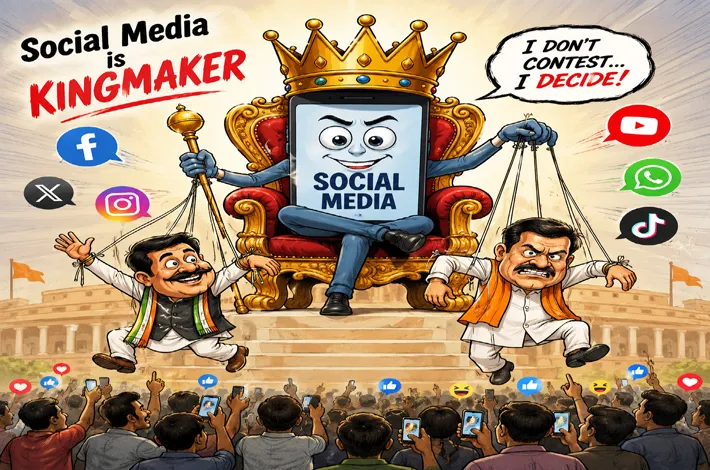
Social media, new kingmaker
11-08-2026 12:00:00 AM
VJM Divakar
Indian politics has undergone a fundamental shift in the past decade. What began as an experimental tool for outreach has matured into the decisive arena where elections are shaped, narratives are controlled, and power is contested. Social media is no longer a side channel for entertainment or casual engagement. It has become the new battleground of power, determining visibility, mobilisation and, ultimately, electoral outcomes. The transformation began in 2014. That year’s general election is widely recognised as India’s first social media election. The Bharatiya Janata Party recognised early the potential of digital platforms and moved decisively.
On Twitter and Facebook, the party built a highly organised, content-driven presence that projected a consistent message of development, nationalism and change. Parallel to this, it constructed the strongest booth-level WhatsApp network the country had seen. Local units circulated targeted messages, countered opposition claims in real time, and coordinated volunteer activity down to individual polling stations. The combination of broad public messaging on open platforms and precise, closed-group communication on WhatsApp gave the BJP an organisational edge that traditional party structures struggled to match.
The result was a decisive mandate and a clear demonstration that digital infrastructure could translate into votes. A decade later, the ground had shifted again. The 2024 general election marked the arrival of YouTube as a primary political theatre. While the BJP retained dominance on X (formerly Twitter), Facebook and WhatsApp, anti-establishment voices and the Congress found fertile ground on YouTube. Long-form videos, independent commentary channels and critical documentaries proliferated. These formats allowed deeper narrative building than the character-limited posts of X or the image-heavy feeds of Facebook. Opposition-leaning creators and party-affiliated channels used the platform to scrutinise government performance, amplify local grievances and reach younger and first-time voters who spent significant time watching video content. YouTube’s algorithm, which rewards sustained viewing and engagement, favoured content that challenged the ruling narrative.
In this sense, 2024 became India’s first YouTube election, revealing that platform mastery is never permanent and that each new dominant medium creates openings for challengers. The pattern continued into the state arena. In the 2026 Tamil Nadu assembly election, actor-turned-politician Vijay and his party, Tamilaga Vettri Kazhagam, conducted a campaign that was, in large measure, fought on Instagram. Short-form videos, Reels, Stories and carefully curated visual content became the primary vehicles for message delivery. Instagram’s visual language, emphasis on personality and rapid virality suited a celebrity candidate seeking to convert screen popularity into political support.
The platform allowed direct communication with younger demographics, bypassing traditional media filters and party hierarchical structures. This approach signalled that 2026 Tamil Nadu may be remembered as India’s first Instagram election, where image-driven, mobile-first content shaped the political conversation in a state long dominated by established Dravidian parties and conventional campaign methods. These successive platform shifts expose a clear strategic reality for the BJP. The party has demonstrated mastery of X, Facebook and WhatsApp. Its organisational capacity, content production systems and volunteer networks on these platforms remain formidable.
The challenge now lies in replicating that dominance on Instagram and YouTube. Instagram rewards aesthetic consistency, relatability and rapid adaptation to algorithmic trends. YouTube demands sustained narrative depth, production quality and the ability to hold audience attention over longer periods. Both platforms favour creators and parties that can generate organic reach rather than relying solely on paid amplification. Failure to adapt risks ceding narrative space to rivals who have already demonstrated fluency on these channels.
The broader implication is structural. Social media has compressed the distance between leaders and citizens while simultaneously fragmenting the information environment. Parties must now maintain parallel campaigns: one for the open, public square of X and Facebook; one for the intimate, group-based communication of WhatsApp; one for the visual intimacy of Instagram; and one for the long-form persuasion of YouTube. Resource allocation, content strategy and talent acquisition have all been reshaped. Political communication teams increasingly resemble media production houses. Data analytics, A/B testing of messaging, and real-time response units have become standard.
At the same time, the same tools that enable rapid mobilisation also facilitate the rapid spread of misinformation, polarisation and coordinated campaigns of all kinds. Regulators, platforms and parties themselves continue to grapple with the tension between free expression and the integrity of the electoral process. What makes social media the new kingmaker is its dual capacity to amplify and to exclude. Visibility on the right platforms at the right moments can elevate a candidate or party disproportionately to its organisational base. Conversely, absence from the dominant medium of a given election cycle can render even well-resourced campaigns partially invisible to key voter segments. The 2014, 2024 and 2026 cases illustrate that each election cycle tends to elevate one primary platform as the central arena of contestation. Parties that anticipate the next shift and invest early gain advantage. Those that remain anchored to previous platforms risk strategic lag.
The trajectory is clear. Social media has moved from supplementary outreach to core infrastructure of political power. In India, with its vast and youthful online population, this infrastructure will only grow more decisive. The parties that treat platforms as permanent battlegrounds rather than temporary tools will shape the contests of the coming decade. The rest will find themselves reacting to narratives already set by those who understood the terrain first. Social media is no longer entertainment. It is the arena where India’s political future is being fought and decided.