30 June, 2026 | 9:39 PM


Skeleton fallout from bank cupboard
29-04-2026 12:00:00 AM
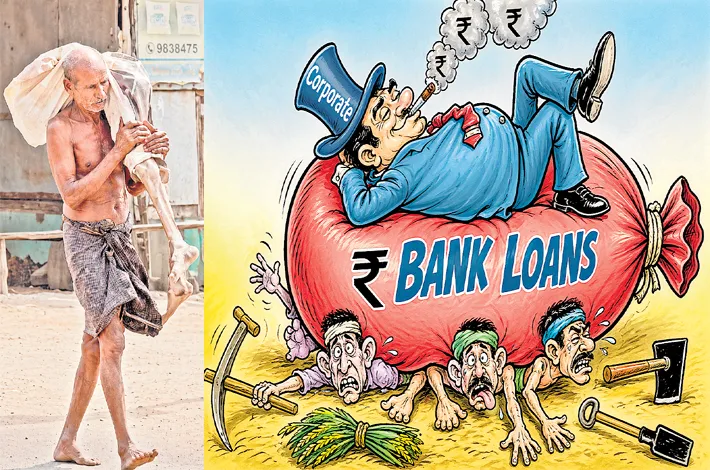
The stark divide in India’s banking system, Rs 20K denied, Rs 19 lakh cr written off
Man carries sister’s skeleton to bank after being denied to withdraw Rs 20k
metro india news I hyderabad
The contrast between one man’s desperate three-kilometre journey carrying his dead sister’s skeleton and the lakhs of crores absorbed through institutional write-offs shows the grave situation that prevails in our country, its economy, it cultural and ethical values. This contrast should be an eye opener for every Indian but not the political leaders as they are the ones who have driven our country to this pass.
Keonjhar, Odisha: In a deeply distressing incident that underscores the chasm between India’s rural poor and its formal financial systems, 50-year-old Jeetu Munda, a tribal daily wager from Dianali village in Keonjhar district, exhumed the skeletal remains of his elder sister Kalra Munda and carried them nearly three kilometres to a rural bank branch. His sole purpose was to withdraw the modest balance of approximately Rs 19,300–20,000 from her savings account at the Maliposi branch of Odisha Gramin Bank in Patana block. The event occurred on April 27, 2026, and has since ignited widespread debate on bureaucratic insensitivity and financial inclusion failures.
Kalra Munda, aged 56, had passed away on January 26, 2026. Jeetu, her only surviving close relative, made multiple trips to the bank seeking access to the funds. According to his account and police statements, officials repeatedly insisted on the physical presence of the account holder or complete legal documentation, including death and legal heir certificates. Illiterate and unfamiliar with these procedural requirements, Jeetu reached a breaking point. He walked to the village cremation ground, dug up the grave, wrapped the remains in cloth, and trudged through the blazing heat to the bank, placing the skeleton outside as proof of death. Eyewitnesses described the scene as shocking and heart-breaking.
Patana Police Station officials, led by Inspector-in-Charge Kiran Prasad Sahu, promptly intervened. The remains were handled with dignity and reburied. Local administration directed the bank to expedite the release of funds, noting that Jeetu is the legitimate claimant as the nominee had also passed away. Bank sources indicated they would process the claim as per RBI guidelines for small accounts, acknowledging gaps in communicating procedures to vulnerable customers. Jeetu later told reporters: “I ran to the bank several times. They said bring the account holder. Though I told them she had died, they did not listen.”
This individual tragedy highlights persistent barriers in India’s financial inclusion drive. Despite initiatives like Pradhan Mantri Jan Dhan Yojana, which opened crores of accounts, procedural complexities around succession, especially for small-value accounts in tribal and rural areas, remain daunting. Keonjhar, a mineral-rich yet economically backward district with significant tribal populations, reports high illiteracy rates and reliance on daily wage labour paying Rs 300–500 per day. For families like Jeetu’s, even Rs 20,000 represents critical support for survival, medical needs, or basic sustenance.
Stark juxtaposition with banking sector write-offs
The desperation of a man forced to carry his sister’s bones for a pittance stands in sharp contrast to the scale of loan write-offs routinely handled by Indian banks. According to data shared by the Union Ministry of Finance in Parliament, scheduled commercial banks wrote off loans worth Rs 9.75 lakh crore over the 11 financial years up to FY25. Broader compilations, including sector-wise and additional categories, place the cumulative figure near Rs 19 lakh crore in some analyses. Write-offs peaked at around Rs 1.59–2.43 lakh crore in FY20 during the aggressive clean-up of non-performing assets (NPAs) following the Asset Quality Review. By FY25, annual write-offs had moderated to approximately Rs 47,568–1.72 lakh crore, reflecting improved asset quality with gross NPAs falling to multi-year lows around 2.3%.
Write-offs remove fully provisioned bad loans from bank books after four years under RBI norms. They are not waivers; borrowers remain liable and recovery continues, often via the Insolvency and Bankruptcy Code, though recoveries average only 15–30%.
Much of the write-offs stem from large corporate loans in infrastructure and steel, largely borne by public sector banks, while retail loan stress is rising. Critics see a two-speed system—strict rules for small depositors, flexibility for big borrowers. Defenders say post-2016 clean-ups strengthened banks and credit growth. Yet cases like Jeetu Munda’s highlight persistent gaps in equity, sensitivity, and last-mile access.
Broader implications and the road ahead
Financial experts say that while digital infrastructure has widened account access, death-claim processes for small accounts remain cumbersome. They suggest simplified affidavits, nominee-based settlements for balances under Rs 50,000, Aadhaar-linked verification, legal aid camps in tribal areas, and better staff training. Odisha Gramin Bank operates in difficult terrains where trust is vital, and authorities have promised swift resolution for Jeetu. Yet the image of a man carrying skeletal remains has sparked national concern, exposing gaps in empathy and access. Despite progress in inclusion, literacy and humane implementation lag. The incident underscores the need to align banking systems with the realities of the poorest citizens.